

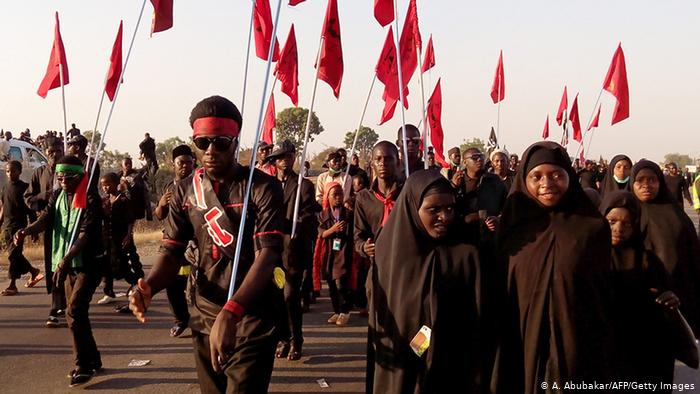
The mention of banned Shi’ites group in Nigeria stuck many listeners to their seats as soon as the resource person rang out the name at the well-attended training programme.
The Shi’ite Muslims associated with Islamic Movement of Nigeria, IMN, critical of northern Nigeria’s traditional religious and political elite, including the Sunnis who are the majority of the country’s Muslim population. In recent times, they have been clashing with security forces.
At The Next Edition 3rd Annual Training Programme for 200 journalists in Uyo, Ibanga Isine, the managing editor of The Edition declared “If the Federal Government does not handle the case of Shi’ites with care, what may come to the country will be worse than Boko Haram insurgency.”
Speaking during a two-day training is organised by The Next Edition Centre for Investigative Journalism and Gender Advocacy (NECIJGA) in collaboration with Policy Alert and Akwa Ibom State Council of the Nigeria Union of Journalists at NUJ Press Centre, Uyo, Isine stated that “There are 30 million Shi’ites in the country.”
The managing editor who presented a paper entitled Advanced Conflict Sensitivity Reporting – How Journalists Can Walk the Thin Line on Friday noted that if each member of the sect contributes N1,000 to defend the interest of the body, then the country would boil and be unable to control the situation.
He used the occasion to call on journalists to embrace responsible journalism anchored on seeking peaceful resolution to crisis situation instead of engaging in sensational reporting that stoke violence.
Earlier, Mr. Moses Ekpo, Deputy Governor of Akwa Ibom State, had said the state government was not interested in sycophancy and boot-licking even as it seeks a better deal in its relationship with the media.
Ekpo noted that the state government was insisting on a robust engagement from the media.
Represented by Mr. Nkopuruk Ekaiko, Permanent Secretary, Deputy Governor’s office, Ekpo reminded the practitioners that as members of the Fourth Estate of the Realm they were “under a constitutional obligation to both receive and administer peer review within the democratic framework of Checks and balances among the arms of government.”
He, however, lamented that the reverse was the case in the state adding that “political alignment and patronage have become the key determinants of media content and for me, the need to address the damage which this has brought on the journalism profession in Akwa Ibom justifies this workshop.”
Ekpo emphasised that the days when bad and fake news were good news were over, insisting that “developmental and advocacy reportage grounded in objectivity had since returned to the real media.”
He reiterated the position of Governor Emmanuel Udom that “if Akwa Ibom journalism professionals were able to put their prejudices behind, and work single-mindedly towards advancing the cause of Akwa Ibom; making demands on our socio-economic and political rights within the polity, not as divisive partisans but as a united front, the results would be phenomenal.”
“Once the media in Akwa Ibom, and indeed elsewhere in the country, gets its vision right, things would be right all the way,” the deputy governor predicted.
The chairman of the Akwa Ibom State Council of NUJ, Amos Etuk, noted that the theme of the training, Conflict Sensitivity Reportage and Constructive Engagement with State Actors, aptly captured a desire to “build rather than add fire in the current widespread violence and internecine feuds, including the crisis of confidence between the people and government ravaging our country.”
Noting that there was an increasing incidence of intolerance by some state actors against free press and freedom of information, Etuk posited that the training was important to ensure stories are couched in such a way as to promote tolerance and cooperation between journalists and people in government.”
He expressed the view that the training will teach participants ways of communicating and reporting conflicts responsibly and sensitively to douse tension rather than exacerbate them.
Topics such as The Consequences of Reckless Reportage on the Journalist, Media and Society by Mr. Ray Ekpu; How to Engage Constructively with State Sources and Government Information Managers by Dr. Reuben Abati; Using Video as a Tool for Solutions Journalism in Nigeria by Shola Ajay; Essentials of Parliamentary Reporting for the Print, Electronic and Online Media by Sam Akpe were presented.
