

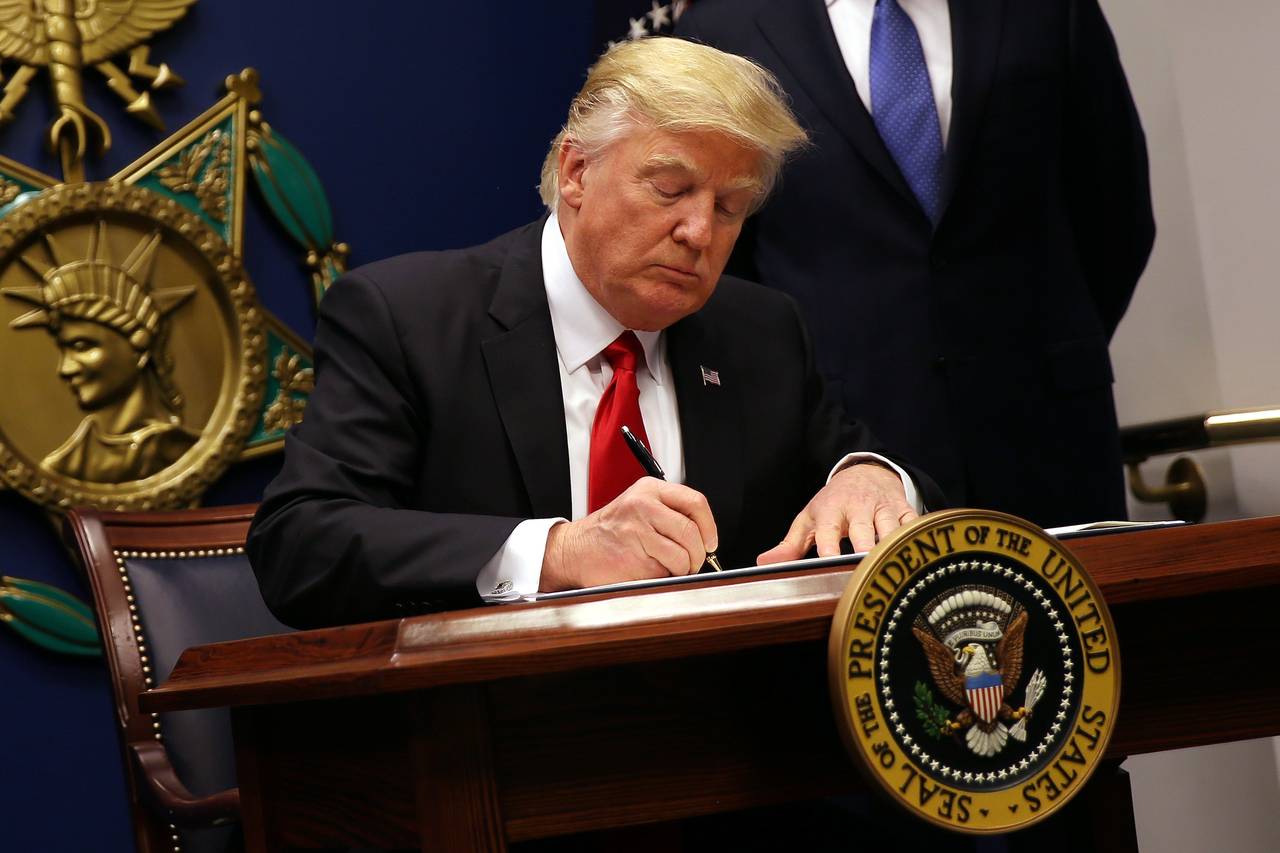
US Government has barred nationals from 12 countries from entering the country from Monday under a proclamation signed Wednesday by President Donald Trump, who framed the decision as necessary to bolster national security and combat terrorism.
Seven more countries will face partial travel restrictions.
The 12 countries targeted in the ban are primarily in Africa or Asia are: Afghanistan, Chad, Equatorial Guinea, Eritrea, Haiti, Iran, Libya, Myanmar, Republic of Congo, Somalia, Sudan and Yemen.
Also read
- White Genocide: Trump Ambushes South Africa’s Ramaphosa with false claims
- Trump’s order cutting financial aid to South Africa unbows Ramaphosa
- Trump hits transgenders, recognising male and female sexes
Several of the countries regularly declined to accept the return of their nationals or had visa overstay rates the Trump administration deemed “unacceptable,” according to the proclamation. Others on the list, including Sudan, Yemen and Somalia, were included for inadequate screening and vetting measures.
In addition, seven countries will be under partial travel restrictions, in which entrance into the U.S. under several visa programs was suspended but an outright ban was not implemented.
Those countries are: Burundi, Cuba, Laos, Sierra Leone, Togo, Turkmenistan and Venezuela.
There are some exemptions, including for any lawful permanent resident of the U.S., as well as diplomatic visas and immediate family immigrant visas, among others. There are also exemptions for adoptions, dual nationals with passports from unrestricted countries and athletes or teams traveling to the U.S. for the World Cup or the Olympics.
In a White House video, Trump cited the recent attack in Boulder, Colorado, as justification for a renewed travel ban. But the suspect, Mohamed Sabry Soliman, is from Egypt, and he entered the country on a tourist visa before he applied for asylum.
During his first term, Trump similarly banned foreigners from six Muslim-majority countries from entering the U.S., a move that the Supreme Court ultimately upheld in a split decision.
Already, in his second term, Trump has limited refugee admissions from almost all countries.
Trump battles Harvard and Columbia
Trump escalated his attack on Harvard University last night with a proclamation declaring he will deny visas for foreign students trying to come to the country to attend the school.
He is moving to block nearly all foreign students from entering the country to attend Harvard University. The move is the latest attack of the incumbent administration against the US’ oldest and wealthiest university.
This latest attempt seeks to choke the Ivy League school from an international pipeline that accounts for a quarter of the student body.
In an executive order signed on Wednesday, Trump declared that it would jeopardise national security to allow Harvard to continue hosting foreign students on its campus in Cambridge, Massachusetts.
“I have determined that the entry of the class of foreign nationals described above is detrimental to the interests of the United States because, in my judgment, Harvard’s conduct has rendered it an unsuitable destination for foreign students and researchers,” Trump wrote in the order.
It’s a further escalation in the White House’s feud with the university. A federal court blocked the Department of Homeland Security from barring international students at Harvard last week. Trump’s new order however invokes a different legal authority.
Trump invoked a broad federal law that gives the president authority to block foreigners whose entry would be “detrimental to the interests of the United States.”
He used the same authority when announcing that citizens of 12 countries would be banned from visiting the US and those from seven others would face restrictions, in what some are calling a resurrection of his infamous first term’s “Muslim ban”.
Trump’s Harvard order cites several other laws, too, including one barring foreigners associated with terrorist organisations.
Earlier Wednesday, the Trump administration had ramped up its battle with another Ivy League school — Columbia University — by threatening its accreditation.
The Education Department said in a statement that it has notified the accreditor for Columbia that the school violated anti-discrimination laws, alleging Columbia “acted with deliberate indifference towards the harassment of Jewish students” in violation of the Civil Rights Act of 1964.
Columbia said that it has addressed the Trump administration’s concerns directly with the accreditor, the Middle States Commission on Higher Education.
The loss of accreditation would lead to Columbia losing access to student aid funds. But even if that happened, it most likely wouldn’t happen immediately.
In a statement on Wednesday night, Harvard said it will continue to protect its international students. “This is yet another illegal retaliatory step taken by the Administration in violation of Harvard’s First Amendment rights,” university officials said.
The feud stems from Harvard’s refusal to submit to a series of demands made by the federal government. It has escalated recently after the Department of Homeland Security said the Ivy League school refused to provide records related to misconduct by foreign students.
Harvard said it has complied with the request, but the White House snapped back saying the school’s response was insufficient.
The dispute has been building for months after the Trump administration demanded a series of policy and governance changes at Harvard, calling it a “hotbed of liberalism” and accusing it of tolerating anti-Jewish harassment.
Harvard defied the demands, saying they violated the university’s autonomy and represented a threat to the freedom of all US universities and higher education institutions.
For foreign students already at Harvard – around 6,800 currently enrolled – Trump says US Secretary of State Marco Rubio will determine whether or not their visas should be revoked.
The new order is scheduled to last six months. The Trump administration also reserves the right to renew the order, and will make a decision on the matter within 90 days.
