

By Israel Umoh
In the grand theatre of Nigerian labour relations, the Nigeria Labour Congress (NLC) and the Petroleum and Natural Gas Senior Staff Association of Nigeria (PENGASSAN) perform roles that sometimes look less like leadership and more like scripted moves on a chessboard — pawns in a larger, unyielding game. It is a game where the stakes are high, yet the pieces seem trapped, moving only as allowed by unseen hands.
At first glance, these bodies represent the hopes and struggles of the Nigerian working class, especially those in the energy sector, whose toil powers the nation’s economy. But scratch the surface, and a disturbing pattern emerges: the labor unions’ bold rhetoric often dissipates into cautious steps, their protests a carefully choreographed dance that ultimately preserves the status quo rather than dismantling it.
Consider the recent skirmishes over fuel subsidy removals, salary adjustments, and workers’ welfare. The NLC and PENGASSAN raise their voices, summon nationwide strikes, and rouse public sympathy. Yet, more often than not, these battles end in negotiated truces that favor neither the workers nor the economy in a meaningful way. The unions retreat, their fists clenched but empty.
You may also read:
- Prying the 18th-Storey Ibom Towers in Lagos
- Natasha’s Sedative and other Nigerians
- The Sci-Civics of Model Schools in Akwa Ibom: Another Vision in Peril?
Is this what the labor movement has become? An apparatus of controlled dissent, designed to absorb public frustration and direct it into harmless channels? The answer lies partly in the unions’ entanglement with the political elite. When union leaders dine with government officials and negotiate behind closed doors, their bargaining chips shrink in value. What should be uncompromising demands for justice and fair wages often become tempered compromises, tempered by the need to maintain influence and relevance.
PENGASSAN, representing a critical cadre of Nigeria’s oil and gas workforce, finds itself in a precarious position. Its members toil in hazardous conditions, often under threat of layoffs and policy neglect. Yet the union’s periodic calls for industrial action seem muted by a chronic paralysis — a fear of upsetting the delicate balance between labor and government, between protest and political patronage.
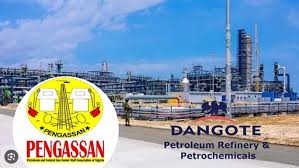
For instance, the recent altercation between Dangote Refinery management and the union is eye-popping to the vacuous and compromising stance of PENGASSAN in subjugating Nigerian welfare and rights in pursuit of the shadowed but microscopic interest of its members. While the four refineries were shut and Federal Government and its duplicitous stakeholders were foot-dragging their revival, the union was playing ostrich on fuel supply to Nigerians since its members were/are feeding fat from the flawed system. No strike, no withdrawal of members from duty and no threat to deter government from indefinitely prolonging opening of the moribund refineries.
The NLC, too, is shackled by its own contradictions. As a coalition of multiple unions, it is tasked with the impossible: to unify disparate voices and demands into a coherent force. But this diversity sometimes morphs into disunity, making the NLC a convenient interlocutor for the state — a big umbrella under which dissent is filtered and controlled.
By pledging solidarity with PENGASSAN in the nationwide strike against Dangote Refinery shows the callousness of the union in jumping into a fighting arena with a private sector instead of rising to protect the overall interest of mostly less privileged Nigerians, not just parochial support of the fired 800 unionised workers by Dangote in a fuel driven-economy. This is not supporting the company replacing them with 2,000 Indian workers.
The question, then, is not whether the NLC and PENGASSAN will strike again — they will, and rightly so — but whether they will ever transcend the role of pawns. Will they dare to become knights and bishops on this chessboard, moving strategically to checkmate the systemic rot that erodes workers’ dignity? Or will they remain trapped in the cycles of symbolic protest, caught in the web of political expediency and muted militancy?
Nigeria’s labor unions have history on their side — a legacy of resilience from colonial times and the fight for independence. The moment calls for a revival of that spirit: bold, fearless, and uncompromising. For if the pawns fail to rise, the king — the status quo — will always win.
In this game, the future of Nigerian workers hangs precariously. It is time for the NLC and PENGASSAN to rethink their moves, lest they remain forever the pawns in a game rigged again them.
