

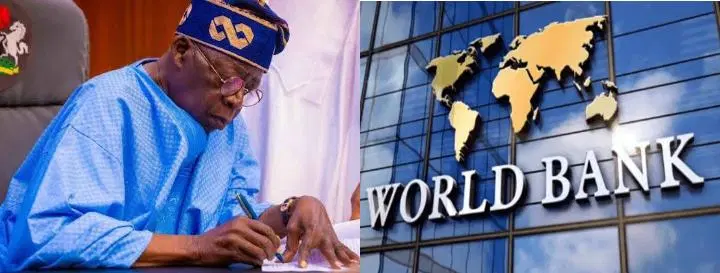
Nigerian Government saddened by the World Bank’s report estimating that 139 million Nigerians are living in poverty has rejected it, insisting that the figure does not reflect current realities under President Bola Tinubu’s administration.
A statement by the Special Adviser to the President on Media and Public Communication, Sunday Dare, said the data quoted by the World Bank must be properly contextualised, noting that it was based on historical and modelled estimates rather than real-time assessments.
According to him, the World Bank’s estimate was derived from the global poverty benchmark of $2.15 per person per day set in 2017 under the Purchasing Power Parity framework, which, when converted to today’s exchange rate, equals about ₦100,000 per month — an amount that is above Nigeria’s new minimum wage of ₦70,000.
You may also read:
- World Bank and IMF allegedly undermine Nigeria’s university system – ASUU accuses
- How World Bank Uses Nigeria for ‘vested’ interest- Reports
- Counterpart funds: Akwa Ibom Govt Approves N450m For World Bank Projects
“The measure is an analytical construct, not a direct reflection of local income realities,” Dare said. “The poverty assessment under the PPP methodology relies on outdated consumption data, with Nigeria’s last major household survey conducted in 2018 and 2019.”
He added that the estimate does not account for the informal and subsistence sectors that sustain millions of households across the country.
The Presidency maintained that the figure should be regarded as a global model estimate, not an empirical representation of conditions in 2025, and emphasised that Nigeria’s poverty trajectory is now one of recovery and inclusive reform.
Dare said the government is already implementing a wide range of programmes aimed at reducing poverty and improving living standards. He cited the Conditional Cash Transfer programme, which has been expanded to reach 15 million households nationwide, with over ₦297 billion disbursed since 2023; the Renewed Hope Ward Development Programme covering all 8,809 electoral wards to provide micro-infrastructure and social services; and the strengthening of the National Social Investment Programmes such as N-Power, TraderMoni, MarketMoni, FarmerMoni, and the Home-Grown School Feeding Programme.
He also mentioned various food security measures including the distribution of subsidised grains and fertilisers, mechanisation initiatives, and the revival of strategic food reserves. Other initiatives include the Renewed Hope Infrastructure Fund, which is financing key energy, road, and housing projects to reduce living costs and create jobs, and the National Credit Guarantee Company, which is expanding access to affordable credit for small businesses, women, and youth.
According to Dare, the government is addressing long-standing structural challenges such as overdependence on imports, productivity constraints, and regional disparities. He said reforms like the removal of fuel subsidies, exchange rate unification, and fiscal redirection toward productive sectors are part of efforts to tackle the root causes of poverty and promote sustainable growth.
“The World Bank itself has acknowledged that these reforms are contributing to macroeconomic stability and renewed growth momentum,” he added.
The statement said the administration’s medium-term focus is to ensure that macroeconomic stability translates into tangible welfare gains for citizens through affordable food, quality jobs, and reliable infrastructure. It explained that ongoing investments in agriculture, micro, small and medium enterprises, and power reliability are expected to create employment and lower living costs.
The World Bank, however, said that despite the expansion of the Nigerian economy and the increase in revenue, the poverty rate remains alarmingly high.
The Bank’s Country Director for Nigeria, Mathew Verghis, speaking in Abuja at the launch of the Nigerian Development Update, said: “So, these results are exactly what you need to see in a stabilisation. These are big achievements. However, despite these stabilisation gains, many Nigerians are still struggling. Most households are struggling with eroded purchasing power.
“In 2025, we estimate that 139 million Nigerians live in poverty. So, the challenge is clear: how to translate the gains from the stabilisation reforms into better living standards for all.”
He said the federal government must reduce inflation, particularly food inflation, ensure effective use of public funds, and expand safety nets to address the high rate of poverty in the country and ensure that citizens enjoy the benefits of economic reforms.
“Food inflation affects everybody but particularly the poor and has the potential to undermine political support for the reforms. Use public resources more effectively ensuring that spending drives real development results that benefit people and expand the safety net so that the poorest and vulnerable get support,” he added.
The Bank projected that Nigeria’s economy would grow by 4.4 percent in 2027, up from the 4.2 percent earlier projected for 2025, driven by services and supported by agriculture and non-oil industry.
Its Senior Economist for Nigeria, Samer Matta, said inflation is expected to gradually ease but remain high, requiring sustained monetary discipline and structural reforms to tackle food prices, which he described as “the biggest tax on the poor.”
The report noted that Nigeria’s economy expanded by 3.9 percent year-on-year in the first half of 2025, up from 3.5 percent in the same period of 2024. It also stated that foreign reserves have risen above $42 billion, the current account surplus has climbed to 6.1 percent of GDP, and the fiscal deficit is projected at 2.6 percent of GDP, while public debt is expected to decline from 42.9 percent to 39.8 percent of GDP.
However, the Bank cautioned that these macroeconomic gains had yet to translate into tangible improvements in people’s lives, saying that poverty and food insecurity remain widespread, with the cost of a basic food basket rising fivefold between 2019 and 2024.
Meanwhile, the Pan-Yoruba socio-political organisation Afenifere dismissed the government’s claim of economic turnaround as “media spin.” It said: “When a $10 billion subsidy with $200 billion production multiplier effects is removed, the economy falls by $200 billion. The question is what happens to the seven million businesses that collapsed and the tens of millions pushed into poverty?”
The group said the fall of real wages by 300 percent made any claim of an economic turnaround “unfounded.” It added that the increase in the minimum wage to ₦70,000 benefited less than five percent of workers, while most Nigerian workers’ purchasing power “has been wiped out by devaluation and inflation.”
