

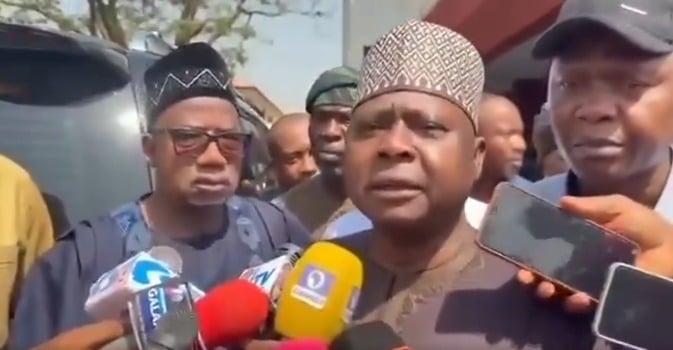
PDP National Chairman, Tanimu Turaki (SAN), Tuesday, called on the US President Donald Trump to protect Nigeria’s fledgling democracy and Christians against genocide.
Specifically, the PDP Chairman issued a passionate appeal to the international community, warning that Nigeria’s democracy is “under threat” and urging global powers, including the United States, to intervene.
Turaki made the remarks while addressing journalists at the PDP national headquarters in Abuja on Monday, where he accused a serving minister of leading “armed thugs” and said the situation required urgent external attention.
He specifically called on President Donald Trump and other advanced democracies to “come and save Nigeria.”
Related News:
- PDP Crisis Worsens as Factional Rivalry Tears Party Apart
- Nigerian Journalist Exposes Worsening Injustices Against Christians in Northern Nigeria
- ”How We Escaped Genocide in Northern Nigeria”- Damina Speaks
According to him: “I want to call on President Trump, what is at stake is not just genocide against Nigerian Christians. He should come and save democracy in Nigeria. Democracy is under threat.
“I’m calling on all other developed nations, all advanced democracies to come and save Nigeria, come and save democracy because I cannot understand how a serving minister of the federal republic of Nigeria will be leading thugs, armed thugs.”
He insisted that PDP officials were prepared to defend their mandate despite the threats he described.
“I have said it, we are willing to lay down our lives to protect our office, to protect our democracy, to protect our mandate. So Nigerians you’re watching what is happening, the international community you’re seeing the threat that Nigerian democracy is under, come and save us!! Come and save us!!”
APC Slams PDP
However, the All Progressives Congress (APC) has condemned the call by Tanimu Turaki, the new factional chairman of the Peoples Democratic Party (PDP), to US President Donald Trump to save democracy in Nigeria.
In a statement, Felix Morka, APC national publicity secretary, described the call by Turaki as “reckless and unpatriotic”.
“For a man declared National Chairman barely 72 hours ago by a faction of his deeply fractured party, Turaki looked and sounded desperate, at his wit’s end, confused, incoherent, and grossly lacking in stamina and capacity to manage his party’s crisis,” the statement reads.
Morka said Nigerians expected Turaki to focus on peace-building and dialogue among warring factions of his party rather than calling for foreign intervention.
“Instead, Turaki’s first official act as factional chairman was his call for foreign invasion of Nigeria as a solution to the self-inflicted internal crisis of his PDP. That is as shameless as it is a dangerous threat to national security and sovereignty,” he said.
The APC spokesperson argued that during the PDP’s 16 years in power, no leader had sought foreign intervention to resolve internal disputes.
“Turaki’s call is not only an admission of the party’s incapacity to manage its internal contradictions; it must be taken as a final certification of the PDP’s demise,” he added.
He said APC urged the international community to dismiss the PDP’s call as a distraction from the opposition party’s failure to manage its internal democracy.
Morka highlighted the desperation of the PDP and other opposition leaders, who he claimed are willing to invite foreign interference to serve a “sinister political agenda”.
He called on Nigerians to continue supporting the APC and President Bola Tinubu’s leadership in building national progress and prosperity.
CAN Reasserts Christians Genocide
Already, the Christian Association of Nigeria (CAN) has maintained its stance over what it describes as a systematic and sustained genocide against Christian communities across
The President of CAN, Archbishop Daniel Okoh, made the declaration on Tuesday at the opening ceremony of the Fourth Quarterly National Executive Council Meeting of the Association held in Jos, Plateau State.
The event, hosted by the Plateau State Government, brought together senior church leaders from across the federation.
Addressing the council, Archbishop Okoh said the Christian body “stands unwaveringly” by its long-held position that a Christian genocide is unfolding in Nigeria, stressing that years of coordinated attacks, unpunished massacres, and the forced displacement of indigenous Christian populations fit the pattern of intentional extermination.
“It would be a grave injustice to deny the painful reality of what has transpired,” Okoh said. “Lives have been brutally cut short, communities uprooted from their ancestral lands, families torn apart, churches razed, and hopes shattered. CAN has spoken clearly and courageously on this matter, and we stand by our position that there is Christian genocide in Nigeria.”
He recalled his recent visit to Bokkos where thousands of Christians remain displaced after waves of violent attacks. According to him, the physical and emotional scars observed underscored the scale of the tragedy, yet the resilience of the victims reflected the depth of their faith. “We declare with one united voice: you are not forgotten. The Body of Christ stands firmly with you,” he assured.
The CAN President lamented that in many communities, entire villages have been levelled without justice, perpetrators continue to roam free, and victims have neither been compensated nor resettled. The persistence of killings and kidnappings, he noted, is evidence of a failure that demands national soul-searching.
He further stated that international institutions have begun to take interest in Nigeria’s prolonged religious violence, a development he said is painful but necessary. “If international attention is what is required to spur decisive governmental action, then the Christian community in Nigeria welcomes it,” he said.
Archbishop Okoh called on the Federal Government to take immediate steps to stop “the senseless destruction of lives,” restore security, and ensure justice for persecuted communities. He emphasised that the prolonged stay of thousands of internally displaced people in camps is a moral indictment on the nation and a ticking humanitarian time bomb.
“No individual should ever be persecuted or killed on account of their faith,” he said. “This humanitarian crisis must be addressed decisively to prevent further escalation. CAN will not relent. We will continue to demand justice, call for accountability, defend the vulnerable, and advocate for peace and unity.”
In his remarks, the Governor of Plateau State, Caleb Mutfwang, represented by his Deputy, Josephine Piyo, described the gathering as significant for a State that has endured some of the worst episodes of ethno-religious violence in recent Nigerian history, and reiterated his administration’s commitment to restoring enduring peace, securing rural communities, and resettling displaced persons.
Mutfwang praised CAN for its steadfast advocacy and moral guidance, acknowledging the Church as a critical partner in rebuilding trust and healing fractured communities. “Nigeria needs the Church now more than ever,” the governor said.
He expressed optimism that the deliberations of the Council would strengthen national unity and further equip religious leaders to continue championing justice, reconciliation, and moral reorientation.
