

Aniefiok Christopher
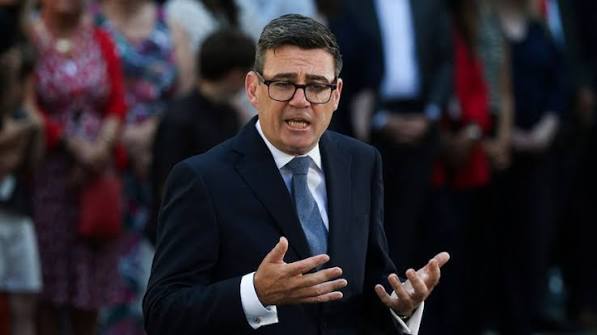
Andy Burnham became new United Kingdom Prime Minister on Monday, July 20, promising to set out a 10-year-plan for Britain, to ease the cost-of-living crisis and outlined policy goals, including an end to sleeping on the streets.
Britain needed to show the world it could “regain stability,” he said, vowing to offer “a new political model” and “build a new economy.”
Accompanied by his wife, Marie-France van Heel, Burnham earlier met King Charles III at Buckingham Palace to become the head of government after Keir Starmer resigned. Burnham, 56, arrived at Downing Street to resounding applause from supporters and acknowledged he was the country’s seventh prime minister since the start of 2016.
Read this:
- UK Prime Minister Starmer Resigns After two Years in Power
- New Labour Leader Burnham Hopeful As Next UK PM
- Britain, Australia and Canada Accord Palestinian State recognition
He immediately got to work after replacing Keir Starmer in Downing Street, holding calls with US President Donald Trump and Ukrainian leader Volodymyr Zelensky before appointing his ministerial team.
Burnham who is the 7th UK Prime Minister underlined his “commitment to defence and security” in his first call with Trump, a UK government spokesperson said. To Zelensky, Burnham reaffirmed “his and the UK’s resolute commitment” to Ukraine in its defence of Russia’s invasion, Downing Street said.
In his brief speech outside Downing Street, the new Labour leader, pledged to re-industrialise Britain and said he would “bring forward a new plan for Britain, a 10-year plan,” without giving specifics. Naming short-term goals, he promised to “give people some breathing space now some help with the cost of living.”
He also said his first instruction would be a pledge to “end rough sleeping,” a measure he attempted to implement as a regional mayor in northern England, although it was not fully successful. Other announcements included a pledge to re-industrialise Britain through public procurement and to build more public housing.
Burnam worked swiftly to stamp his authority on the new government by sacking several Starmer loyalists from his cabinet and reshuffling other ministers who served under the previous regime. Ex-defence secretary John Healey replaced Rachel Reeves as finance minister while Ed Miliband left his energy brief to become foreign minister.
Shabana Mahmood was reappointed interior minister to see through her hardline reforms of Britain’s asylum system. And David Lammy left his role as deputy prime minister.
‘Stronger and fairer’
Starmer departed Downing Street earlier, insisting his short time in office had made Britain a better place. “I am confident that Britain is now stronger and fairer than it was two years ago,” Starmer told reporters in his farewell speech outside Downing Street. “I go with good grace, I go with a smile, and I go proud of everything that we have achieved,” he added.
EU Commission President Ursula von der Leyen said she looked forward to working with Burnham “to strengthen the EU-UK partnership,” European Council President Antonio Costa also congratulated Burnham on taking up the job, and German Chancellor Friedrich Merz invited him to visit Berlin to mark “the deep bond between us.”
French President Emmanuel Macron also sent congratulations, and urged him to “give new momentum to the partnership between the United Kingdom and the European Union.”
‘Restoring confidence in government’
In his first speech, Burnham pledges to set out “priorities for restoring confidence in government and giving Britain more breathing room” amid the cost-of-living crisis, his team said. Delivering growth and devolving power to regional communities are also expected to feature.
He repeated his belief that “in the 1980s Britain took some wrong turns”, as he pledged to decentralise power away from Westminster and “put life’s essentials back under stronger public control to make them affordable”.
The former mayor of Greater Manchester, nicknamed the “King of the North,” has been parachuted in by the Labour Party, after Starmer resigned last month, with MPs viewing him as the party’s best chance of reining in Nigel Farage’s anti-immigration Reform UK party.
Bigger, bolder
Among Burnham’s most urgent challenges will be a tepid economy, high government borrowing costs, a ballooning welfare bill and irregular migrants arriving in small boats that have fueled support for Reform. Unpredictable energy prices due to the US-Iran war and a volatile American president in Donald Trump also threaten to buffet his premiership.
Burnham told The Times he would take a “different approach to public spending, and to running the economy – more focused on early investment, early intervention, setting people up for success, and much less paying for failure.” He promised “early moves to help” with the cost of living, saying that while campaigning he heard the “pressure people feel around their finances.”
But Burnham, who only returned as a member of parliament four weeks ago, has little room to manoeuvre amid sluggish economic growth, high public debt and strict financial rules requiring him to balance government spending against tax revenue.
Last chance
Burnham was an MP between 2001 and 2017, serving as a minister in the governments of Tony Blair and Gordon Brown. He has since reinvented himself as a man of the people, melding a relaxed, folksy style with slick social media videos. But he has only three years to turn things around, with Reform leading in polls ahead of the next general election expected in 2029.
