

Aniefiok Christopher
The criminal case involving the Ekid community rights activist, Princess Godsown Monday Udoito took a major turn following her pardon by Akwa Ibom Governor Umo Eno at Government House, Uyo on Friday.
The governor’s intervention has paved way for legal resolution of the case that emanated from controversial social media posts and circulated around the circumference of threats, cyberbullying and defamation in Suit No. HU/12C/2026 in which Governor Eno was identified as nominal Complainant, leading to her incarceration at the Federal Correctional Centre, Uyo for 270 days.
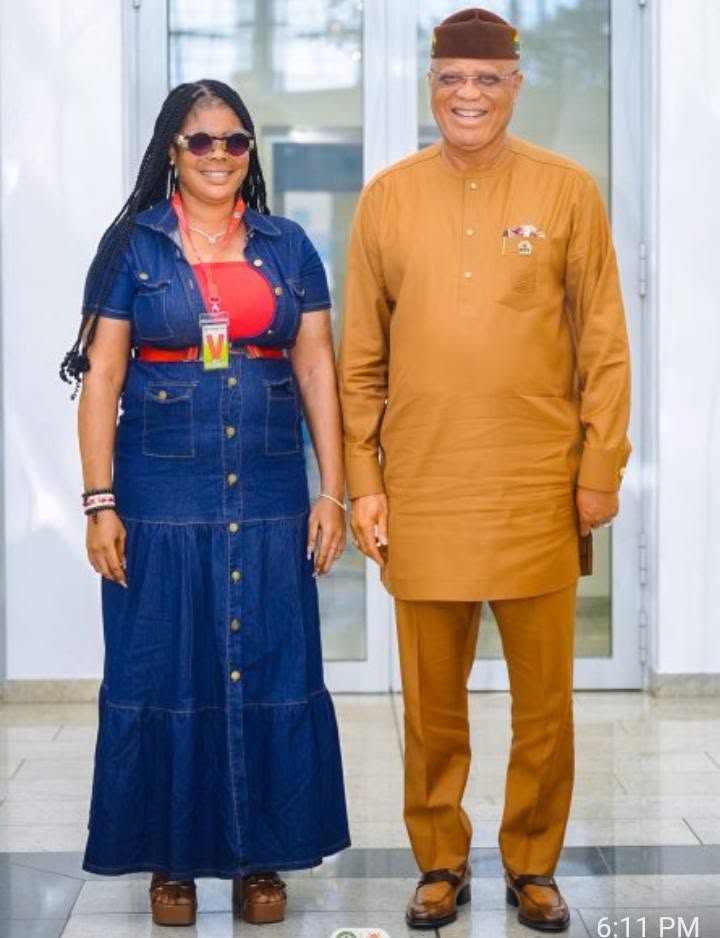
Udoito, who regained freedom two days earlier, appeared before the governor in a delegation of traditional rulers led by the Paramount Ruler of Eket, Obong E. C. D. Abia.
In the event witnessed by Akwa Ibom State Commissioner of Police, Baba Mohammed Azare, she knelt and apologised to the governor over the controversy that had led to her prosecution and months of incarceration.
Also read
- 18 Lawyers withdraw form Facebook User’s Case Allegedly Defaming Gov Eno
- Court Heard How a Facebook User Invoked Ekid Traditional Deities Against Gov Eno
Governor Eno said he had forgiven her, while urging citizens to remain civil and responsible when expressing criticism or disagreement with public officials.
Her legal ordeal began in January 2026 when the Akwa Ibom State Police Command arraigned her before a state High Court in Uyo on allegations arising largely from publications attributed to her Facebook account.
The charges included criminal defamation, conspiracy, seditious publication, public nuisance and conduct or threats allegedly capable of causing fear or disturbing public peace.
The prosecution alleged that Udoito, whose Facebook account reportedly had more than 20,000 followers, made statements accusing Governor Eno of unlawfully selling ancestral land in Eket Local Government Area and of financial wrongdoing.
It also alleged that some of the publications referred to traditional spiritual forces in ways prosecutors claimed were capable of creating fear.
Udoito pleaded not guilty to the charges and was remanded in correctional custody. What initially began as a criminal proceeding soon developed into a wider political and civil-rights controversy as her detention stretched from weeks into months.
Her first application for bail was rejected by the Uyo High Court, which cited the gravity of the allegations, concerns about public order and the possibility of flight.
Her lawyers subsequently approached the Court of Appeal in Calabar, Cross River State, asking the appellate court to overturn the decision.
| Court Denies Facebook User Bail for Alleged Defamatory, Seditious Posts Against Gov Eno |
On July 16, 2026, a three-member panel of the Court of Appeal dismissed the appeal and affirmed the lower court’s refusal to grant bail, while directing that the substantive trial be accelerated.
Justice Mohammed Ambi-Usi Danjuma delivered the ruling, with Chief State Counsel Utomobong Inyang appearing for the state and Akpadiaha Ebitu representing Udoito.
The case was also affected by several delays, including difficulties surrounding the presentation of video evidence and issues involving members of the defence team. As those delays accumulated, Udoito’s continued detention increasingly became the focus of public attention rather than the substantive allegations against her.
Community leaders, civil-rights advocates and the leadership of the EPU repeatedly appealed for her release, questioning whether prolonged incarceration was proportionate to the offences alleged against her.
The controversy became particularly painful after Udoito lost her father while she remained in custody. Her inability to regain her freedom during that period intensified appeals for humanitarian and political intervention and added an emotional dimension to a case that was already deeply divisive in Ekid communities.
For many of her supporters, the case had also become entangled with older disputes over ancestral land, community rights and the relationship between sections of Ekid and the Akwa Ibom State Government.
The EPU, through its President-General, Dr. Samuel Udonsak, and Secretary-General, Bassey Dan-Abia, said in a joint statement on Wednesday, September 16 that Udoito had regained her freedom and was receiving medical attention and counselling following her release.
EPU welcomed and thanked individuals, traditional rulers, religious leaders and others who intervened in efforts to secure her release. Its leaders, Dr. Samuel Udonsak and Bassey Dan-Abia, said her immediate priority after leaving custody was recovery from the physical and emotional effects of her detention.
This brought to an end more than eight months of incarceration that generated protests, legal battles and an intense public debate over free speech and the use of state power.
According to the EPU leaders, the post-release medical assistance is intended to help her recover physically and emotionally after the prolonged period in custody.
Udoito’s ordeal began in January when the Akwa Ibom State Police Command arraigned her before a state High Court in Uyo on charges arising largely from publications attributed to her Facebook account.
The charges initially contained six counts and were later referenced as five, including criminal defamation, conspiracy, seditious publication, public nuisance and conduct or threats allegedly capable of causing fear or disturbing public peace.
The prosecution alleged that Udoito, whose Facebook account reportedly had more than 20,000 followers, published statements accusing Governor Umo Eno of unlawfully selling ancestral lands in Eket Local Government Area and of financial wrongdoing.
It also alleged that some of her publications contained references to traditional spiritual forces which the prosecution claimed were capable of creating fear.
Udoito pleaded not guilty to the charges.
She was subsequently remanded in correctional custody, beginning what would become a prolonged legal and political controversy.
Her initial application for bail was refused by the Uyo High Court, which cited the gravity of the allegations, possible flight risk and concerns about public order.
The defence later approached the Court of Appeal in Calabar, Cross River State, seeking to overturn the decision.
But, on July 16, 2026, a three-member panel of the appellate court dismissed the appeal and affirmed the lower court’s refusal to grant bail, while directing that the substantive trial be accelerated.
The ruling was delivered by Justice Mohammed Ambi-Usi Danjuma.
Chief State Counsel Utomobong Inyang represented the state, while Akpadiaha Ebitu appeared for Udoito.
The case experienced several delays during the year, including difficulties surrounding the presentation of video evidence and issues involving the appearance of members of the defence team.
As her detention stretched into months, the case moved beyond the courtroom and became a major civil-rights issue in Akwa Ibom.
The controversy became even more emotional after Udoito lost her father while still in custody.
Her inability to regain her freedom during that period intensified appeals by community leaders and rights advocates for humanitarian and political intervention.
The EPU leadership also appealed publicly to Governor Eno to intervene in the matter.
Rights lawyers who criticised aspects of the prosecution argued that some of the charges raised important constitutional questions, particularly around freedom of expression, criminal defamation and the continued reliance on sedition-related provisions.
The case consequently became part of a broader debate over the limits of political criticism, the protection of public officials from defamatory claims and the constitutional rights of citizens to criticise government.
For Ekid communities, however, Udoito’s detention became more than a legal proceeding.
It evolved into a rallying point in longstanding disputes over ancestral land, community rights and the relationship between sections of Ekid and the state government.
Her supporters repeatedly insisted that whatever the merits of the criminal case, keeping her in custody for such an extended period was excessive.
On Wednesday, September 16, 2026, Akwa Ibom High Court in Uyo vacated the matter and granted Princess Udoito a conditional release in the sum of N200,000.
Next hearing is scheduled for October 5, 2026 and the Commissioner for Justice and Attorney-General is expected to enter a nolle prosequi, which will bring the prosecution to an end.
