

Our Reporters
The family of Mrs. Glory Eno has alleged foul play over the untimely death of their relative during blood transfusion in Rivers State, calling for a thorough investigation into the circumstances surrounding the incident.
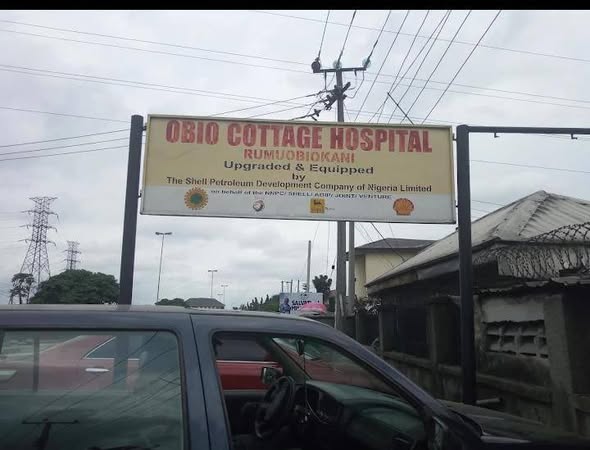
Eno, an indigene of Nsit Ubium in Akwa Ibom State, died at Obio Cottage Hospital in Port Harcourt on Wednesday, 7 October 2026 after developing severe complications during a blood transfusion.
Rehabilitated in 2010 by the Shell Petroleum Development Company (SPDC), the hospital is run by Renaissance Africa Energy Company.
Writing on his Facebook page, Celestine Mel, a Chartered Banker, said that Glory was admitted after complaining of weakness and fatigue, saying ‘‘Glory walked into Obio Cottage Hospital in Rumuobiokani, Port Harcourt, with her two legs, merely complaining of weakness and fatigue.
Also read: Hospital’s Deaths: ‘Nobody will be shielded,’ Health Commissioner assures
‘‘She was armed with lab results gotten the day before, from an independent laboratory. Wanting to be sure, her daughter, Ekaette, requested and paid for confirmatory tests. The results showed her Packed Cell Volume (PCV) at a dangerously low 18%, and the attending doctor recommended immediate transfusion.
According to him, ‘‘Harboring deep, intuitive doubts about the safety of blood transfusion, Glory resisted, but her daughter, who worshipped the ground her mother walked on, pleaded with her. And desperate to give a layer of assurance to her only parent, Ekaette offered to donate her own blood.
Mel, a family friend of Eno, said tests conducted reportedly showed a dangerously low packed cell volume of 18%, prompting a doctor to recommend a blood transfusion.
“Despite her initial reluctance, she agreed after persuasion from her daughter, Ekaette, and reassurance from a physician relative.”
‘‘Ekaette called her cousin, Dr. Bassey, a physician in the University of Uyo Teahcing Hospital, who added her professional weight to the plea and assured that transfusion was the right solution.
‘‘Bound by her daughter’s tearful persuasion and the cousin-doctor’s assurances, Glory surrendered. She looked at the daughter she loved, quieted her own instincts, and willy-nilly agreed to a procedure she feared. Ekaette must now live the rest of her life with the soul-crushing trauma that her well-meaning love, inadvertently ushered her mother into a death trap.
‘‘Ekaette paid N40,000 for a pint of blood, N5,000 for screening and N30,000 for registration. As the dark red liquid began dripping into Glory’s veins, the horror began. She gasped for air, complaining of a sudden shortness of breath. A terrified Ekaette called the nurses, who told her to “cool down.” “But I cannot ‘cool down’ when my mother’s veins are on fire…..” he recounted.
‘‘Halfway through the bag, the nightmare peaked. Glory began jerking. Her breathing turned into frantic, desperate heaves. Blood suddenly gushed from her nose. She vomited and her bowels gave way.’’
Mel alleged that shortly after the transfusion began, Glory developed breathing difficulties, began convulsing, bled from her nose and lost control of her bodily functions.
He further alleged that hospital staff failed to respond adequately to the emergency, delayed arranging a referral to another hospital, and refused to provide an ambulance without payment. Glory reportedly died before she could be transferred.
‘‘Instead of an urgent, life-saving medical intervention, the hospital staff shifted into a frantic, cowardly cover-up. Ekaette watched in horror as nurses hastily yanked the needle out, tore down the blood bag, and began scrubbing the space clean to erase their fatal blunder. As Glory slipped into unconsciousness, the supposedly SPDC-backed hospital desperately scrambled to write a referral letter to the Rivers State University Teaching Hospital (RSUTH).
‘‘Ekaette frantically placed a call out to Dr. Bassey again, who demanded to speak to the attending physician. What she got were stammered excuses. The doctor claimed Obio Cottage was merely an “Obstetrics and Gynecology outpost” without experience in transfusions and anaemia. When challenged, he changed his story, blaming the error on a “newly recruited” doctor.
‘‘The account also alleged that the hospital demanded payment to transport her body to the morgue, forcing her distraught daughter to hire a vehicle and take her mother’s remains to a mortuary herself.’’
Mel suspected that incompatible blood may have been administered, citing claims that Glory was blood group O negative. However, the precise cause of death and whether a transfusion error occurred have not been independently established in the account.
He criticised the hospital, the relevant health authorities and the corporate interests associated with the facility for their alleged failure to respond adequately.
‘‘As Glory lay dying, the hospital management allegedly refused to provide an ambulance. They callously told a weeping, panicked Ekaette to either pay for the service to evacuate the mother to RSUTH or go out to the street and find a taxi. Ekaette rushed out, screaming, struggling to hold down a Bolt driver to take them. But time had run out. Before they could move her, Glory leaned over in excruciating, unspeakable pain, breathed her last, and died.

‘‘Dr. Emmanuel, one of the doctors on duty, stepped forward with platitudes to pacify the traumatized daughter. But the damage was absolute. Ekaette broke down completely, wailing in the corridors as her mother’s once vibrant hands, legs, and limbs wobbled unhinged, totally lifeless. The mother who had walked into the hospital hours earlier was gone.’’
He recalled that the hospital demanded money from her shattered daughter to convey her remains to the morgue.
‘‘Unable to afford their shylock demands, Ekaette stepped into the dead of night, searching for a cab to evacuate the remains to the morgue. She dragged the heavy, lifeless body of her beloved mother; the woman whose laughter filled our Christmas, the seventh of eight children, the matriarch from Nsit Ubium, into the back seat of a hired car; rode in the dark, next to her mother’s corpse, all the way to the Home of the Sick Mortuary in Port Harcourt where it remains, knocking the doors of every good conscience in our nation for answers to this moment.
Medical experts that I have spoken to, point to one glaring conclusion. Glory was blood group O-negative, a rare type that can only receive O-negative. Obio Hospital must have administered the wrong blood to her, which triggered a violent, catastrophic systemic immune response. Her body was literally fighting what it perceived as a chemical invasion in grave pain.
‘‘Yesterday, Ekaette’s haunting viral video, screaming that “fake blood” killed her mother brought back echoes of a healthcare system that has become a slaughterhouse.
‘‘Yesterday too, I called up a certain Dr. Hope Avundaa who identified himself as a representative of the Rivers State Ministry of Health and the Medical and Dental Council of Nigeria (MDCN) to inquire about the incident and what the government is doing. He told me that he is in touch with the family and that I should direct all further inquiries to the daughter.
‘‘Later in the day, I called up Ekaette. She told me Dr. Avundaa called once, and has not been heard from since then. SPDC and the administrators of the Renaissance Africa Project have not reached out either. And I ask, if the beneficiary hospital of a big corporate body like the SPDC cannot perform a basic blood match without killing the patient, who can?
He, therefore, called for an independent investigation, preservation of medical records and blood samples, disciplinary proceedings against any practitioners found culpable, and possible criminal investigations where evidence warrants them.
He called on the Akwa Ibom State Government to support the bereaved family in pursuing justice.
‘‘The Medical and Dental Council of Nigeria (MDCN) must immediately suspend the licenses of the practitioners involved and launch a full-scale disciplinary tribunal.

‘‘The Rivers State Government must secure the records at Obio Cottage Hospital before they are permanently erased and initiate a criminal investigation. Furthermore, we call upon the Akwa Ibom State Government to stand with this grieving family and provide the robust legal backing needed to fight this Goliath.’’
Ata Ikiddeh’s Account
Ata Ikiddeh’s recounted ‘‘Just last night, a very dear sister of mine travelled to Scotland. She had been told that she required a hip replacement, an operation that would cost her approximately £15,000, or about ₦30 million. The same procedure in Nigeria would cost between ₦10 million and ₦15 million. I told her to sell whatever she needed to sell to secure the operation in Scotland, because at least she could be reasonably assured of surviving the procedure.
In his Facebook account, Ikiddeh wrote ‘‘I also told her that every piece of metal implanted in her hip would be made of pure titanium. These tragedies constitute a daily indictment of us as a people. Yet, nothing will happen. No one will be held accountable, and no compensation will be paid. It is profoundly distressing to watch this tragedy unfold repeatedly, as though the loss of human life has become an inconsequential statistic in our national existence.
He queried, ‘‘But then, what is the value of human life in Nigeria? Judging by the appalling state of our healthcare system and the seeming indifference to the suffering of ordinary citizens, one might conclude that human life is worth no more than a piece of beef or mutton in Ikot Akpandem Market. That is the tragedy. A nation that cannot guarantee its citizens access to safe and dependable healthcare has failed one of its most fundamental obligations to the people it governs,’’ he added.
