
Israel Umoh
Nigerian journalists have been charged to be beacons of public interest and to challenge leaders in their different callings to do more for the good of the society.
‘‘Journalism is not just your everyday profession. It is calling to serve society. No social change or revolution has taken place in any society without the involvement of journalists.
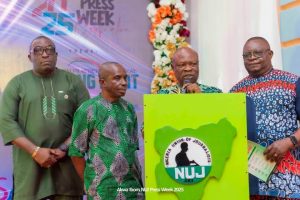
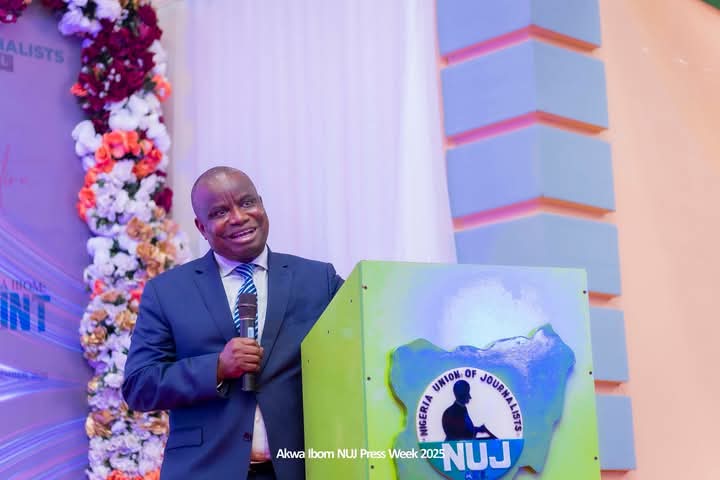
Moffat Ekoriko, Publisher, NewsAfrica, London, who made the call, at the 2025 Press Week of the Nigeria Union of Journalists (NUJ), Uyo, Akwa Ibom State, December 1, further enjoined journalists to act as beacons for the common good of the society.
Ekoriko talking as a key speaker at the event on the topic: Journalism Practice in Akwa Ibom State: The Turning Point in Pursuit of the Common Good , said ‘‘Journalism practice in Akwa Ibom must provide the beacons from which we measure the extent of the deviation of our society from status quo. We must not perpetuate trends alien to the culture of our people, be it in marriage, respect for our elders and leaders, children upbringing and treatment of our women.’’
Related News:
- Mkpanang, Ekoriko pen elegy for Journalist-kinsman
- No Corruption Fight, But Media Trial – Asserts Ekoriko
- Gov Eno inaugurates NUJ Auditorium Complex, Presents cars to Journalists
Giving Biblical allusion, he recalled ‘‘For those of you who are Christians, ‘the Lord gave the word and great was the company (the journalists) that published it’. Karl Marx who had great ideas about how society should be organised could best push his ideas as the editor of Rhenische Zeitung (The Rhenish Newspaper). After the German government shut it down in1843, he moved on to establish Neue Rhenische Zeitung, the New Rhenish Newspaper in 1848.
‘‘Coming home to Nigeria, the anti-colonial movement in the last century acquired a new momentum when Nnamdi Azikiwe returned from the United States with new ideas of freedom, equality, and self-determination.
‘‘To give life to his campaign, he had to establish the West Africa Pilot. I have drawn these two examples to illustrate that no movement, ideas, government or even campaign can achieve its goals without the practice of journalism. If in doubt, please take a look at the number of Ph.D. theses in Nigerian universities oJering panacea for Nigeria’s problems for which many Nigerians are not aware of.’’
He, therefore, harped on the need for journalists to compel the society to do better, stating ‘‘As journalists, we must challenge our society to do better. This we can achieve by raising awareness about our potentials. We can also challenge other components and institutions in the society to up their game.’’
‘‘Let me pick one example we may not be conscious of: the Akwa Ibom Church. We have very strong church congregations in Akwa Ibom State which can serve as engines of economic empowerment and social mobility.
‘‘However, most of them are not doing much beyond telling us of the place prepared for us in Heaven (when we die o!) They are actually awash with stranded resources. For a moment, picture that all the church buildings in every Akwa Ibom village were cottage industries.
‘‘Imagine that most of the churches have scholarship schemes for brilliant children. The socio-economic transformation of our people with be the legendary. How come that up till today, no church in Akwa Ibom, even national ones with headquarters here, has established a university like Seven-Day Adventists’ Babcock University? The onus in pursuit of the common good is for our journalists to point out where we are punching below our weight.’’
To aggregate interest of the society, the Publisher remarked that ‘‘Part of the problem we have in our state is we leave it for the government to aggregate what is in the ultimate interest our people at any given time. So far, we have been lucky with our governors.
‘‘Also, the trouble with politicians, given the layers of security around them and mindset of the king/people (instead of servant/people) relationship is that they become hostage to power. They may not actually be in touch with the needs of the people. As a result, governments can articulate policies that do not serve the interest of our people. A good example is the past policy of government establishing industries. One wonders how many of the industries are functioning today.
‘‘Imagine if that money had been invested in boosting the quality of primary and secondary education in the state. By today, we would be at the top of the education league table. I dare say that the highest need of our people is qualitative and universal education. Our educated children will build the industries. We must not forget that every society has limited resources, the appropriation of the resources makes the difference between advancement and waste.’’
To set agenda for the society, Ekoriko remarked that ‘‘In pursuit of the common good, it is the place of journalists to set agenda for society. This is diJerent from interest aggregation which is season specific.
‘‘The practice of journalism must evolve to a point where the path society should thread is a consensus arising from study society’s needs, global trends and past mistakes. It is left for journalists to define what type of society we should have.’’
On checking the negative excesses of social media, he observed ‘‘In this era of social media and online news, there is a temptation for journalist to attempt to play catch up.
‘‘This is the most dangerous thing we can do. We should stick to the values of journalism: objectivity, accuracy fairness, balance, social responsibility. It is actually our place to check against tendencies inimical to the long term interest of our people.
‘‘On the Akwa Ibom social media space, I see a few persons fanning embers of disunity. We must take a stand that our people cannot be divided. Those people, and there are less than ten of them, should be treated as extremists. Every society has some.’’
He used the opportunity to call on journalists to re-orient the mindsets of people to attaining the common good of the society.
‘‘One of the obstacles to the attainment of the common good for our people is our mindsets. In Hebrew, there is a word ‘firgun’, which means a state of exceeding happiness over another person’s progress.
‘‘In German, there is a word schadenfreude, which means a state of rejoicing over another person’s misfortune. We do not have the former in our language. We have the latter ‘idiok esit’. It is our place to reorient our people from ‘idiok esit’ over their brothers and sisters’ achievements. If we can simply change this mindset, our society would take a big leap.’’