

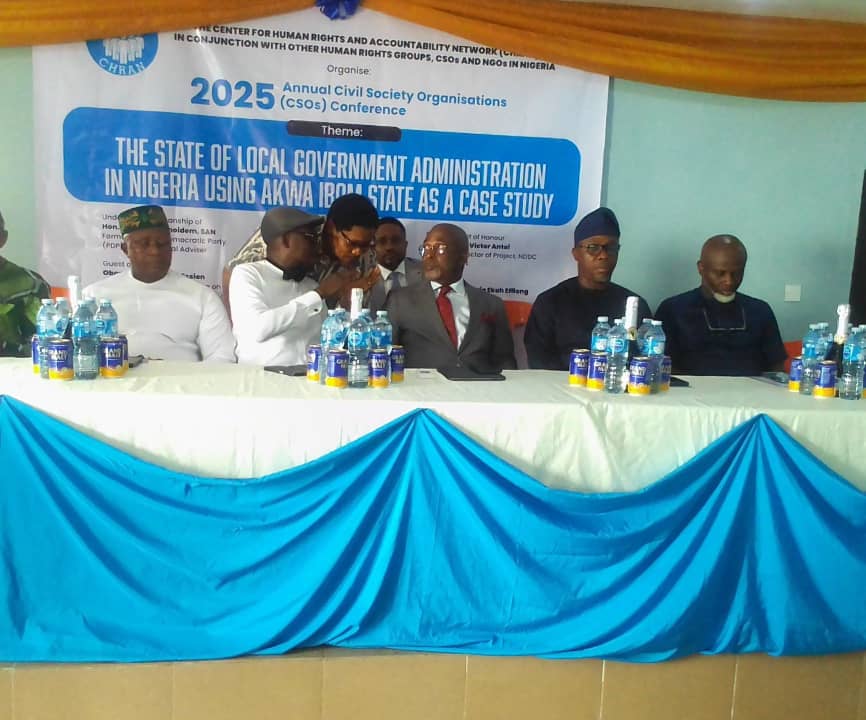
The Civil Society Organisations (CSOs) Conference in Akwa Ibom State has called on National Assembly to amend the 1999 Constitution of the Federal of Nigeria to enshrine local government autonomy.
The CSOs conference stated this in a communique signed by Otuekong Franklyn Isong, CHRAN Director and issued at the end of a one-day Annual Civil Society Organisations Conference in Uyo on Monday, 6 October, 2025.
Others who signed the communiqué were Comrade Ifot N. Ifot, Chief Executive Officer, Peoples’ Rights To Life Development Foundation (PERLDEF) & Chairman of the Communique Drafting Committee; Comrade (Dr.) Victor David, Executive Director, Vital Partners For Development (VPD) & Secretary of the Communique Drafting Committee; Comrade Ekarika Samuel, Chairman, Committee For the Defence Of Human Rights (CDHR); Comrade Gideon Usen, Director, Civil Society Network For Development; Comrade Ime Udoh, Coordinating, Center for Human Rights; Comrade (Mrs.) Helen Ubit, Executive Director, Theolight Global Foundation (TGF); and Comrade (Barr.) Ubiere Harrison, Executive Director, Treasure Advocate.
Also read:
- CHRAN Hails EMOIMEE for Executing 35 Projects in Akwa Ibom
- CHRAN decries development deficit in Akwa Ibom LGAs
- CHRAN urges Gov Eno, LG Chairmen to account for monthly allocations
The conference acknowledged the 774 local government councils as the third tier of the government of the Nigerian federation.
The Conference recalled the judgment of the Supreme Court of Nigeria with respect to the financial autonomy of the 774 Local Government councils, but expressed dismay that state governments still have total control of local government councils despite the Supreme Court judgement.
The conference called on the National Assembly to urgently amend Section 162(6) of the Nigerian Constitution, 1999 (as amended) to reflect the Supreme Court judgment by providing direct funding of the 774 local government councils from the Federation Account Allocation Committee (FAAC) as against the “State Joint Local Government Account” created by the said Section 162(6) which the state governments are using as an avenue to take full control of the local government funds.
In Akwa Ibom State, the Conference said while there is a spirited attempt by several local government councils to interpret their roles effectively, there’s a near-absence of grassroot governance in many of the 31 local government councils of the State despite the huge monthly Federal allocations to the councils.
While the Conference refuted public declarations by Akwa Ibom State Governor, Pastor Umo Eno, to the effect that the funds of the local governments from the FAAC go directly to the Local Governments account untouched by the state government under his administration, the Conference lamented that the Local Governments in the state are bereft of physical presence of developments and infrastructure and have become poverty brewing centers.
According to the Conference, majority of the 31 Local Government Chairmen are not residing at their respective local government areas in order to provide the needed grassroot governance and development to the people at their local government areas.
To assess the performance of the local government chairmen in the State, the Conference called on Governor Eno to carry out an urgent tour of the 31 local government areas with members of the civil society organisations and the Press, in order to have a firsthand information of the management of funds, transparency and accountability in respect of funds accruable to the 31 local governments from FAAC by the Councils’ Chairmen in the past one year of their stewardship.
However, CSOs Local Government Councils to domesticate the Akwa Ibom State Environmental Protection and Waste management Agency law to enable them focus more attention in environment sanitation protection, and Waste management issues in the local Government Areas.
The CSOs Conference advocated the restructuring of the Ministry of Local Government and Chieftaincy Affairs with a view to repositioning it for effective service delivery, particularly by making the local government councils to be responsible in the affairs of Chieftaincy, so that the welfare and well-being of the Paramount Rulers, clan heads, village heads, family heads and other Chieftaincy Affairs can be handled by the local government council Chairmen who will only be accountable to the Governor’s office.
