

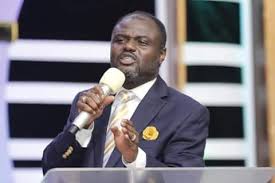
Pastor Abel Damina
The genocide in Nigeria is endemic spanning decades-old attacks by religious fanatics and fundamentalists have, over the slightest provocation, been visiting their angst on Christians.
In fact, the fanatics armed with dangerous weapons have been burning churches and engaging in massacre of innocent persons whose religious faith differs from theirs.
In the light of this, US President Donald Trump’s declaration that there is genocide of Christians in the country, and vowing to rid the country of terrorists, many Nigerian Pastors have voiced out their experiences and opposition against the attackers.
Straightnews, therefore, stumbles in a viral video in the social media that one of them is the fiery Pastor Damina who voices his thoughts against terrorism in the country and supports Donald Trump’s pledge to use military action to clear the terrorists from the country.
Excerpts:
‘‘Well, whether you call it genocide or you don’t call it genocide, let me speak as a victim. I am not just a student of research, but I am speaking as a victim of these gruesome circumstances around the Nigerian people, where innocent lives have been taken away by some people who think they have more right than others in this nation. And some people have reduced it to herders and farmers clash.
Related news:
- Adeboye predicts end to Banditry, Terrorism in Nigeria
- Terrorism: Bandits Implicate Nigerian Government in Sponsorship as Financiers Emerge
- Terrorism: Nigerian female doctor, six killed in Abuja-Kaduna train attack
No, sir! This has been ongoing. I grew up in Northern Nigeria. My father was a pastor with the Assemblies of God Church.
One morning, we just woke up at Assemblies of God Church, Samaru in Zaria, somewhere adjacent the north gate of Samaru in Zaria. My father was a pastor. All of a sudden in the morning, no provocation, nothing, the next thing we were hearing was that people were just running all over our house and the church with matchets and all of that. The next thing was they starting to pour petrol all over buildings – both the church and the house, because our house was attached to the church. And the next thing was flames.
Everything was burnt to ashes. We narrowly escaped, found a place where we could shelter ourselves in the military barracks. Eventually, they brought us back to the lecturer’s quarters of ABU, Zaria.
And we had to camp with a family for weeks and months before we could rebuild and start life all over again. That is long, long, long. I’m talking about 1986 and 1987.
What about the Maitatsine uprising? Maitatsine was a sect of the Islamic religion who went around burning and destroying and killing Christians back in the 80s. This is far before there was anything like farmer-herders clash. Then fast forward.
What about in the year 2000, where over 2,000 people were killed in Kaduna? What about the over 300 people who were victims of the Miss World Pageant in November 2002? All of them were not a part of the Miss World pageant. They were just on their own. Something happened somewhere else and they became victims of it.
Lives were lost, houses were destroyed. And whenever they are carrying out this chariot, they will be shouting ”Allah Khabar! Allah khabar!” And they will carry their matchets and carry whatever they have.
And they will move in their numbers. They are chanting, anyone who cannot shout becomes a victim. I can go on and on.
A few years ago, I was preaching in Kaduna for a great man of God. And I only succeeded in preaching Sunday morning service. After the service, the next morning as we were preparing for the next service on Monday, the next thing I was hearing was the whole city was on fire.
Kaduna is on fire. Please, stay in the hotel room. Don’t come out. They are killing, they are burning churches. They are killing everybody.
That is how we were stuck in a hotel. Even in the hotel, we were not sure of ourselves because they were going from hotel to hotel, room to room, killing people that were not chanting ”Allah ya Kadara, sammar- sammar,” God saved our souls.
After about four days, we were able to leave Kaduna. Unfortunately, a friend of mine who was a pastor, Rev. Northcott Andrew, of blessed memory, was caught in the midst of this as he was escaping for his life. They caught him because he was wearing a collar of a Bishop.
They hacked him to death, dug the ground, buried him and put a cross there. It is that little wooden cross that made people knew that there was a corpse in that place. And this, my friend, was buried.
These are real-life situations. So for somebody to just sit down in the comfort of his home, maybe somewhere in the south, and be saying there’s no such thing in northern Nigeria, my brother, you’ve not been a part of it.
We’ve been right in the heart of the fire. I remembered one night, these Muslim boys were all over the place in my school and they were shouting ”Allah Khabar.” They were looking for me.
I had to escape that night. My saving grace was that I found a female hostel and I slept under the bed. By the next day, I left the town.
For what? I did nothing. No provocation. Just because I am preaching the gospel.
And of course, some of them believe that once you are not of the Islamic faith, you are an infidel. You know, and they believe that if you kill an infidel, you will sleep with seven virgins. You know, all of this kind of indoctrination that leads to violence and the slightest provocation, whether it has to do with the people or not, you just get on the streets.
What about the Reinhard Bonnke Crusade? I’m talking about the Reinhard Bonnke crusade in Kano, where people were hacked, macheted, and killed because a crusade where the gospel of Christ was going to be preached. And that is why I thank God for people like President Donald Trump, who lent his voice to what is going on here. At least for whatever, there’s an ongoing conversation all over the world.
The matter is no more put under the carpet. And we don’t want just conversations. We want some action. We want some action. And in the midst of all this, it’s snowballed into the hardest and farthest clash. It’s snowballed into banditry, and everything becomes very complicated, very complicated.
And people are dying by the day. There are people in Northern Nigeria- places like Borno State, places like Plateau State, places like Benue State, places like Southern Kaduna, where whole villages have been taken over by some of these bandits, by some of these Islamic extremists, by some of these Boko Haram people. They’ve taken over whole villages, driven the villagers away.
And somebody said, there is no such thing in Nigeria. Why do we have IDP camps? Why do we have IDP camps? When we never had an earthquake? We never had an earthquake. Why do we have IDP camps when there is no natural disaster; other than the fact that people are being made victims of what they have no knowledge of.
In a secular state like Nigeria, where all religions are permitted to be practised – this ought not to be allowed. This ought not to be allowed at all. Our government has a duty.
Now, when you live in a country like that, where you don’t know what becomes of you the next day, you go out, you don’t know if you’re going to come back. When you go to church, you’re not sure if you’re going to come back. When you live in such a country, it’s almost as if there’s no government because the first responsibility of government is security of lives and properties.
That’s the first responsibility of government, whether at the federal level, at the state level, or at the local government level because the population don’t have access to arms.
Unfortunately, some of these bandits, some of these terrorists, some of these extremists, are carrying AK-47s. And you wonder where did they get them from? In fact, it’s unfortunate that at a point in Nigeria, there was even a local government area in Borno State, where Boko Haram drove out all our Nigerian security forces and put their flag there. It’s very unfortunate.
And the government of Nigeria needs to do something quickly, quickly, quickly; otherwise, where this is taking us to, we do not know. This has to come to an end.
The IDP camps need to be emptied, let people go back to their homes, let people go back to their villages, let people go back to their farmlands, let people go back to their habitations, so that they can live normal lives. So, they can live the life they’re supposed to live on earth. You know, this is very, very important.
And this conversation is so critical at this time. And it’s critical that I add my voice to it as a victim of this situation in a country like Nigeria. And I’m believing God that the day has come when this menace will surely come to an end.”
Damina is the Senior Pastor of Power City International, 98 Nwaniba Road, Uyo in Nigeria
