

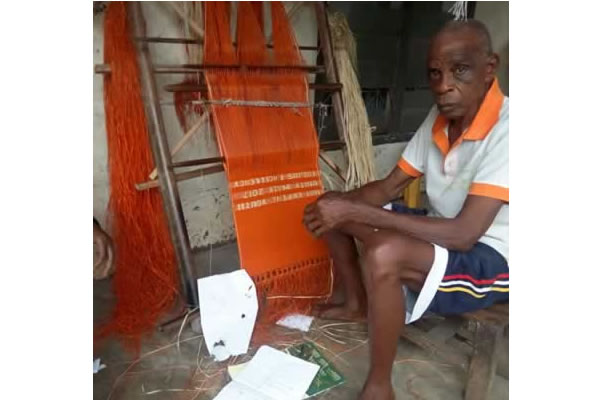
Raffia city. This sobriquet symbolizes Ikot Ekpene in Akwa Ibom State. Created as an experimental local government headquarters in 1951, the city is famously known for production of raffia materials. Raffia usually sourced from palm wine tree is not easy to come by. The locals have produced raffia products over the years and used proceeds to better their economic status. At the same time, they have succeeded in generating employment opportunities for themselves and other willing Nigerians.
The raffia palm tree grows in the tropical regions, wet soil of Madagascar, Africa and Philippines. Raffia palm is made up of long leaves and the fibre is obtained from the membrane on the underside of each palm frond. The dried raffia fibres are turned beige in colour to yield the natural coloured raffia.
Ikot Ekpene, the acclaimed raffia city is not a ruse. Gregory Ukpong, a prominent indigene of Ikot Inyang in Ikot Ekpene who had been in the business confirmed the raffia city epithet of Ikot Ekpene. “Before the civil war in Nigeria, people from Ikot Ekpene had always been into raffia making, apart from trading. So, the major craft here is raffia making. Raffia is produced here in large quantity and has attracted huge patronage. Some people come here to buy in dozens,” he recalled.
Ukpong, however, applauded the former Commissioner for Health in the then Cross River State, the late Mrs. Elizabeth Ekong who used to buy raffia products and exported them in large quantity to some foreign countries. “But since her demise, we don’t have such patronage to export the raffia products again. The raffia is used to design bags, shoes, suits and various things. So, it is a traditional craft in Ikot Ekpene to produce raffia using the craft skills to produce the items,” he narrated.
Mrs. Rose Uko, an indigene of Ikot Abia Idem in Ikot Ekpene said Ikot Ekpene also supported Ukpong’s narrative. “Ikot Ekpene is nicknamed raffia city because of its overriding authority in the making of raffia products. We use raffia to produce bags, window blinds, shoes, hand bags, lawyers’ wigs and key holders, among others,” she enthused.
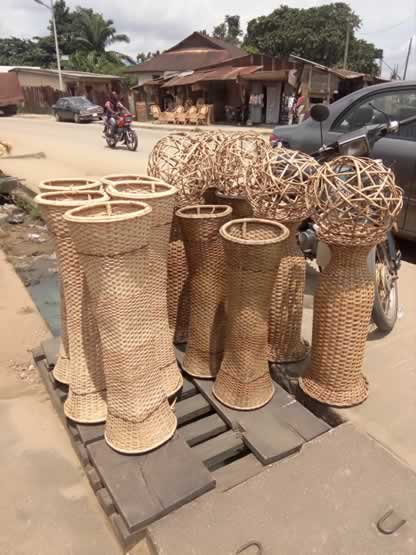 To authenticate the various accounts, StraightNews crew took a trip to Ikot Inyang, one of the villages in Ikot Ekpene specializing on raffia products. It was like entering day-old university to unravel the complexity of processing raffia into finished product. From his youthful days, an 80-year-old Emmanuel Sebbas Ukpong has been dexterous in the home-spun raffia products. In showcasing his artistic ingenuity in the business, he untied raffia production in a matter of minutes with practical demonstration of dyeing. The colour combinations posed another study in Physics. He explained the step-by-step process involved in dyeing. “When you have raffia, you put it in water. The colour you depends on the mixture you use. To get black, you mix green, red and violet to get it. To produce red colour, you mix yellow with violet colours. Orange colour is derived from the use of a local herbal root called onio or yellow,” he stated. This is the preliminary stage one.
The refinement process is another preliminary stage that involves heating the raffia on fire. Mr. Ukpong told the reporter “Gather the raffia. Pound it seriously. Put it in mud then a big pot and place it on fire to melt properly. Allow it to boil for at least one hour before you bring it down. Depending on your mixture, it will turn to your desired colour. Wash and remove the mud. Spray it on the sun and allow it to dry for one hour. It is done and fit for use.”
Now, the making stage is another crucial stage, which involves weaving it into what you want. Ukpong, the craft maker mounted the wooden loom to spin raffia. He brought out his tapestry or knitter’s needle. He sat comfortably on a wooden stool, jacked up the serrated wooden loom and reached to nkun or transformer. Once the dried raffia fibre is fixed in the loom, he tightened all the ends and used the tool to stitch the raffia. After this, Ukpong used etuk ndokbe in local parlance to fasten the raffia to the loom to run it up and down. Thereafter, he used ekek, which is another device for weaving. It separates the line from one another to give the embroidery a prefect look. When finishing off, he threaded and carefully knotted the raffia ends to avoid loosening.
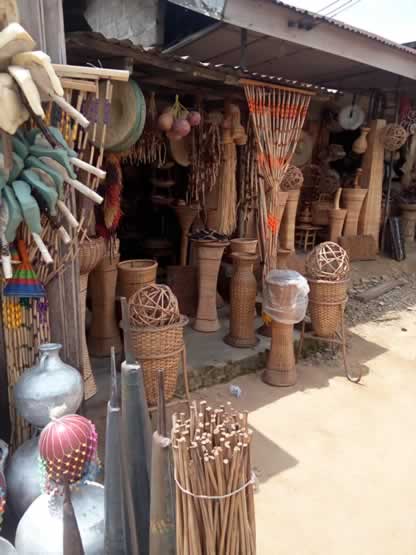
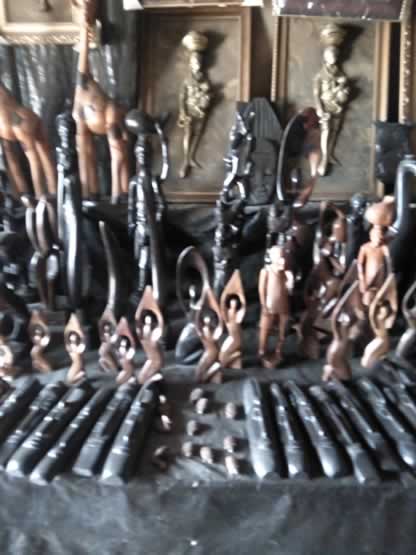 From raffia harvesting, dyeing and packing are done by the local people. From the processed into a refined, value added form, the raffia work is rolled into specimens ready for display, use and sale. The finished works were packed and moved to 1 Ito Road in Ikot Ekpene. It is a mini-raffia market where shops displayed their array of raffia products. The coloured hanks and raffia crafts were cynosure of outdoor project and costumes. Milliners, crafters, florists and designers frolicked the area to make their choice.
Solomon Udom from Ibiakpan in Ikot Ekpene is owner of one the shops. In guiding StraightNews reporter round the shop, he stated that “I got these products from Ikot Inyang. But the sculptures are gotten from Ikot Abia in Obot Akara Local Government Area. We have many materials for individuals, churches, traditional marriages, and traditional dancers, among others.”
The shop is a one-stop supplier of raffia and sculptural works. From packing raffia bags, wall mat, box mat, nyoho for traditional dancers, raffia-made shoes, caps, hand fans to raffia-spun petty coats, among others.
From the curator’s home in Ikot Abia were earthen pot, drums of varying sizes, Ayo game, traditional bell, ntakrok (slit-like instrument for traditional song), traditional chair, wooden drum, mortar/pestle, flower stands for traditional marriage, walking stick, wooden gong to side drums, among others.
Though Udom, the shop owner put the cost of his products at N5 million, he described raffia market as a booming one begging for patronage from individuals. He lamented that he did not have enough money to expand and lacked shop to put more items, calling on the state government to provide them with soft loan to do more to create more job opportunities for the teeming Nigerians roaming the streets for white collar job.
How does the raffia help to improve the economy of the rural people in Ikot Ekpene? Gregory Ukpong responded thus “Yes, it has improved the economy of the people here. For example, Mr. Leo Umanah, used the proceeds from raffia he produced to sponsor himself to school. A lot of people here venture into the business of raffia making and they are able to marry wives, build houses for themselves.”
Collaborating, Mrs. Uko, a retired Director of Administration in the state Ministry of Culture and Tourism, asserted that “These raffia works have put foods on many tables and send many people to difeerent schools in the country.
Unfortunately, the state government, through the Ministries of Trade, Industry and Investment as well as Culture and Tourism, has not thrown their support to the raffia business which could help in propagating the culture of the state to other people in addition to creating employment opportunities to the jobless. According to Ukpong, “No, we don’t have any sponsors from government. I have now registered Raffia/Craft Multi-Purpose Cooperative Society and obtained a certificate for the raffia producers.
 As a way out, he opined “Yes, the state government can assist us by giving money to increase the planting of palm wine trees where we get the main raw material used for the business. For instance, the location where we get this palm is Ubodio in Odukpani Local Government Area of Cross Rivers State. It is far and very costly to convey the materials down here caused by the poor state of road there.
So, the state government can assist us plant the palm here in a large quantity to encourage us to produce raffia in large quantity and also reduce the cost of bringing the materials from a long distance,” the community leader solicited.
In her opinion, Mrs. Uko stated “It is advisable foer government to step in and assist the crafters so that they would be able to export Akwa Ibom culture to other parts of the world as well as expand the frontiers of marketing the products beyond Nigeria and Africa.”
“Government should assist the crafters to produce the materials in large quantity. Let government donate and build raffia market for them. Again, I want to appeal to government to provide them with soft loan to enable many of them to embark on large-scale production of different materials using our local materials,” the retired director opined.
Though the local people have the capacity to produce the raffia materials in large quantity, most Akwa Ibom people and even Nigerians have not hugely patronise raffia products hence the inability of the people to assert the materials both in the national and international markets.
