

Israel Umoh
Journalists in the country have been told to demand greater accountability from their leaders in politics, business, religion and education for the betterment of the society.
‘‘Journalists in Akwa Ibom State must demand more from our leaders in politics, business, religion and education. We should demand that our leaders mentor and raise successors,’’ Moffat Ekoriko said.
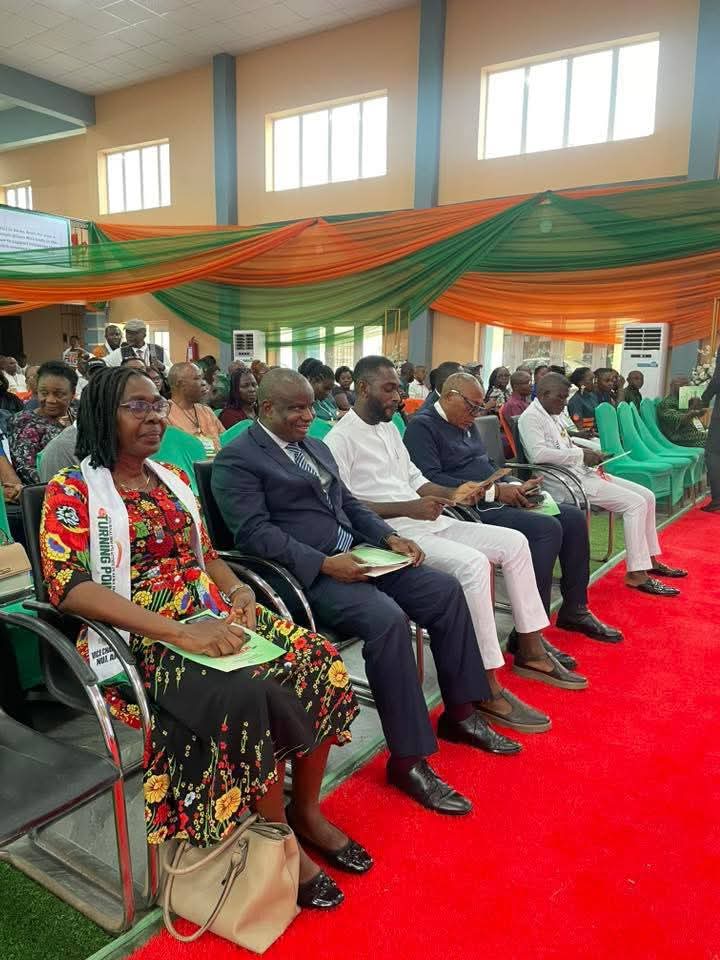
Ekoriko, Publisher of NewsAfrica, London, who made the call at the 2025 Press Week of the Nigeria Union of Journalists (NUJ), Uyo, Akwa Ibom State, December 1, said ‘‘Given the demanding chores of life, very few citizens have the time, the energy, the resources and the capacity to keep a tap on the various institutions any society has set up for the actualisation of its common good.
Related news:
- Akwa Ibom NUJ Joins in marking 2022 World Press Freedom Day
- Get To Work To Improve Journalism Practice In A’Ibom, Past NUJ Chairmen Tell New Exco
- NUJ Boss Wants Nigerian Govts To Provide Conducive Atmosphere For Journalists
‘‘If we have 10 dollar millionaires in Akwa Ibom State today, we should produce 100 in another 10 years just by having the existing ones mentor and bring up others. Eto ked isikabake akai(One tree does not form a forest).’’
The Publisher pointed out ‘‘It falls on the journalist to be the eyes of the people (who see what those charged with the common good are doing), the ears of the people who pick up and can calibrate the state of the society and the mouth of the people (who say the things ordinary people cannot say).
‘‘As a result, the quality of the common good in any society is directly proportional to the quality of journalism in that society. This will explain why every dictator moves to shut down the media. Dictatorship cannot thrive where journalists are vibrant. It also follows that democracy cannot thrive where journalists become laid back, compromised or unpatriotic. In summary, it is journalists, not any other group of professionals, who are the guardian angels of society in pursuit of its common good.’’
‘‘In the elementary class, you are taught that the role of journalists is to inform, educate and entertain. I wish it was that simple. Journalists are mediators between those charged with responsibility for delivering the common good and the people themselves.’’
Talking about accountability, Ekoriko reasoned ‘‘if the concept of the common good must be optimised, journalists in Akwa Ibom must act as a check against the abuse of common trust. It is our place to ensure that resources meant for the common good are not mismanaged but it in government, the church or public institutions.
‘‘Part of that accountability is ensuring that people saddled with public duties discharge them. For example, if the state government employs a doctor and posts him to Ukanafun General Hospital, that doctor must not live in Uyo and go to work in Ukanafun.
‘‘He must live there so he can be called to save the life of a woman in labour by 2 a.m. If government money is voted for a project, there is no point to wait to blame the governor if the project fails: monitor that project and raise alarm on time.’’
However, he canvassed for the welfare of journalists for them to sustain the fight for the common good of the society.
‘‘The second housekeeping imperative is the welfare of journalists. We expect our journalists to fight for the common good but how can he do so on an empty stomach or when his children’s school fees are not paid? I challenge the Nigerian Union of Journalists to work with industry stakeholders to develop a robust welfare package for journalists.
‘‘Some of the lapses we see today in the practice of journalism arise from the pull of survival instincts. We must not forget that whenever there is a conflict between survival and morality, survival takes precedence. Agwo awiong Ndong inyeneke uko (A hungry man lacks courage).’’
Ekoriko who has been in Journalism practice canvassed for the regular trainings of journalists for them to do their work creditably, saying ‘‘The third housekeeping imperative is the continuous training of practitioners. The journalist must be an authority in any field he chooses to write on. If he writes a business story, it should make sense to the professor of economics as well as the trader at Akpan Ndem market.
”This means that he must be in continuous education. The NUJ can play its part by liaising with the tertiary institutions in the state to mount short courses on various subjects: economics, artificial intelligence, finance, health and wellness, politics and philosophy.’’
