

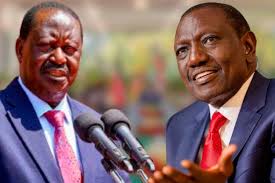
Kenyan President William Ruto announced a seven-day national mourning and a state funeral for opposition leader, Raila Odinga, who died on Wednesday.
Kenyan opposition leader, Raila Odinga died in India, Indian police said Wednesday
Ruto described him as “Kenya’s foremost statesman and one of Africa’s greatest sons… a giant of democracy, a fearless freedom fighter and a tireless warrior of good governance.”
Also read:
- Plans for Odinga’s Counter Swearing-in Complete
- Raila Odinga Takes Oath of Office, Musyoka Absent
- William Ruto beats Raila Odinga to become Kenya’s President
Ruto said he would postpone all his public engagements in the coming days “as a mark of respect”.
Odinga had been receiving medical treatment abroad and suffered a cardiac arrest, according to the hospital in the city of Kochi where he died.
He was for decades at the heart of Kenyan politics, striking alliances with former foes, serving as prime minister for a term, and inspiring lifelong loyalty from his base, particularly among fellow Luos in the west and in the capital Nairobi.
Odinga’s ability to work with rivals earned him the nickname “Agwambo” (“mysterious one”) in the Luo language.
Supporters called him “Baba” (“father” in Swahili), refusing to turn their back even when he was accused of exploiting ethnic divisions for political gain or of striking deals with opponents for the sake of personal power.
Upon news of his passing, hundreds of supporters from the Nairobi slum of Kibera, many crying and waving twigs to ward off bad omens, made their way in a procession to Odinga’s family home in the capital’s upscale Karen suburb.
Crowds also gathered in the lakeside town of Kisumu and the Rift Valley town of Eldoret where Odinga was popular.
His legacy as a democracy activist over the years helped seal two of Kenya’s most important reforms: multiparty democracy in 1991 and a new constitution in 2010.
Among Kenyans, opinions were divided over his legacy.
“May his fight for democracy continue to inspire our nation’s leaders,” said Nairobi resident Grace Mbugua.
“He may not have had the best interests of all Kenyans at all times, and during his push for democracy, many lives were lost,” added accountant Patrick Mungai.
How Odinga Died
“The death is confirmed,” Krishnan M, additional superintendent of police in India’s southern state of Kerala, told AFP.
“The Kenyan national was on a walk with his sister, daughter, and a personal doctor when he suddenly collapsed. An Indian police security officer and a Kenyan security officer were also with them at the time. He was rushed to a nearby private hospital, but was declared dead.”
Odinga’s death was also confirmed to AFP by a member of his political team but they requested anonymity while awaiting an official announcement from the party.
A spokesman for the Sreedhareeyam Ayurvedic Eye Hospital and Research Centre in
“This morning, around 07:45 am, Mr Raila was on his morning walk,” the spokesman told AFP.
“Suddenly, he experienced some breathing difficulties and collapsed. He was provided CPR on the spot and having seen some sign of recovery, he was rushed to the nearest modern hospital. Despite repeated efforts by the medicos, his condition deteriorated and the doctors were unable to save him.”
Born on January 7, 1945, he spent his early years in politics either in jail or in exile, fighting for democracy during the autocratic rule of President Daniel Arap Moi.
A member of the Luo tribe, he entered parliament in 1992 and ran unsuccessfully for the presidency in 1997, 2007, 2013, 2017 and 2022, claiming to have been cheated of victory in the last four elections.
(FRANCE 24 with Reuters and AFP)
