

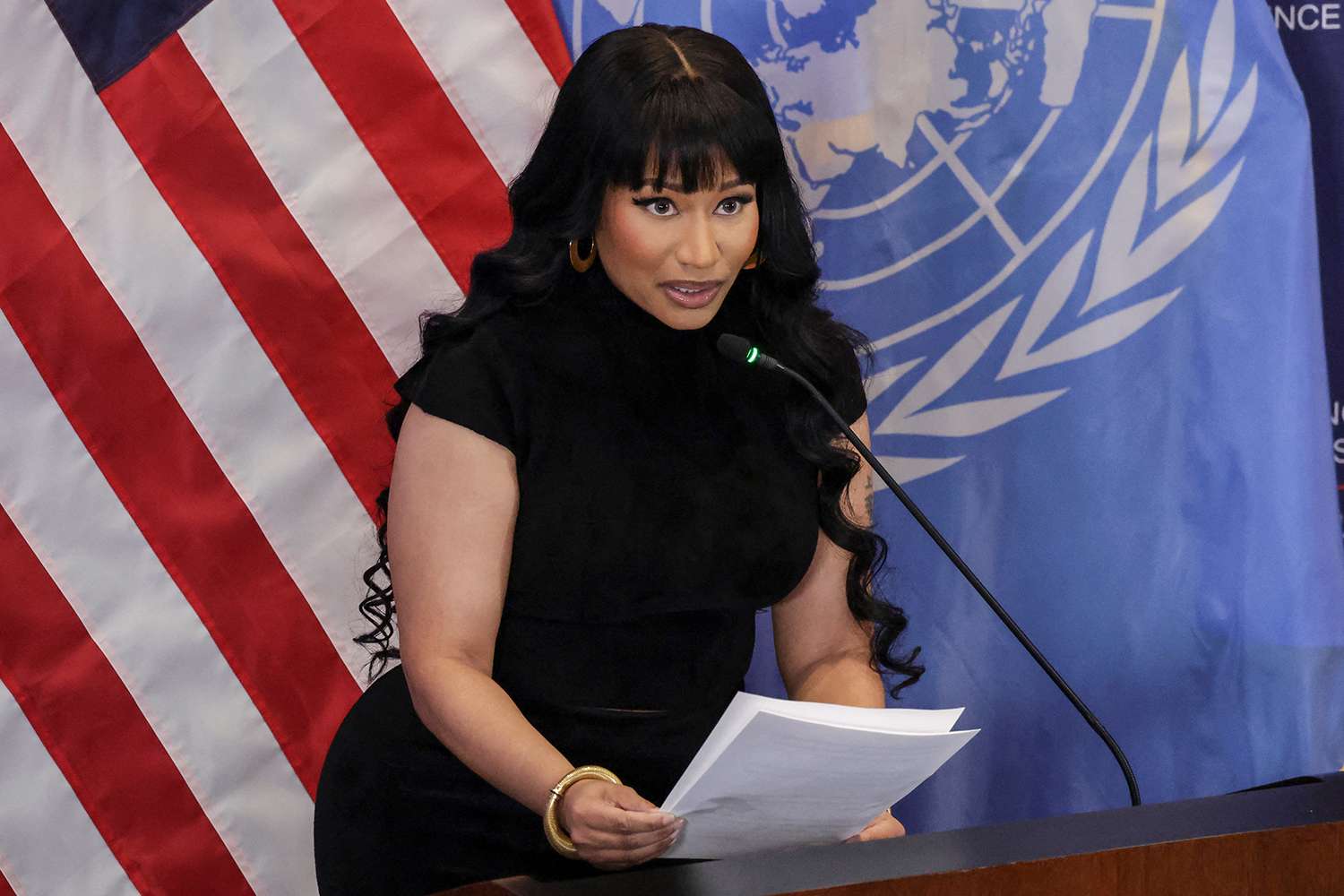
Rapper Nicki Minaj raised awareness at the United Nations on Tuesday of alleged persecution of Christians in Nigeria, marking a rare appearance by a pop star on a diplomatic stage.
“I must say, I am very nervous,” Ms. said before delivering her four-minute speech, calling the moment “an honor.”
This is coming as Pope Leo XIV, Sunday, condemned the increasing violence and discrimination faced by Christian communities across several countries, naming Nigeria, Mozambique, Bangladesh, Sudan and others as hotspots where believers continue to suffer deadly attacks and destruction of their places of worship.
Minaj spoke at a panel organised by the U.S. Mission to the United Nations, entitled Combating Religious Violence and the Killing of Christians in Nigeria.
Related News:
- Terrorists Are Taxing Poor Farmers in Northern Nigeria – Pastor
- Nigerian Journalist Exposes Worsening Injustices Against Christians in Northern Nigeria
- ”How We Escaped Genocide in Northern Nigeria”- Damina Speaks
The Trinidad and Tobago-born artist appeared alongside U.S. Ambassador to the United Nations Michael Waltz and several faith leaders.
“I would like to thank President Trump for prioritizing this issue and for his leadership on the global stage in calling for urgent action to defend Christians in Nigeria, to combat extremism and to bring a stop to violence against those who simply want to exercise their natural right to freedom of religion or belief.
“I stand here as a proud New Yorker, with a deep sense of gratitude, that we live in a country that we can freely and safely worship God, regardless of one’s creed, background, or politics,” Ms. Minaj said.
Her remarks follow recent, highly charged statements by former President Donald J. Trump threatening Nigeria with cuts to U.S. aid and potential military intervention, citing the violence as a justification.
In a post on Truth Social earlier this month, Mr. Trump wrote that the United States “may very well go into that now disgraced country, ‘guns-a-blazing,’ to completely wipe out the Islamic Terrorists who are committing these horrible atrocities.”
Ms. Minaj, whose legal name is Onika Maraj-Petty, discussed the global reach of her music and its power to inspire people of different backgrounds.
“Religious freedom means we all can sing our faith, regardless of who we are,” she said. “But today, faith is under attack in many places.”
She went on to describe what she called the targeted persecution of Christians in Nigeria, saying that they are “being driven from their homes and killed. Churches have been burned, families have been torn apart, and entire communities live in fear constantly simply because of how they pray.”
The rapper’s remarks come after a Nov. 1 post on X (formerly Twitter), in which she commended Mr. Trump’s stance on religious persecution. “No group should ever be persecuted for practicing their religion,” she wrote.
“Numerous countries all around the world are being affected by this horror & it’s dangerous to pretend we don’t notice. Thank you to the President & his team for taking this seriously. God bless every persecuted Christian.”
On November 3, the U.S. State Department designated Nigeria as a “Country of Particular Concern” under the International Religious Freedom Act, which requires the president to annually review countries where governments engage in or tolerate “particularly severe violations of religious freedom.”
Violence in Nigeria has long been a complex and multifaceted problem. The country is roughly evenly divided between Christians in the south and Muslims in the north. While reports from the Armed Conflict Location & Event Data Project and the Council on Foreign Relations indicate that Christians are sometimes targeted in attacks motivated by religion, analysts note that Muslims constitute the majority of victims in most northern states.
Experts cite factors such as corruption, insufficient weaponry for security forces, failure to prosecute attackers, and porous borders that facilitate the flow of arms as drivers of widespread violence.
“These attacks are indiscriminate: They attack state institutions, they target Nigerians in their places of worship, they target Nigerians in civilian locations,” said Bulama Bukarti, a Nigerian conflict researcher and human rights lawyer. “In essence, it is a war against Nigeria.”
According to Genocide Watch, an international monitoring group, more than 200 Christian villagers were killed by armed jihadists on June 13 in Guma County, Benue State, in North Central Nigeria.
Some Nigerian officials have pushed back against claims of systemic persecution. Gimba Kakanda, Senior Special Assistant to the President on Research and Analytics, wrote in Al Jazeera that foreign actors often mischaracterize the country’s domestic conflicts and exaggerate sectarian tensions.
“These attacks, driven by foreign actors, mischaracterize Nigeria’s domestic conflicts, ignore its complexities and manipulate longstanding ethnic and resource-based tensions to advance sectarian agendas,” he said.
