

Israel Umoh
Discussants were unanimous in condemning the attitude of most Nigerian authors and scholars from major ethnic groups in downplaying the experiences of ethnic minorities of Nigeria as collateral victims of the Nigerian Civil war.
The war which broke out in 1967 and ended in 1970 claimed about three millions of the civilian population in the former Eastern Region of the country.
At a roundtable discussion organised by Uyo Book Club in honour of Professor Uwem Akpan, author of an awarding-winning novel, New York My Village, the discussants rejected the one-sided stories in published works of such Igbo writers as Chinua Achebe and Chimamanda Adichie, among others who portrayed the Igbos as the main victims excluding the minorities who were mindlessly killed, buried alive, maimed, tortured, women raped and properties destroyed by both Nigerian and Biafran soldiers.
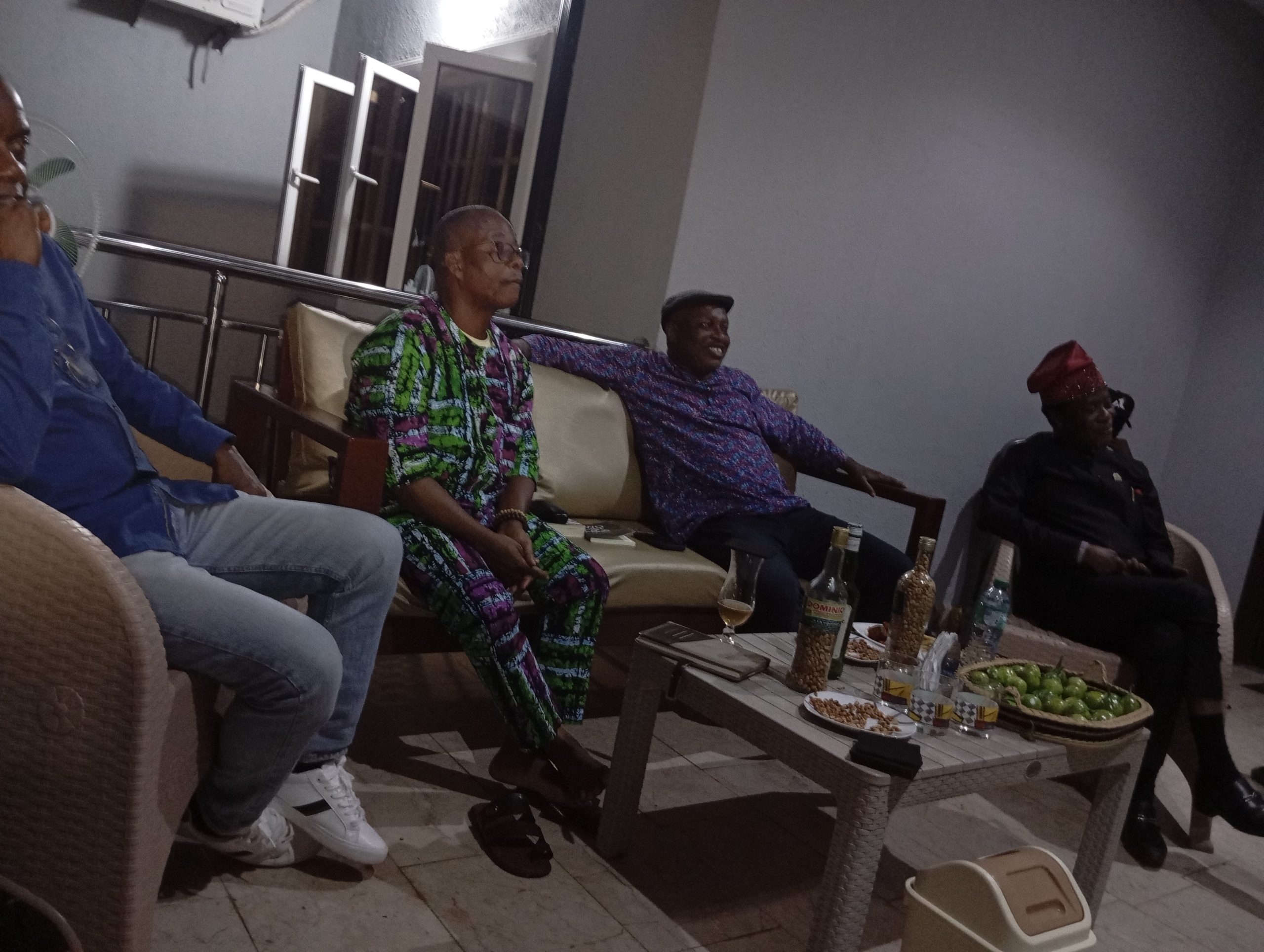
The intellectual sit – out held at Professor Ndaeyo Uko’s country home on Friday, July 25 drew flaks from the discussants who saw the framing of the war as deliberate by Igbo authors to further silence the voices of the minorities, inflict hardships and subjugate their rights and interests in the country.
The moderator of the occasion, Dr. Udeme Nana, founder of Uyo Book Club and the Father of the Book Club initiative in Akwa Ibom State described the title of Akpan’s award winning novel: New York My Village as sarcastic and paradoxical. ”The title is a contradiction,” the respected Media Scholar observed.
Nana praised Prof Akpan for writing the book to change the long held wrong perception that Igbos, not minorities, were the main war victims.
Narrating his war experience as told by his mother, he said though he was toddler, his mother told him that his father was not in the country at that time and his mother grappled through the crisis alone.
He said he lost two of his siblings, his aunty, grandfather who was taken away and shot and his grandmother who died during the war due to starvation , exhaustion as a result of long trek to escape from the frontiers of the war.
”Our village, Mbiabong Ikot Etim shares a common boundary with the Igbos and according to my mother, it was a Sunday in the month of April 1968 when Biafran soldiers invaded the village. My mother said that on cue, she gathered a few belongings and trekked to her own village to join her mother. From there, they trekked to Mbiafun Nquongo, then moved to Ndiya in the present Ikono Local Government Area. The movement continued to Use Abat in Ibiono Ibom and from there to Anua where refugees gathered. From Anua, she trekked to Ituk Mbang and then to Oron to join relatives and it was at Oron that they were ferried to Calabar,” he recollected.
Dr Nana announced that apart from the novels of Iquo DianaAbasi, Professor Joseph Ushie and Anietie Usen that got listed for the competition in the previous years, Professor Akpan’s novel is another good book that has joined the long list of books to compete for $100,000 Nigerian Natural Liquefied Gas (NNLG) literary prize in 2025.
The Author, Prof Uwem Akpan said “I wanted people to know the experiences of the minorities in the defunct Biafra during that war. Our people were part of the war, but we were written out of the war. Nobody told our own side of the story. The outside world barely knew that we existed. As far as they knew it, everyone in the Biafran enclave were Igbos.
“In the book, I also injected many cultures from various major and minority groups to avoid cultural diffusion by Western culture.”
According to the author, the colonizers had ulterior motives to grab land and control the inhabitants wherever they went ; “When the colonial masters seized and killed millions in some cities in North America, they changed names to New York, New Jersey, Ibakachi instead of Ibakesi and Gobir to Sokotó as a few examples.
“Minorities could be overrun easily. In Nigeria, the Igbos, Yorubas and Hausa/Fulanis had overrun the minorities. In US, the blacks are minority and could make little impact in most things,” he narrated.
”Ekong Udo Usoro who is the protagonist in the book recounted the experiences from his village to Lagos to obtain visa.
“Of course, Usoro was denied a visa on three occasions. When he moved to New York City, he was bitten by bed bugs in the apartment he rented. This was the first time he experience such as he was bitten in the city of New York in America! The whites even thought he brought it from the his village to the city. The experience is that the Whites usually demonise the Blacks and our people have bought into it,” he pointed out.
“Our culture is rich in Music and Literature and we have to maintain this as I have put forward in the book. When a white man accused me of using their pair of trousers and acquiring their education and asked to know what was original to me and my people, I visited my village, bought a cassette, waltzed Ekpo masquerade songs and took it them. The whites bowed to our culture. Though our culture is demonized and relegated to the background, we have to amplify it by allowing our children to speak in our dialects, our mother tongues rather than encourage them to speak English Language all the time. This will counter the negative impact of Western culture in our lives. We need cultural reorientation.”
On the Nigerian Civil war, Akpan lamented that the Nigerian forces came with 30,000 soldiers to liberate the minorities, but they later raped, tortured and killed the civilian population. When the solders were moved out, Biafran soldiers returned, killing people , called our people ‘saboteurs’, raping women and burying many alive in hurriedly dug open graves.
“Despite the atrocities visited on the minorities, many writers from major ethnic groups came out with one-sided stories. I think every community needs a writer to tell the true story of his community to avoid distortion of facts by others.”
The New York-based author lambasted the Nigerian and Biafran soldiers who forcefully conscripted children into the army, blocked food supply to his village and several communities thus forcing many to slaughter their domestic animals and turned such to “bars, restaurants and chop no reach home spree.”
Decrying the lack of mentorship in these parts, he stressed the need to wage a war against food security, insecurity, and a war against unemployment facing Nigerians. He called on all hands be on deck with a view to solving the challenges.
Mr. Anietie Usen, author of Village Boy, said it was the first time people in Etinan saw soldiers and were so fascinated to the point that many young men joined the army, while women who preferred to follow and marry Nigerian Army soldiers, later discovered that the soldiers were on the move and they couldn’t move with them to the warfront.
”By the time they returned to their village lovers, they were rejected. A song about such women mocked them to return to their soldier-boyfriends at the warfront as their local lovers and husbands had no need for them anymore.”
However, Usen recounted the trouble with Nigeria is rebellion in not adhering to structures that supports leadership.
Usen blamed the current challenges in the country’s leadership on implementation of unitary system of government by the colonial masters and successive regimes in the country calling for the practice of true federalism in the country.
The Senior Special Assistant to Governor Umo Eno on Media stated that the war was triggered by the assassination of Nigeria’s Prime Minister, Alhaji Tafawa Balewa, Alhaji Ahmadu Bello coupled with the massacre of many prominent military personnel of Northern extraction by mainly Igbo Soldiers.
According to him, the Northerners who suspected foul play in the assassination of their leaders without the any sign that the coupists would be brought to justice, went on a revenge mission, killing Major-General Aguiyi Ironsi, then Head of State and other Southerners at random.
Dr. Martin Akpan, author of Crumb Eaters and many others, spoke about the atrocities of war and the heavy toll in decimating lives and destroying properties of many in the defunct South Eastern State now Akwa Ibom and Cross River States.
Akpan who is the Chairman of the Akwa Ibom State Primary Healthcare Development Agency specifically recalled how he personally witnessed how children who suffered from kworshiokor were being emptied into a big pit near the Uyo main market where they died slowly from starvation and suffocation, because many people then thought that kwaorshiokor was contagious.
He further mentioned that soldiers often went on combing in the communities during which they killed the locals considered saboteurs as well as looted, maimed and ‘commandeered’ young women. He maintained that virtually all the houses in his community were set ablaze and razed by rampaging Biafran soldiers when they invaded Ikono-Ini villages in the wake of the war.
Akpan, who hails from Mbioku Ikot Abasi in Ikono LGA of Akwa Ibom State also recalled a story which made the rounds in those days that Ikot Ekpenyong, a village in the then Itu LGA of the State was almost completely wiped out by Biafran soldiers who accused them of sabotaging their war effort.
Mrs Ekaete Umoh, General Manager of Akwa Ibom Leadership Entrepreneurship Development Center , said though she was a child during the war period, but based on the stories by her parents the action of the soldiers portrayed genocide of the minorities.
Mr. Israel Umoh, publisher of Straightnews newspaper, narrating his experience, said he saw the war but he did not experience it due to his age at that time.
“I could recall that my father moved me and my sister on his bicycle to Inem Abasiatai now in Oruk Anam Local Government Area. Later, we settled in Ikot Okoro still in Oruk Anam. I saw many dead from kwashiorkor. I saw Nigerian soldiers prodding the village with their hefty boots.”

In his contribution, Dr. Eyo Etim, a Lecturer in the Department of English, Akwa Ibom State University weighed in on the enduring impact of wars, whether economic or political, saying that ”Wars left scars across generations and centuries. Wars must be avoided,” he said.
Later, Ndaeyo Uko, a visiting Professor in the Department of Journalism, University of Uyo, said “I have been looking for this opportunity to express my mind on the adverse side of the war. I am a child of the civil war. My father taught Physics in Lutheran High School, Obot Idim, but the war came and stalled activities of the school and the foreign assistance usually sent to the Lutheran Church.”
The Guest Reader, Uwem Akpan and the host, Ndaeyo Uko commended the Founder of the Book Club initiative in Akwa Ibom State, Dr Udeme Nana for creating a platform that has made it possible for authors and book enthusiasts to gather regularly.

In a related development, Professor Uwem Akpan also visited Abak Book Club last Saturday and was the special Guest at the July reading session of Raffia City Book Club held in the Divisional Library, Ikot Ekpene, Saturday, 26 July.
