

One of the aides to Nigeria’s Senate President, Senator Godswill Akpabio has hailed President Donald Trump’s policy that would help to curb the country’s brain drain that has remained hydra- headed for years.
The Deputy Chief of Staff to the Senate President, Dr. A. John Ukpe addressing A Letter of thanks to President Donald J. Trump, says ”History will record—perhaps not in gold, but certainly in the footnotes—that you accomplished what decades of summits, panels, retreats, roadmaps, communiqués, task forces, and PowerPoint presentations failed to achieve: you slowed Nigeria’s brain drain by making America suddenly, shockingly, and unapologetically unavailable.”
In a Facebook post, Ukpe who is a journalist notes ”For years, America was Nigeria’s national hallucination. A glittering distraction. A celestial visa shrine where most Nigerian graduates believed their destinies lay somewhere between the Statue of Liberty and Silicon Valley, preferably with a green card and dental insurance. Then you arrived—with walls in your imagination and suspicion elevated to a foreign policy doctrine—and abruptly reminded Nigerians of an ancient truth: the thing wey dey for Sokoto, dey for Sokoto.
Related News: US Travel Ban: Trump Lists Nigeria Among 39 Restricted Countries
”Before your benevolent obstruction, Nigeria exported brains the way OPEC exports crude oil—raw, unprocessed, and at giveaway prices. Every year, tens of thousands of highly trained Nigerians disappeared into the airports like raptured saints. Doctors trained at public expense reappeared in American hospitals. Engineers raised in Nigeria debugged Silicon Valley at midnight.
”Scientists groomed on Nigerian scholarships published papers under foreign flags. Nigeria became the only country on earth foolish enough to educate its brightest citizens specifically for other people’s GDP.”
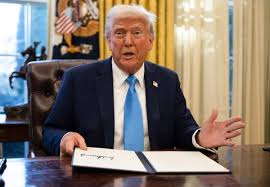
Though Trump has not directly addressed brain drain, his administration has subtly signed executive orders and policies focusing on an “America First” agenda to restrict overall immigration to the U.S, making it more difficult for Nigerians to migrate to the country.
According to him, ”Nigeria provided the eggs, America made the omelette. Nigerians are now one of the fastest-growing and most successful immigrant communities in the United States. Over 60 percent hold at least a bachelor’s degree, and nearly one-third possess graduate or professional qualifications, far above the U.S. average.
”Nigerian doctors, scientists, and engineers—people like Dr. Jacqueline Nwando Olayiwola, Dr. Wendy Okolo at NASA, and Robert Okojie, a NASA Inventors Hall of Fame inductee—are curing diseases, flying spacecraft, and inventing the future. Meanwhile, Nigeria was left holding the chalkboard and their tuition receipts.
”The cruel joke, Mr. Trump, is that many of these geniuses were first trained in Nigeria before America finished them off—politely, efficiently, and with good funding. Had even a fraction stayed home, Nigeria’s universities might rid itself of mediocrity, its hospitals might treat more than malaria, and its laboratories might discover something other than darkness during power failure. But thanks to your visa ban, Nigerians may now be forced to confront a terrifying thought: What if I actually have to make Nigeria work?
”Even better, you restored spiritual discipline. Many Nigerians, cut off from the fast lane to JFK, are now reconsidering heaven. America had become a rival promised land flowing with visas and green cards. Now, denied entry, many are rediscovering that salvation does not require biometric capture, proof of funds, or an interview with a cynical consular officer. Eternity, it turns out, has no forms and no bans on selected nationalities.”
The Pastor further states that ”This is Nigeria’s moment of truth. Fewer exit doors mean more people inside the room. The Nigerian government must seize this gold-plated, Trumpian opportunity and seize the moment: invest seriously in science, fund universities properly, modernize laboratories, reward innovation, and make staying home less of an act of martyrdom and more of a rational career choice. Mercifully, Parliament did not have to pass a law banning brain drain and triggering nationwide riots. Providence simply outsourced the job to you. God, as the ancients told us, works in mysterious ways.
Mr. Trump, you are indeed a gate in God’s hands. History is full of accidental heroes, and you may yet be remembered as the man who helped Nigeria discover itself by refusing Nigerians entry.
Thank you for reminding us that the future we seek abroad is the one we must finally build at home.”
Trump administration added Nigeria to a list of countries whose citizens faced specific restrictions or limitations on entry into the U.S. in 2020 due to non-compliance with identity management and information-sharing criteria.
Trump also signed an executive order to suspend Foreign funds for 90 days, with a potential for a longer pause. This affected numerous U.S.-funded programs in Nigeria, including health and development initiatives, leading to job losses and program disruptions within Nigeria.
Moreover, Trump pursued a general broader immigration crackdown on both legal and illegal immigration, including plans for mass deportations and a re-evaluation of the legal immigration system. These measures affected Nigerian citizens residing in the U.S., particularly the undocumented.
Lastly, Trump administration introduced additional fees for certain types of visas (e.g., H-1B high-skilled visas) and toughened the citizenship test, creating more barriers to entry and permanent residency.
Over 8,000 Nigerian-trained doctors currently practice in the UK, and the Association of Nigerian Physicians in the Americas has over 4,000 members.
Another survey further shows that about 7,000 nurses left Nigeria in the first nine months of 2021 alone, while around 1,300 medical consultants left the country in the last five years, leaving only about 6,000 in the country as of early 2024.
Also, lecturers are among the most affected by poor salaries and conditions of service, leading to a significant loss of human capital in education, and a survey shows that over half (52%) of highly skilled Nigerian professionals moved abroad as of May 2023.
