

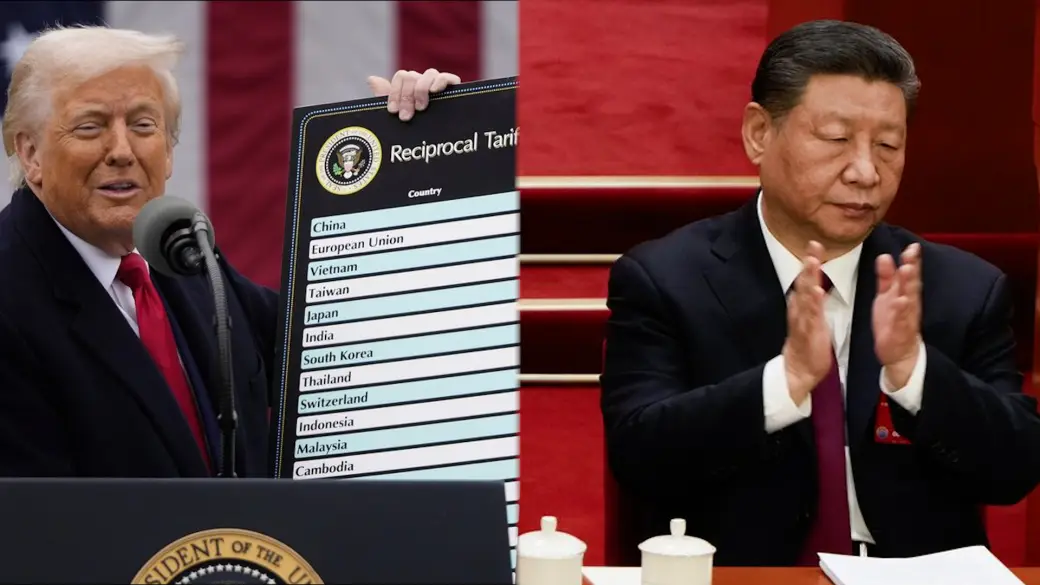
The World Trade Organization says the US-China tariff war could reduce trade in goods between the two economic giants by 80 percent, pulling down the rest of the world economy.
This is as U.S. President Donald Trump raised tariffs on China to 125 percent on Wednesday as the world’s two largest economies fought over retaliatory levies.
“The escalating trade tensions between the United States and China pose a significant risk of a sharp contraction in bilateral trade. Our preliminary projections suggest that merchandise trade between these two economies could decrease by as much as 80 percent,” WTO director general Ngozi Okonjo-Iweala said in a statement.
She said the United States and China accounted for three percent of world trade and warned that the conflict could “severely damage the global economic outlook”.
Even as he slapped further tariffs on China, Trump paused higher tariffs on the rest of the world for 90 days after dozens of countries reached out for negotiations.
Okonjo-Iweala warned that the world economy risked breaking into two blocs, one centred around the United States and the other China.
“Of particular concern is the potential fragmentation of global trade along geopolitical lines. A division of the global economy into two blocs could lead to a long-term reduction in global real GDP by nearly seven percent,” she said.
She urged all WTO members “to address this challenge through cooperation and dialogue”.
“It is critical for the global community to work together to preserve the openness of the international trading system,” said Okonjo-Iweala. “WTO members have agency to protect the open, rules-based trading system. The WTO serves as a vital platform for dialogue. Resolving these issues within a cooperative framework is essential.”
Hours earlier, Trump ramped up duties on Chinese goods to 104 percent, only to hike them further when China retaliated by raising tariffs on US imports to 84 percent.
In a social media post announcing the moves, Trump said China had been singled out for special treatment because of “the lack of respect that China has shown to the World’s Markets”.
US stock markets had slumped around 10 percent in the past week as trade tensions grew, but they surged after Trump announced his pause.
EU Pauses reciprocal tariffs against US
Consequently, the European Union has announced a 90-day pause on countermeasures against the United States, a day after President Donald Trump unveiled a similar pause on his “reciprocal” tariffs.
“We want to give negotiations a chance,” said European Commission President Ursula von der Leyen.
This move comes after the EU initially declared it would begin collecting higher duties on US imports, retaliating against the steel and aluminium tariffs announced by Trump in March.
Von der Leyen emphasized that the EU’s pause is not indefinite. “If negotiations are not satisfactory, our countermeasures will kick in,” she warned.
The bloc of 27 countries has been hit by three waves of US tariffs: 25% on steel and aluminium exports, 25% on car exports, and 20% reciprocal tariffs on other goods.
While Trump paused the reciprocal tariffs, he maintained that the industry-specific levies and a 10% flat-rate minimum tariff on all nations would remain.
Although Trump’s abrupt reversal brought temporary relief in Europe, analysts and investors remain wary. The unpredictable, stop-start nature of US trade policy under Trump could deter investment and slow global economic growth.
“Clear, predictable conditions are essential for trade and supply chains to function,” von der Leyen said in a separate statement.
Despite the pause, European Commission industrial strategy chief Stéphane Séjourné advised EU companies to stay “calm and cautious.”
He added, “The only certainty is that instability will remain for the next four years.”
While the EU maintains its commitment to constructive negotiations with the US, it is also working to diversify trade relationships, focusing on partnerships that account for 87% of global trade, according to von der Leyen.
Olaf Gill, a spokesperson for the European Commission on trade matters, said the bloc had “pressed the pause button to allow space for negotiations” and to consult with member states on the best path forward.
Since returning to the White House in January, Trump has taken a harsher tone toward the EU, stating the bloc was created to “screw” the US.
“They rip us off,” he said last week while announcing the sweeping tariffs. “It’s so sad to see. It’s pathetic.”
Trump also criticized the EU’s value-added tax—a 15% standard levy on most goods and services—as an “unfair” trade practice. He claimed, using a crude and widely disputed methodology, that the EU effectively imposes a 39% tariff on US products. However, the European Commission notes that the actual average tariff rate on goods between both sides is around 1%.
