

Features Article
By Israel Umoh
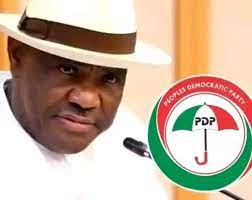
In the dramatic theatre of Nigerian politics, few figures embody contradiction as openly as Nyesom Wike, the former governor of Rivers State and current Minister of the Federal Capital Territory (FCT). Since his surprising emergence as a cabinet appointee in President Bola Ahmed Tinubu’s All Progressives Congress (APC) government — despite being a card-carrying member of the opposition Peoples Democratic Party (PDP) — Wike has danced on a tightrope stretched precariously between loyalty and ambition, principle and pragmatism.
Since his presidential trial in PDP and subsequent exit from Government House, Port Harcourt, Wike tunred to a political hustler- ‘no vacancy’ in staying without power thrust. Hence, he jump shipped into APC pot as a Minister to maintain his relevance in the power lever of the country.
Wike’s political odyssey is not short on spectacle. Brash, forceful, and unrepentantly populist, he ruled Rivers State with an iron grip, projecting himself as a defender of southern interests and a bulwark against APC’s perceived overreach. But in the build-up to the 2023 general elections, Wike’s relationship with his own party curdled. Disenchanted with PDP’s presidential ticket going to Atiku Abubakar — a fellow northerner following Buhari’s eight-year reign — Wike led the self-styled G5 Governors in an internal rebellion, demanding zoning equity and rotational justice.
You may also read:
- Audacious Nyesom Wike
- I Will withdraw if PDP Zones Presidency to North- Gov Wike
- Wike, Umahi exchange verbal attacks over Court sack claim
When Atiku Abubakar refused to cede the ticket or negotiate meaningful compromise to a Southerner, Wike turned tacitly — and later explicitly — toward Tinubu, then the APC candidate. Campaigning against his own party’s flagbearer, Wike became a political free agent, a wildcard in a game whose stakes were national power.
By August 2023, he was sworn in as Minister of the FCT in Tinubu’s cabinet, breaking long-standing party lines and flouting the fundamental opposition-versus-government binary in Nigerian politics.
Yet, publicly and on record, Wike insists he remains a member of the PDP.
He appears to be inspired by Janus, the Roman god with two faces, but in human depicting traits of honesty and deception. This duality — his “body” in the APC-led federal government, his “soul” still (ostensibly) with the PDP — has left Nigerians and analysts alike scratching their heads. How does a man serve in the ruling party’s government while belonging to, and previously leading, the principal opposition? How does the PDP reconcile Wike’s federal patronage with its ideological contestation of the same government?
To many, Wike represents the erosion of party discipline and the hollowing out of political ideology in Nigeria. His continued identification with the PDP, despite serving in the APC government, underscores the permeability and transactional nature of political platforms in Nigeria. The question isn’t merely whether Wike is loyal, but whether loyalty — to party, to people, or to principle — still holds currency in a landscape increasingly dominated by power-seeking chameleons.
This is not new in Nigerian politics, where political defection is often treated like seasonal migration. But Wike’s case is unique in that he did not formally defect. He inhabits both political realities simultaneously — a minister in APC, a power broker in PDP — straddling two horses galloping in opposite directions.
Wike’s ongoing influence within the PDP — particularly in Rivers, where his political machinery remains intact — poses existential questions for the party. Why has he not been expelled or sanctioned? What does it say about the internal coherence of the PDP that one of its most prominent members publicly fraternizes with and works for the government it claims to oppose?
The answer may lie in fear, or pragmatism. Wike remains a formidable political force, with access to federal power, vast financial networks, and a grassroots following. For a fractured PDP, already weakened by serial defections, infighting, and electoral defeats, alienating Wike might be seen as political suicide — even if tolerating him signals moral and ideological bankruptcy.
But silence, too, is a form of complicity. By allowing Wike’s duality to persist unchecked, the PDP may be conceding the collapse of party identity, and by extension, the credibility of its role as a counterweight to APC dominance.
Indeed, Wike is muddying the waters of opposition politics. Samuel Anyanwu, the PDP National Secretary, has also played his part in what many critics call an orchestrated implosion of the party. His controversial candidacy in the recent Imo State governorship election—while still holding the national office meant to serve as a neutral backbone of the party—further exposed the cracks in PDP’s fragile edifice.
Together, Wike and Anyanwu illustrate a sobering truth: that PDP, once Nigeria’s dominant political force, is now in danger of becoming a shadow of itself—hijacked by ambition, bereft of unity, and increasingly indistinguishable from the power it claims to oppose.
Nowhere is this contradiction more violently playing out than in Rivers State, where Wike’s succession politics has plunged the state into a crisis. His handpicked successor, Governor Siminalayi Fubara, has increasingly resisted Wike’s control, leading to political brinkmanship, a near-impeachment, and a power tussle that almost destabilised the state following the appointment of Vice Admiral Ibok-Ete Ibas as the Sole Administrator of the state for six months.
This implosion is emblematic of the wider contradiction Wike embodies. His attempt to remain both kingmaker and minister, both PDP and APC, has created vacuums of legitimacy. The confusion over which political script he is reading from has blurred governance lines and ignited factionalism — not just in Rivers, but within both major parties.
In the end, Wike’s political duplicity is not merely a personal drama. It is a reflection of Nigeria’s broader democratic malaise — where politics is stripped of ideology, parties are vehicles for self-interest, and public office is a negotiation between godfathers, not voters.
Enter his trap, he tears like a lion preying on its victim- bad mouthing his opponent, disemboweling the opposition and excoriating the skin with skinny bones stalking out- that the victim looks wasted and useless.
That Wike can occupy a strategic seat in an APC government while insisting he remains PDP, and face no institutional consequences, speaks volumes about the weak regulatory and moral framework of Nigeria’s democracy. It tells young voters that party affiliation is meaningless, loyalty is expendable, and principle is an afterthought.
Yet, perhaps most tragically, it reduces governance to theatre — full of noise, colour, and charisma, but void of substance.
As Nigerians struggle with economic hardship, insecurity, and institutional decay, the spectacle of Wike’s dual loyalty feels like a cruel joke. It suggests that even at the highest levels of power, the rules are flexible, the boundaries are negotiable, and the only real ideology is expediency.
In the coming months, Wike may well have to choose between his heart and his hand — between remaining a nominal PDP stalwart or fully embracing the APC establishment he now serves. Until then, he remains a man suspended between two parties, two loyalties, and two futures — none of which seem particularly invested in the public good.
