
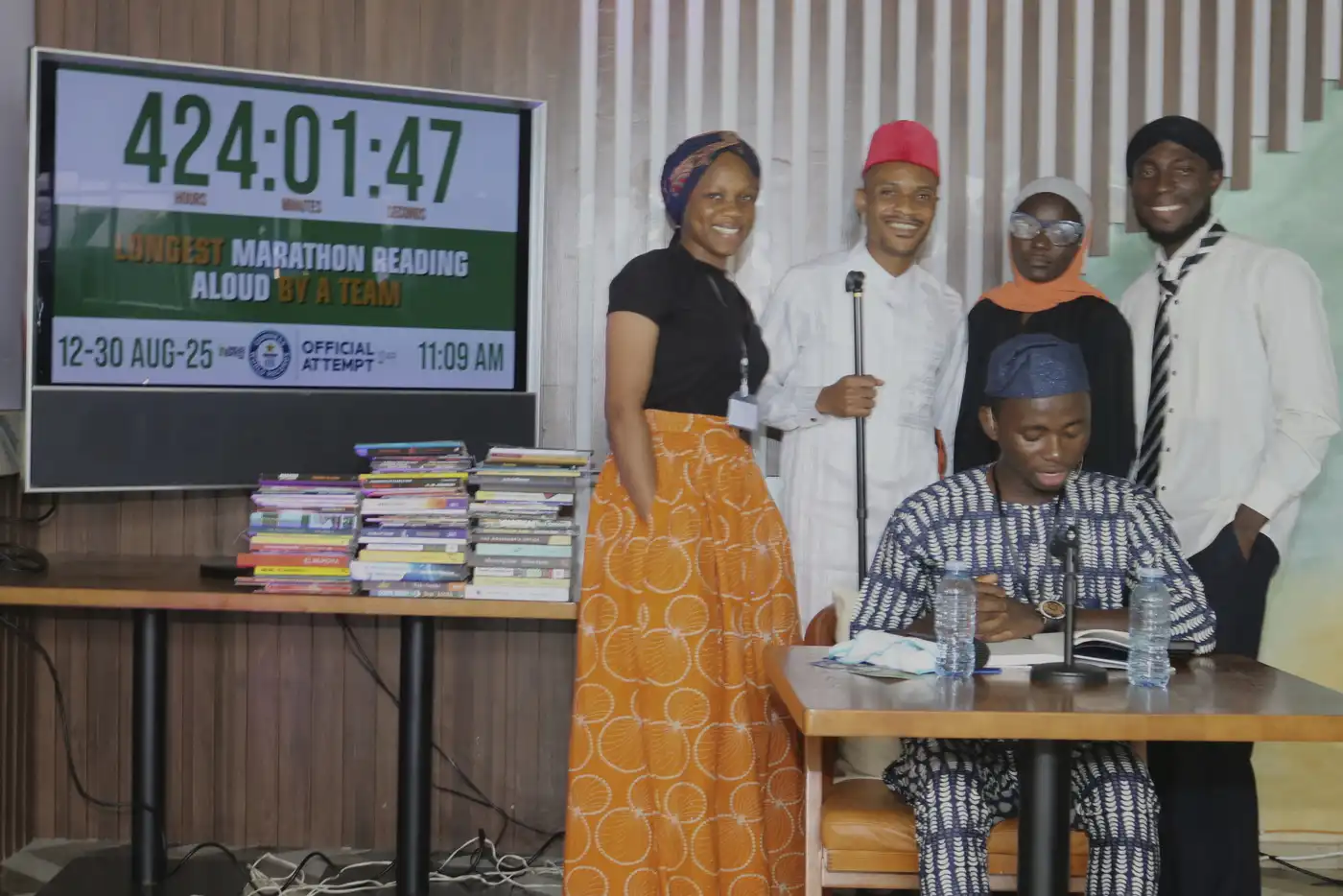
An Akwa Ibom native, John Obot and four other Nigerians attempted a 431-hour reading marathon for 18 days to set new Guinness World Record.
The triumph was also achieved by Keturah Heman (Gombe), Stephen Oyelami (Osun), Preciouslight Ukachi (Imo), and Ogunremi Temitope (Kogi).
Held in a restaurant in Nigeria’s Lagos, the books’ reading was held for over 431 hours in an attempt to set a Guinness World Record for the longest marathon of reading aloud, part of a campaign to promote literacy in Africa’s most populous country.
The current record holders for the longest reading aloud marathon are a group of five people from the Dominican Republic, who clocked 365 hours and 39 seconds in 2011.
Also read:
- Engineer breaks Guinness World Records in Mathematics in Akwa Ibom
- Guinness World Records attempter attracts rain of curses
- Read-a-thon: Nigerian set to break new Guinness World Records
This time in Nigeria, the last word was uttered when the timer showed: 431 hours, 31 minutes and 25 seconds.
By Saturday, August 30, 2025 when the attempt ended, the reading marathoners had read 79 books authored by Nigerians, taking turns to continuously read out loud literary works and self-help books to give the other team members a chance to catch their breath.
This was against the Longest Marathon Reading Aloud by an Individual, held by Samson Ajao of Osun State, making Nigeria the only country in the world currently holding both reading records simultaneously.
Throughout the daunting task, dozens joined the group, some online via a live stream, cheering them.
‘‘In the country of more than 210 million people, most people don’t have access to books (and) I participated to encourage inclusive education,” Precious Ukachi told The Associated Press.
The 30-year-old was one of the reading marathoners. Others were John Obot, 37, Stephen Oyelami, 23, Temitope Ogunremi, 28, and Ketura Heman, 27.
Obot said the hardest part of the attempt was reading at night. “We had limited time to rest, but what kept me going was the goal.”
“We did this to celebrate Nigerian literature,” said Kingsley Sintim of the Naija ReadFest.
Oyelami, one of the reading marathoners, said: “It was difficult to get books because of the kind of environment I grew up in.” He attended a public school where new books and education tours were mostly out of reach.
The nonprofit said the event aimed at highlighting books by local authors to young and old alike. The books the group read also covered issues like migration and finance — both major concerns for the West African country.
Besides having one of the world’s highest numbers of children out of school, with more than 10 million affected, Nigeria also has a literacy rate of around 63 percent in 2021, which advocates say has barely improved in recent years.
A major challenge has been the poor investment and policies in the education sector, Irene Okon, executive director of Lead-Out nonprofit that seeks to improve learning in public and low-income schools, told the AP.
The poor investment in literacy in Nigeria has made things more difficult for writers, said Carol Yaakugh, an Abuja-based author.
“While we have numerous tech startups addressing finance, health, and other areas, the literacy space remains underdeveloped,” Yaakugh said.
The Guinness World Record is yet to confirm the new record, a process that takes weeks. The non-profit behind the event, the Naija ReadFest, says it will forward all evidence needed to the organization.
