

Akakan Umoh
South African Deputy Minister of Cooperative Governance and Traditional Affairs, Reverend Prince Zolile Burns-Ncamashe, has strongly condemned the destruction that unfolded during Monday’s protests.
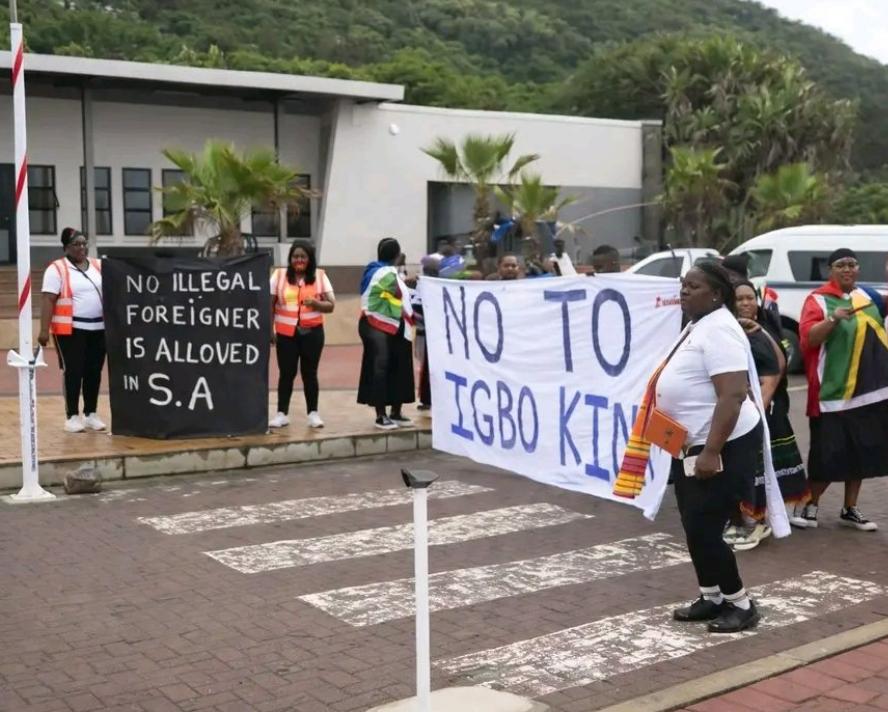
Violence erupted in KuGompo, Eastern Cape, South Africa, as protests over alleged coronation of an Igbo traditional leader escalated into violence, property destruction, and looting.
Burns-Ncamashe made it clear that violence is not the answer.
He urged communities to exercise restraint while government works through the matter using proper diplomatic channels.
Media reports indicate that the protest was organised by one of South Africa’s political parties called ActionSA alongside traditional leaders and residents against claims that a Nigerian man, Solomon Eziko, had been crowned as a traditional leader of the Igbo community in the province.
They claimed that the crowning violated South Africa’s constitutional and traditional governance systems.
According to SABC News, ActionSA’s Eastern Cape chairman, Athol Trollip, said the party stood firmly with recognised traditional authorities, insisting that due process must be followed in matters of cultural and traditional governance.
The protesters reportedly destroyed vehicles and vandalised buildings believed to be owned by foreign nationals, as they marched through affected areas demanding urgent government intervention and warned that inaction could trigger wider unrest.
Some participants issued threats of armed resistance, while others called for the deportation of Nigerians allegedly linked to the incident.
Videos circulating online showed protesters smashing vehicle windscreens and damaging property, prompting criticism from residents who questioned the justification for the destruction.
The Economic Freedom Fighters (EFF) emphasised that only South Africa’s Department of Cooperative Governance and Traditional Affairs (COGTA), through a process involving presidential approval under the Traditional and Khoi-San Leadership Act of 2019, has the authority to recognise kings or queens.
The party described any self-declared coronation, particularly by a foreign national as both unlawful and provocative, while also calling for those responsible for the violence to be held accountable.
“It is not to be taken lightly, nor should it be declared by individuals without any legal authority. Coronation of a foreign king in the Eastern Cape, this irresponsible act has led to a rightful and justified outcry by the people of KuGompo, the Eastern Cape, and South Africa at large,” the group said.
However, the Nigerian High Commission in Pretoria issued an advisory on Monday evening, urging Nigerians in South Africa to remain cautious and vigilant.
The advisory urged Nigerians to maintain a low profile, avoid large gatherings, limit unnecessary travel, and be mindful of their social media activities, warning that misinformation could escalate tensions.
It emphasised the importance of unity, caution, and adherence to local laws, noting that while South Africa offers significant opportunities, safety must remain a priority amid rising tensions.
The High Commission stressed that the advisory was not meant to cause panic but to encourage responsible behaviour and prevent avoidable risks during the period of uncertainty.
This is the second time Igbo kingship coronation causing crises outside Nigeria in recent times.
Recall that the “Nigerians must go” protest in Ghana was triggered by the installation of a Nigerian traditional leader, Eze Chukwudi Ihenetu, as the “Eze Ndi Igbo Ghana” King of the Igbo People in Julu last year.
Ghanaian youth groups and cultural advocates opposed the installation, saying that the presence of a foreign monarch undermined Ghana’s sovereignty and traditional chieftaincy institutions.
The title ‘Eze Ndi Igbo’ is widely recognised within Igbo Diaspora communities as a symbolic representation of cultural leadership.
The protesters urged the Ministry of Chieftaincy and Religious Affairs to intervene and clarify whether Ghanaian law allowed foreigners to assume royal titles within the country.
