

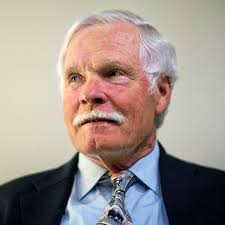
A family spokesman confirmed that Turner died on Wednesday at his home near Tallahassee.
A statement by CNN CEO and Chairman, Mark Thompson, described Turner as a committed leader.
“Ted was an intensely involved and committed leader, intrepid, fearless and always willing to back a hunch and trust his own judgement.
Also read
- Influential US Secretary of State Dies
- Queen Elizabeth Fazed By Death Of Singer, We’ll Meet Again
- Larry King, Veteran Broadcaster, Dies Of COVID-19
“He was and always will be the presiding spirit of CNN. Ted is the giant on whose shoulders we stand, and we will all take a moment today to recognize him and his impact on our lives and the world,” Thompson said.
The mustached southerner, yachting enthusiast and philanthropist, whose empire also included sports clubs, had been suffering from the degenerative disease Lewy Body Dementia.
Turner’s most enduring legacy was the creation of Cable News Network in 1980, which revolutionised television journalism by introducing round-the-clock news coverage.
The model reshaped how audiences consumed information and set a standard later adopted across the global media industry. He subsequently expanded the network into CNN Headline News and CNN International, extending its reach worldwide.
His influence stretched far beyond the news. Turner built a portfolio of cable channels, including TBS and TNT, and later launched Turner Classic Movies following his acquisition of the MGM film library in 1985.
A similar strategy underpinned the creation of Cartoon Network in 1992 after he purchased the Hanna-Barbera catalogue.
In 1996, he merged Turner Broadcasting System with Time Warner, forming one of the largest media corporations of its time.
An entrepreneur known for bold and often risky decisions, Turner frequently pushed the boundaries of the industry, at times coming close to financial collapse before rebounding. He also ventured into sports, captaining the winning yacht in the America’s Cup and owning the Atlanta Braves, which he helped popularise through national television broadcasts.
Turner’s personality was as prominent as his business achievements. Nicknamed the “Mouth of the South” for his outspoken style, he was known for grand ambition.
“I’m trying to set the all-time record for achievement by one person in one lifetime,” he once said.
Even rivals acknowledged his impact; media magnate Rupert Murdoch described him as one of the most influential figures in modern media.
His interests extended into philanthropy and conservation. Turner donated $1bn to the United Nations and became one of the largest private landowners in the United States, setting aside vast tracts for environmental preservation.
His personal life, however, was often turbulent, marked by high-profile relationships, including his marriage to Jane Fonda, and a reputation for controversial remarks and unpredictable behaviour.
His political views were similarly complex, spanning conservative affiliations while maintaining relationships with figures such as Fidel Castro.
Born in Cincinnati, Ohio in November 1938, Robert Edward “Ted” Turner III went to a military boarding school in Tennessee, and then attended Brown University, but was expelled before graduating.
Turner took over a faltering family advertising business after his father, despondent over financial problems, committed suicide.
After buying a number of radio stations, Turner’s purchase of a struggling Atlanta station in 1970 was his first move into television.
CNN’s success inspired the creation of other 24-hour news channels including Fox News by longtime Turner rival Rupert Murdoch, MSNBC and countless networks worldwide.
Turner’s television empire expanded beyond CNN and included TBS and TNT channels for sports and entertainment, Turner Classic Movies and Cartoon Network, among others.
