

Edi Umoh
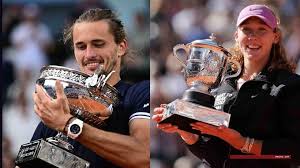
Mirra Andreeva and Alexander Zverev each won their first career Grand Slams at a French Open filled with unexpected twists and turns.
Alexander Zverev beat Flavio Cobolli 6-1, 4-6, 6-4, 6-7 (5), 6-1 on Sunday in the French Open final to win his first major title.
He is the first player outside of an elite cohort of Jannik Sinner, Carlos Alcaraz and the former Big Three-including Novak Djokovic and Rafael Nadal- to win a Grand Slam since Daniil Medvedev won the 2021 U.S. Open.
In the women’s final on Saturday, Mirra Andreeva defeated Maja Chwalińska 6-3, 6-2 to win the biggest title of her career.
Also read: US Open: Alcaraz, Sabalenka Reclaim No. 1 Ranking
The 19-year-old is the third-youngest Grand Slam women’s champion of the 21st Century and the youngest at Roland Garros since Monica Seles in 1992.
Andreeva was dominant throughout her championship run, dropping only one set in her seven matches.
Both singles winners in Paris took home $3.3 million. (The French Open typically pays out the third-most prize money of the four majors).
At the end of the 15 days of play, the man with the second-best odds to win the tournament and the woman with the fifth-best odds to win lifted their respective trophies.
Those final outcomes, however, mask just how wild this 2026 French Open was. Let’s review some of the chaos.
Sinner’s Early Exit
Sinner entered the tournament with -275 odds to win it all, implying a roughly 70% chance of his hoisting the trophy. That made him the second heaviest favorite ever at a Grand Slam on record, which seemed justified—he was riding a 29-match win streak into the event.
Since the start of 2024, Sinner was 164-7 in matches that weren’t against his rival Carlos Alcaraz, who didn’t play at Roland Garros due to injury.
Sinner’s French Open was initially going to plan, as he was a game away from ending his second-round match against Juan Manuel Cerúndolo in straight sets.
But he suddenly suffered from cramping and heat exhaustion, and eventually lost in five sets, blowing open the draw for a number of other contenders, including Zverev.
Ironically, the only player ever with stronger odds to win a major, Rafael Nadal at Roland Garros in 2009 (-400), was also upset early in the tournament, losing to Robin Soderling in the fourth round.
Even though men’s tennis has felt awfully predictable over the past two decades, fans always must be on their toes, because anything can happen.
Chwalińksa’s Finals Run
Given her 500-to-1 odds to win the tournament coming in, it wouldn’t be hyperbole to call Chwalińska the most unlikely Grand Slam finalist of this generation.
The 24-year-old Pole drew comparisons to Emma Raducanu, who won the 2021 U.S. Open as a qualifier, with 100-1 odds to win the title at the start.
Chwalińska had won just $864,000 in prize money over her entire pro career, which began back in the 2010s, meaning she roughly tripled her career earnings with the Roland Garros runner’s up prize of $1.6 million.
There were plenty of upsets on the women’s side—Marta Kostyuk took down four-time Roland Garros champion Iga Świątek in the fourth round, and Diana Shnaider sent No. 1 seed Aryna Sabalenka home before the semifinals of a major for just the second time in four years.
The bracket opened up for Chwalińska, who didn’t have to face a top 20 seed until the final.
Reuters
