

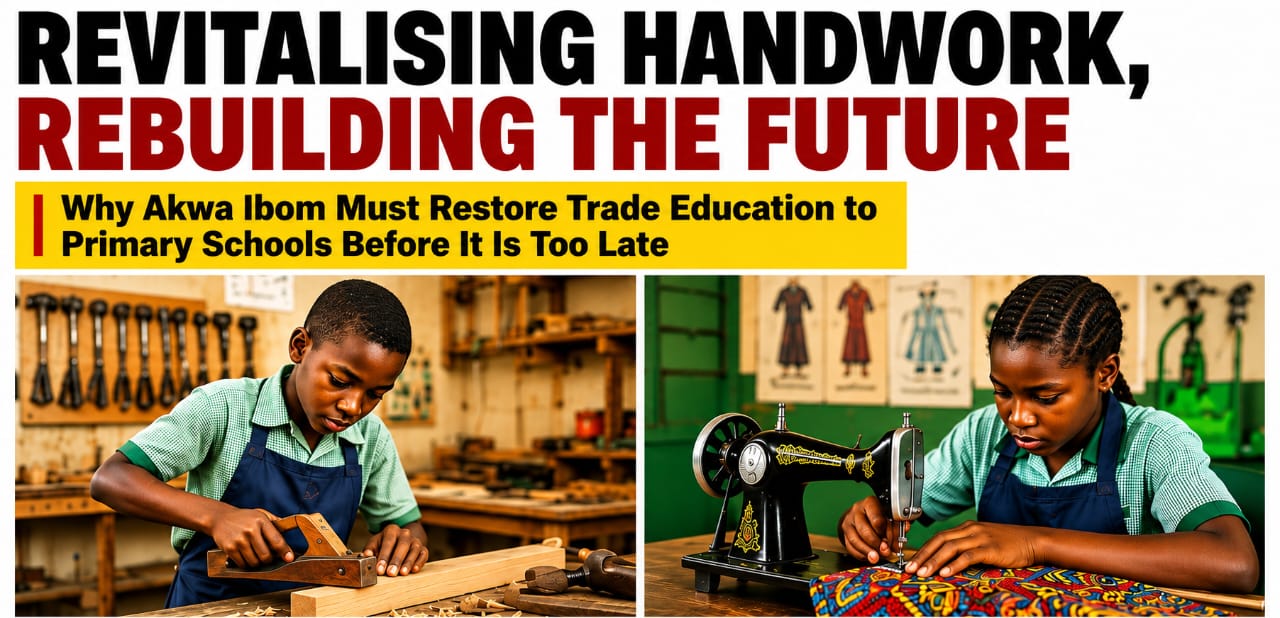
…Restore Trade Education to Primary Schools
Prince Ukpong Idiong Jr
A society that neglects practical education gradually weakens its capacity for innovation, industrialisation, and self-reliance. As Akwa Ibom State continues to invest in human capital development, restoring trade education at the Primary/Secondary school level should become a strategic priority rather than an afterthought.
There was a time when handwork occupied a respected place within Nigeria’s Primary /Secondary education curriculum. Children learned practical skills that complemented classroom instruction and nurtured creativity, discipline, and self-confidence. Today, that culture has largely disappeared, leaving many young learners with limited opportunities to discover and develop their natural talents.
Education must go beyond producing certificate holders. It must produce problem-solvers, innovators, entrepreneurs, technicians, and skilled craftsmen capable of contributing meaningfully to economic development. This is why Akwa Ibom State should urgently review its primary/Secondary basic education curriculum to restore trade education as a vital component of learning.
Also read
- Heavens Overflow: The Rising Cost of Heavy Rainfall in Akwa Ibom
- Beyond Political Rhetoric: Recalibrating Akwa Ibom’s Development Architecture
- Economic Emergency: Why Akwa Ibom Must Import Opportunities, Not Export Talents
The growing number of graduates entering Nigeria’s labour market reminds us that academic qualifications alone cannot absorb the country’s expanding workforce. The recent Call to Bar ceremony in Abuja produced thousands of new lawyers. While this reflects academic achievement, it also raises a critical question: who will become the skilled technicians, electricians, mechanics, carpenters, fabricators, and innovators needed to sustain a productive economy?
The experience of technicians displaced from Ibom Plaza following its renovation further highlights the importance of vocational occupations. Many skilled artisans continue to struggle because they lack affordable workspaces and structured support. Their situation demonstrates that technical skills remain indispensable and deserve stronger institutional backing.
Across rural communities in Akwa Ibom, countless children display exceptional creativity by building simple machines, designing household tools, producing artworks, and experimenting with local materials. Sadly, many of these abilities fade away because there is no organised mechanism for identifying and nurturing such talents from an early age.
Government should establish talent identification units within every Local Government Area to discover gifted children in primary schools and connect them with mentorship opportunities. These young innovators can subsequently benefit from specialised training through the existing Dakkada Skills Acquisition Centres, creating a seamless pathway from talent discovery to professional development.
Akwa Ibom has already demonstrated commitment to youth empowerment through several skill acquisition initiatives. However, implementation remains the decisive factor. Policies achieve little without effective execution, proper funding, qualified instructors, and continuous monitoring.
The world’s fastest-growing economies offer valuable lessons. Asian countries invested heavily in technical education long before they became manufacturing and technology leaders. Their schools encouraged practical learning, innovation, experimentation, and craftsmanship alongside conventional academic subjects.
The transformation of Asian manufacturing illustrates what is possible when practical education receives sustained attention. Automobile manufacturers such as Hyundai and Kia evolved into globally respected brands because their countries consistently invested in technical knowledge, research, and industrial skills. Their success was built in classrooms long before it appeared in factories.
Akwa Ibom possesses the human potential to replicate similar success. What is required is a deliberate educational policy that values practical intelligence as highly as academic excellence. Children gifted with their hands should receive equal encouragement as those gifted in science, law, medicine, or the humanities.
The Ministry of Education and the State Universal Basic Education Board should therefore reintroduce structured handwork into primary/Secondary schools, provide practical learning materials, establish simple workshops, and train teachers capable of nurturing creativity among young learners.
Parents also have a responsibility to appreciate that every child has unique strengths. Success should not be measured solely by white-collar professions. Skilled artisans, inventors, engineers, and entrepreneurs are equally important in building a prosperous society.
Revitalising trade education is not merely an educational reform. It is an investment in employment, innovation, industrialisation, poverty reduction, and sustainable development. The future prosperity of Akwa Ibom depends not only on what children learn from textbooks but also on what they are empowered to create with their own hands.
The time to restore handwork is now.
“Every child may not become a lawyer or a doctor, but every child possesses a talent that, when properly nurtured, can build industries, create employment, and transform society.”
“The classroom should not only produce job seekers it should produce innovators, inventors, craftsmen, and employers of labour.” ~anonymous
Reviving trade education at the primary school level is not a backward step, it is a forward-looking investment in Akwa Ibom’s economic future. A balanced education system that combines academic excellence with practical skills will produce a generation equipped to compete, innovate, and lead in the twenty-first century.
Prince Idiong Jr, Public Affairs Analyst, Based in Abuja, Nigeria
