

…Oil wealth without industrial growth is a promise unfulfilled
Prince Ukpong Idiong Jr.
Akwa Ibom has every reason to be an economic powerhouse. It is one of Nigeria’s highest crude oil-producing states, blessed with abundant natural resources, a strategic coastal location, a peaceful business environment, and one of the most educated populations in the country.
Despite these undeniable advantages, one uncomfortable truth remains: the state is not attracting enough large-scale industries, multinational companies, or manufacturing investments to match its economic potential.
This is no longer a political argument. It is an economic emergency. A simple comparison with Rivers and Delta States reveals a worrying reality. Those states continue to host a broader network of multinational corporations, servicing companies, fabrication yards, logistics firms, marine businesses, and manufacturing industries that generate thousands of jobs. In contrast, outside the operations of Seplat Energy and a handful of related firms that emerged following the transition from ExxonMobil, Akwa Ibom’s industrial landscape remains far below what its status as a major oil-producing state should command.
Also read
- Development Commissions, Economy and National Question
- Nigerian Economy Slips Into Further Recession- NBS
- Nigeria’s Economy’ll Take New Turn When Ibom Deep Seaport Comes On, Says Udom
The obvious question is this, what exactly is driving investors elsewhere?.
Is it government policy? Is it bureaucracy?
Is it the absence of a long-term industrial master plan?
Is it inadequate investment incentives?
Or, has Akwa Ibom simply failed to market itself aggressively as the preferred destination for local and foreign investors?
These questions deserve sincere answers, not partisan slogans.
Every year, universities, polytechnics, colleges of education, and professional institutions produce thousands of graduates from Akwa Ibom. The recent Call to Bar ceremony in Abuja once again showcased hundreds of brilliant young lawyers from the state joining the legal profession.
Their achievements deserve celebration. But celebration alone cannot replace employment.
One must ask: after the applause dies down, where will these young professionals work? Will they spend years pursuing scarce opportunities or remain trapped in an economy that cannot fully absorb their talents?
The recent teachers’ recruitment exercise exposed this challenge in stark terms. Tens of thousands of qualified applicants competed for only a limited number of positions. That single exercise reflected the silent unemployment crisis facing many young people across the state.
This should alarm policymakers. Government cannot continue to be the largest employer indefinitely. Sustainable prosperity comes when private investment flourishes and industries create employment at scale. The public sector alone cannot carry the burden.
The Dakkada Skills Acquisition Programme is one initiative that has equipped many young people with practical skills. However, skills without opportunities eventually become wasted potential. Training is only the first step. The real measure of success is whether graduates secure jobs, establish viable businesses, or contribute meaningfully to productive industries.
The same concern applies to beneficiaries of overseas technical training sponsored by government. Sending young people to China and other countries to acquire specialized knowledge is commendable. But returning them to an economy with limited industrial capacity undermines the very purpose of that investment.
Knowledge must meet opportunity. Unfortunately, what Akwa Ibom appears to be producing in abundance are certificates without corresponding industries. The result is predictable: migration, frustration, underemployment, and an increasing dependence on government recruitment exercises.
Another noticeable trend is the rapid increase in hotel development across the state. While hospitality contributes to tourism and economic activity, it cannot become the foundation of a modern economy. Hotels create jobs, but they cannot replace factories. Entertainment initiatives and leisure programmes stimulate commerce, but they cannot substitute for industrial production.
An economy driven mainly by consumption will always struggle. An economy driven by production creates wealth.
The state must now shift its development priorities toward industrialization. Petrochemical industries, Agro-processing plants, pharmaceutical manufacturing, marine services, renewable energy companies, technology parks, fabrication facilities, logistics hubs, and export-oriented industries should become central pillars of economic planning.
This is where real transformation begins. Akwa Ibom already possesses many of the ingredients investors seek: natural resources, an international airport, access to the Atlantic coastline, expanding infrastructure, skilled manpower, and relative peace. These are competitive advantages that should be aggressively leveraged.
However, infrastructure alone does not attract investors. Predictable policies, efficient institutions, ease of doing business, transparent regulations, reliable power, and investor confidence matter just as much.
Government must therefore move beyond commissioning projects and begin aggressively courting industries capable of employing thousands of citizens. Investment promotion should become as important as infrastructure development.
The private sector must also rise to the occasion. Indigenous entrepreneurs should be encouraged to invest beyond commerce into manufacturing, agriculture, technology, and value-added production. Banks and development finance institutions should support businesses willing to establish industries that create long-term employment.
Educational institutions must equally align their curricula with the realities of a changing global economy. Producing graduates without connecting them to industry weakens both education and economic development.
Ultimately, the future of Akwa Ibom will not be determined by how much crude oil leaves its shores. It will be determined by how many factories are built, how many industries take root, how many businesses expand, and how many young people find meaningful employment within the state.
History will not remember how many conferences were held or how many speeches were delivered. History will remember whether this generation of leaders transformed oil wealth into lasting prosperity.
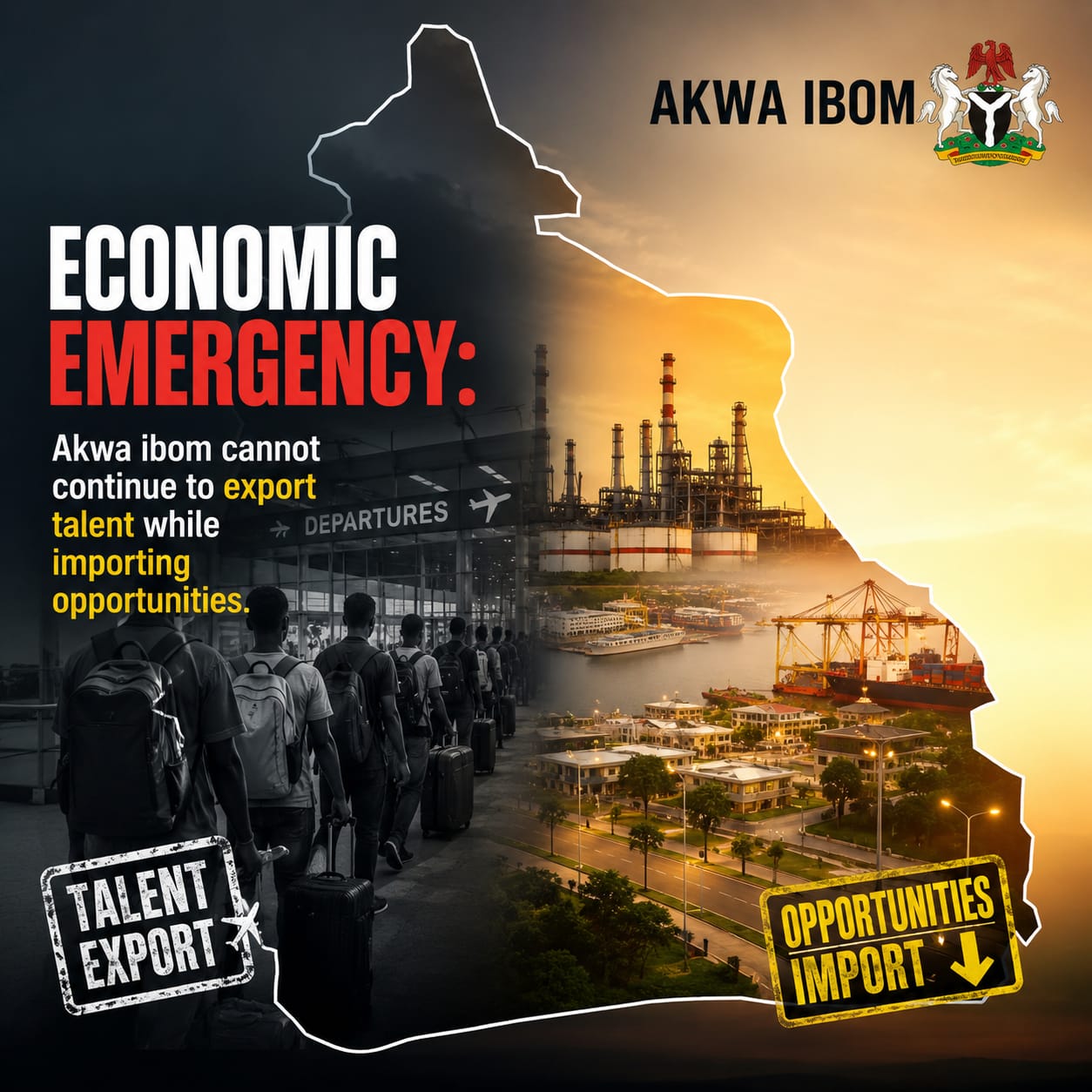
The time has come to stop exporting talent while importing opportunities.
Akwa Ibom deserves an economy where its graduates build industries instead of waiting endlessly for vacancies, where technical skills translate into innovation, and where natural resources become engines of inclusive growth.
The state’s greatest resource is no longer beneath its soil—it is the intelligence, creativity, and resilience of its people. Investing in industries that harness that potential is not merely an option; it is the defining responsibility of this generation.
Prince Idiong is a Public Affairs Analyst based in Abuja-Nigeria.
