

Israel Umoh
The proposed Ibom Deep Seaport in Akwa Ibom has become a battered child of development, which at the snap of a finger, is dragged into a relentless storm of location disputes and tribal tensions.
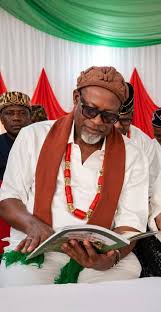
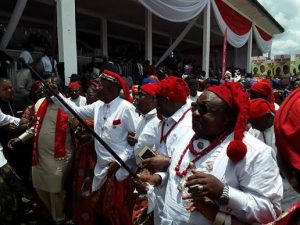
The sloppy seaport project was roved into another kiln of controversy by Dr. Samuel Udonsak, the President of Ekid Peoples Union (EPU) during the swearing-in ceremony and installation of the 12th elected officers of Mboho Mkparawa Ibibio on Friday, July 24.
Though the leadership of Mboho did not envisage that controversies would trail it, the EPU President’s speech fell like bomb, reverberating ripples and heated exchanges between the union and Oron Union.
The swearing-in ceremony had come and gone, yet the dust generated after the speech overshadowed the colourful ceremony and is yet to settle.
Also read
- Controversies and Intrigues Delaying Ibom Deep Seaport Take-off
- Ibom Deep Seaport development, not a sprint but a marathon- Gov Eno
- Stubbs Creek: EPU Faults Governor Eno’s ‘‘terrorists’’ Remark on Ekid people
Diving into the running into what could be likened to river of blood, he started ‘‘The resurgence of Oro-Obolo consciousness and its quest for state creation, if allowed, will render the Ibibios and Annangs of Akwa Ibom State economically sterile and devoid of our Atlantic shoreline.
The 1918 judgment and the Down Below judgment gave the Atlantic shoreline all to the Ibibios. The only part excluded is the one our great-grandfathers officially and voluntarily gave to the settlers. The falsehood about the seaport (and the falsehood against the Ibibio concerning it) is all about our Atlantic shoreline.’’
Udonsak fired ‘‘Let me tell us all that if the Ibibios keep quiet, if the rest of Akwa Ibom keeps quiet, and believe that all the falsehood being peddled about the seaport is about location, that is not true. It is about the Atlantic shoreline.
No map, and I repeat, no map in history has made the Oro nation a littoral state. No map. And the attempt today to grab the seaport is to establish their claim that the Oro nation is a littoral state. It is not. It will not be. And it will not be in our generation. From the mouth of the Qua Ibo River to Okposo 1 and 2 belongs to the Ibibio; the southern Ibibios of Ekid.
We will own it, we will keep it, and we will stop anybody from saying it is not ours. Today, Tolcan Energy says Okposo is in Mbo Local Government Area. It is not. We are only being responsible; we are only being peace-loving to allow that. We have gone to court. If the court says we are not right, we will take the next steps.’’
Oron Union hits Udonsak
Like striking a match, the Union in a statement by Dr. Prince Edenseting, Publicity Secretary, Oron Union, wrote ‘‘It is precisely because of our confidence in the peace-loving disposition of the Governor and his Deputy that the Oro Union respectfully calls upon them, as the Chief Security Officers and principal custodians of the peace of our dear State, to call to order those whose utterances threaten to undermine the peaceful coexistence that has historically existed among the constituent ethnic nationalities of Akwa Ibom State.
Of particular concern is the address attributed to the President of Ekid Peoples Union, Dr. Samuel Udonsak, at the swearing-in ceremony of the 12th International Executive Council of Mboho Mkparawa Ibibio in Uyo on Friday, 24 July 2026.
In the reported address, Dr. Udonsak made sweeping assertions concerning Oro-Obolo consciousness, the proposed creation of a state for the Oro-Obolo people, the Atlantic shoreline, the Ibom Deep Seaport and the alleged territorial status of Oro Nation. The reported remarks went considerably beyond a legitimate expression of historical or political opinion and ventured into language capable of provoking ethnic apprehension and antagonism.
We are particularly disturbed by the reported declaration that the Oro Nation is not, and will not be, a littoral state “in our generation,” together with the assertion that particular territories and the Atlantic shoreline belong exclusively to the Ibibio/Ekid people.
These are matters of profound historical, constitutional, geographical and political consequence. They cannot responsibly be settled through grandiloquent declarations at public ceremonies, ethnic mobilisation, social-media rhetoric, or appeals to primordial sentiments. Where legitimate disputes exist, they should be subjected to the competent institutions of the Nigerian state, including the courts and other lawful mechanisms of dispute resolution.
The Oron Union therefore unequivocally rejects any attempt to convert matters requiring sober historical, legal and constitutional examination into a contest of ethnic supremacy.
Let it be unequivocally understood that Oro people are peace loving, law abiding and constitutionally conscious citizens of Nigeria. Our preference for peace must never be misconstrued as weakness, timidity or an abdication of our legitimate rights.
The Oro people have no interest in dispossessing any neighbouring ethnic nationality of its lawful rights, nor do we seek conflict with our Ibibio, Ekid, Annang, Nkari, Itu Mbuzor, Obolo or other brothers and sisters with whom we share a common state and a common destiny.
It is therefore unacceptable for any individual or group to suggest that the pursuit of legitimate aspirations by the Oro people constitutes an existential threat to another nationality. The aspirations of one ethnic nationality do not, by themselves, constitute an assault upon another.
The Oron Union reiterates that the aspiration for the creation of an Oro-Obolo State, insofar as it is pursued within the constitutional framework of the Federal Republic of Nigeria, is a legitimate subject of political advocacy and democratic engagement.
No ethnic nationality possesses a proprietary veto over the aspirations of another.
If there are disagreements concerning boundaries, administrative arrangements, historical records, ownership, jurisdiction or other matters incidental to state creation, those issues should be addressed through evidence, constitutional procedure, dialogue and adjudication where necessary, not through ethnic mobilisation or inflammatory rhetorics.
The Oro people will continue to pursue their legitimate interests through peaceful, lawful and democratic means. The Oron Union is equally concerned by the attempt to frame the Deep Seaport question as an existential ethnic contest.
The seaport is an economic project of enormous significance to Akwa Ibom State and, indeed, the wider Niger Delta and Nigerian economy. Its development should unite rather than divide our people.
The Oron Union will not permit legitimate questions concerning geographical location, territorial jurisdiction, host community interests, economic participation or developmental benefits to be transformed into a crude contest of ethnic ownership.
If any party believes that a particular geographical or legal claim is correct, the proper forum is the court of law and not the court of public opinion, ethnic rallies or inflammatory speeches. As the ancient principle of justice teaches, “Audi alteram partem” let the other side be heard.
We therefore call upon all parties to refrain from prejudging matters that are properly before the courts or capable of being determined by competent institutions.
Professor defends Udonsak’s coastal status debate
However, a University don, Professor Etie Ben Akpan, has tangoed with Dr. Udonsak, insisting that the claim that Oro Nation is a coastal or littoral area is not supported by geographical or scientific evidence.
According to Akpan, those engaged in the ongoing debate to rely on established facts rather than emotions, ethnic sentiments or political considerations.
Reacting to criticisms that followed Dr. Udonsak’s remarks, Professor Akpan stated that Dr. Udonsak merely presented a geographical fact.
‘‘While Oro Nation is hydrocarbon-bearing, this should not be confused with the legal and geographical definition of a coastal or littoral territory.’’
He challenged critics of Dr. Udonsak’s position to provide verifiable geographical and scientific evidence to support their claims.
The professor also faulted claims credited to some commentators that Oron and Mbo Local Government Areas possess over 60 kilometres of Atlantic coastline.
He argued that the areas mentioned are located along the Oron River, the Cross River estuary and associated tributaries, and are therefore shoreline environments rather than territories directly bordering the Atlantic Ocean or the Gulf of Guinea.
The Professor maintained that no recognised historical or contemporary map identifies any Oro Local Government Area as occupying the Atlantic coastline.
Akpan further contended that available historical records, including colonial-era maps and the current official map of Akwa Ibom State, do not classify Oro Local Government Areas as littoral.
He listed Esit Eket, Eket, Ibeno, Onna, Mkpat Enin, Eastern Obolo and Ikot Abasi as the local government areas that properly fit the description of coastal or littoral areas in the state, while describing Mbo, Udung Uko, Oron, Okobo, Uruan, Itu and Oruk Anam as shoreline local government areas.
He called on Akwa Ibom people to approach the issue with maturity and avoid personal attacks, stressing that differences of opinion should be resolved through facts and constructive engagement.
Professor Akpan added that the benefits associated with the state’s coastline belong to all constituent parts of Akwa Ibom State and should not become a source of division, noting that this, in his view, was the central message conveyed by Dr. Udonsak.
