

Prince Ukpong Idiong Jr.
The greatest measure of leadership is not the number of promises made during elections, but the number of sustainable opportunities created between elections. A prosperous society is built when governance evolves from distributing political patronage to institutionalizing economic productivity – Anonymous
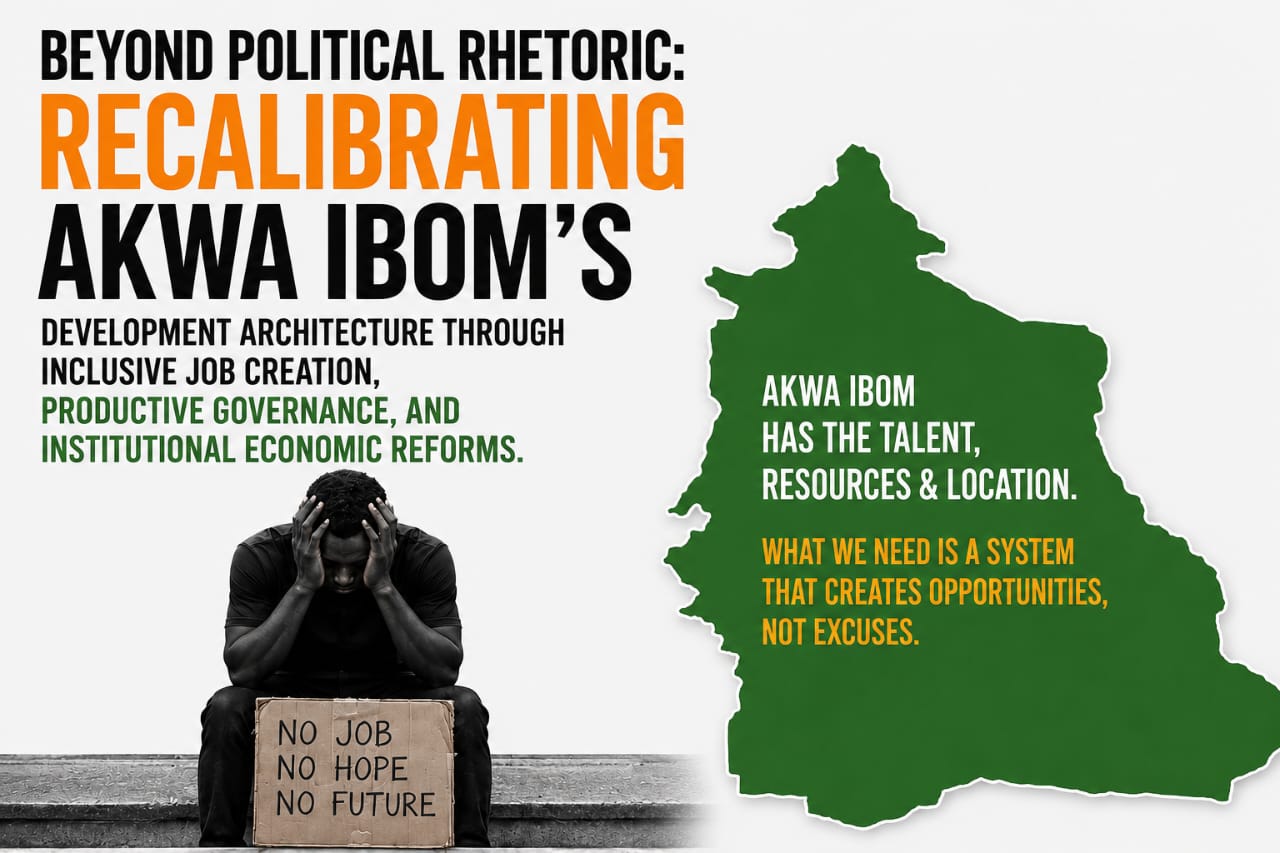
The conversation about Akwa Ibom’s future must now transcend politics and enter the realm of economic realism. For decades, successive administrations have invested significantly in infrastructure, education, aviation, and human capital development.
These achievements deserve recognition. However, the defining challenge before the state is no longer simply building roads or public structures; it is building an economy capable of sustaining the aspirations of its people.
Meanwhile, the ongoing national conversation around youth empowerment also deserves careful reflection. Recent public remarks by Nigeria’s First Lady encouraging young people to embrace entrepreneurship including small-scale ventures such as selling akara (bean cakes) were intended to promote self-reliance and the dignity of labour.
Also read: Economic Emergency: Why Akwa Ibom Must Import Opportunities, Not Export Talents
Similarly, her appeal to internationally successful Nigerian music stars such as Davido and Burna Boy to establish Non-Governmental Organisations (NGOs) and expand their philanthropic engagement has generated widespread public debate.
Regardless of differing opinions on these suggestions, the broader lesson is that sustainable youth development cannot rest solely on individual resilience or private charity. While entrepreneurship, philanthropy, and community initiatives all have important roles to play, they cannot substitute for deliberate public policies that stimulate industrial growth, attract investment, create quality jobs, and build institutions capable of providing millions of young Nigerians with meaningful economic opportunities. Lasting prosperity is achieved when personal initiative is complemented by an enabling economic environment created through effective governance.
As the countdown to the 2027 general elections gathers momentum, political activities are gradually dominating public discourse. Unfortunately, many young people are once again finding themselves drawn into political camps, not necessarily because of ideological conviction, but because politics has become one of the few available sources of temporary economic survival.
This reality should concern every policymaker. When politics becomes the largest employer of young people, democracy gradually transforms into a welfare programme rather than a vehicle for development. Elections should determine leadership, not determine who eats.
The fundamental question therefore remains unanswered: Have previous employment promises translated into measurable economic outcomes?
While several intervention programmes have been implemented, many citizens continue to ask whether these initiatives have produced permanent livelihoods or merely temporary relief.
Akwa Ibom cannot continue exporting highly educated professionals while importing unemployment. Every year, thousands of graduates, artisans, engineers, healthcare professionals, ICT experts, researchers, and entrepreneurs leave the state in search of opportunities elsewhere. What should have been our greatest economic asset is gradually becoming another region’s competitive advantage.
The painful irony is that Akwa Ibom is not deficient in talent. Rather, it is deficient in the industries capable of absorbing that talent. Our universities continue producing competent graduates, yet our economy has not expanded proportionately to accommodate them.
Government alone cannot employ every graduate, artisan, or skilled professional. Neither should that be its constitutional responsibility. The true responsibility of government is to create an enabling environment where private businesses flourish, investments multiply, and employment becomes a natural consequence of economic growth.
This is where the missing link in Akwa Ibom’s development architecture becomes evident. Economic development must become a collective institutional responsibility rather than the exclusive responsibility of the Governor.
Commissioners should move beyond administrative supervision of ministries to becoming sectoral investment ambassadors, aggressively attracting investors, development partners, and innovative enterprises into their respective portfolios.
Members of the Akwa Ibom State House of Assembly should equally champion constituency-based economic development by facilitating vocational centres, agro-processing clusters, industrial parks, innovation hubs, and small business incubation programmes within their constituencies.
Likewise, members of the House of Representatives and Senators should leverage federal interventions, development funds, and strategic partnerships to attract major industries, research institutions, manufacturing facilities, and technology parks into Akwa Ibom.
Local Government Councils must also rediscover their constitutional relevance by becoming centres of grassroots economic development. Every local government should identify its comparative advantage—whether agriculture, fisheries, tourism, commerce, or mineral resources and deliberately build local value chains capable of generating employment.
The state must also pursue an aggressive Ease of Doing Business agenda. Investors are attracted not only by natural resources but by predictable policies, transparent regulations, efficient land administration, stable taxation, reliable electricity, and effective security. Confidence is the currency of investment.
Youth empowerment must equally move beyond periodic empowerment ceremonies. Instead of distributing equipment without structured follow-up, government should establish enterprise development centres that provide continuous mentorship, business advisory services, access to finance, market linkages, and digital support for young entrepreneurs.
For instance, the thousands of phone technicians operating around Ibom Plaza in Uyo represent an informal technology ecosystem that has survived through resilience and innovation.
Rather than allowing them to operate in scattered locations with inadequate infrastructure, government should establish a modern GSM Village equipped with workshops, retail spaces, training facilities, uninterrupted electricity, internet connectivity, security, and affordable business spaces. Such a project would formalize the sector, create additional employment, and position Uyo as a regional technology repair hub.
Similarly, dedicated industrial clusters should be developed for fashion designers, furniture makers, welders, automobile technicians, digital innovators, creative artists, food processors, and building material manufacturers. Clustering small businesses improves productivity, lowers operating costs, encourages innovation, and strengthens competitiveness.
Agriculture must equally evolve beyond primary production. Rather than exporting raw cassava, palm produce, cocoa, rubber, seafood, and fruits, Akwa Ibom should deliberately encourage processing industries that add value before products reach national and international markets. Value addition creates significantly more employment than raw commodity sales.
Healthcare presents another enormous opportunity. Investments in biotechnology, pharmaceutical manufacturing, diagnostic laboratories, medical equipment assembly, and specialist healthcare facilities would not only retain highly skilled professionals but also position Akwa Ibom as a destination for medical services within the South-South region.
Equally important is the digital economy. Technology incubation centres, software development hubs, artificial intelligence training institutes, outsourcing centres, and innovation laboratories should become integral components of the state’s economic blueprint. The future economy will increasingly reward knowledge, innovation, and creativity rather than dependence on public sector employment.
Addressing youth restiveness also requires strengthening civic engagement. Young people who have access to meaningful employment, quality education, sports, entrepreneurship programmes, creative industries, and leadership development initiatives are far less susceptible to political manipulation, crime, cultism, drug abuse, and violent conflicts. Economic inclusion remains one of the most effective security strategies available to any government.
Ultimately, the future of Akwa Ibom should not be measured by the intensity of political campaigns or the volume of electoral promises. It should be measured by the number of thriving industries, successful entrepreneurs, expanding businesses, innovative startups, productive farms, modern technology hubs, manufacturing plants, and gainfully employed citizens.
The next phase of Akwa Ibom’s development requires more than political goodwill; it demands institutional reforms, economic vision, coordinated leadership, and unwavering commitment to implementation. Only then can the state truly transition from producing job seekers to nurturing job creators, from exporting talent to retaining excellence, and from managing unemployment to building enduring prosperity for generations to come.
Prince Idiong Jr, is a Public Affairs Analyst, based in Abuja-Nigeria.
