

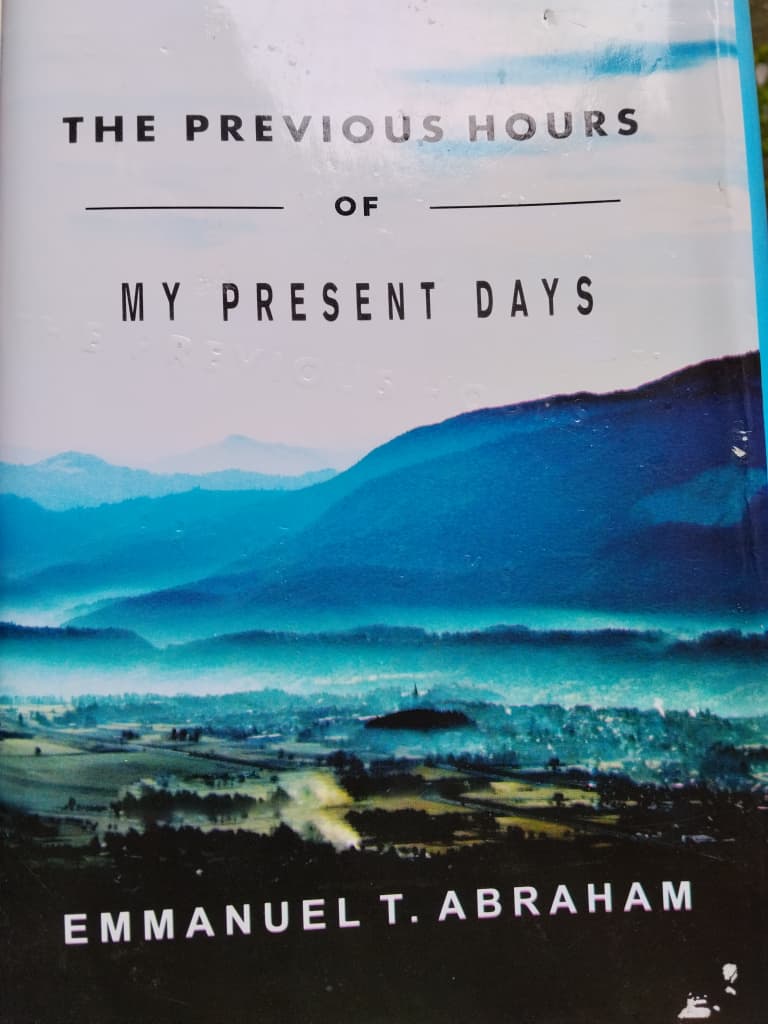
Title: The Previous Hours of My Present Days
Author: Emmanuel Thomas Abraham
No. of Pages: 594
Publisher: Union Communications and Publications Limited, Ikeja, Lagos
Reviewer: Israel Umoh
The book, an inspiring autobiography, chronicles the author’s village, parentage/kinsman ship, role models, grueling childhood experiences, academic adventure, banking odyssey to becoming employer of labour through establishment of highly rated basic and secondary schools as well as a top-class tertiary institution.
It is a collector’s item of a determined, young boy, who struggled from poverty in Mkpatak Village in Essien Udim Local Government Area of Akwa Ibom State to becoming high-profile figure, through sound education, hard work, focus and ingenuity.
The book’s title: The Previous Hours Of My Present Days is allegorical, suggesting experiences of the past as mere forgotten events but important foundations which the present is built.
The 594-page book has 21 Chapters and ends with such sub-topics as: Soliloquy, Bibliography and Index but is printed and bound in a blue hard cover colour.
Also read
- Topfaith University In Akwa Ibom, 19 Private Varsities Get FG’s Approval
- We intend To be a Research University, Topfaith University Founder declares
- I Have Reversed Rural-Urban Drift- Educationist
Prosaic in content, the book showcases Emmanuel Abraham as the leading character and begins with Chapter 1 akin to legal title to fling to the origins of names associated with him, paternity and maternity affiliations, cultural indignities of the village later abolished, and bonding among members of the nuclear family. It dovetails into Chapter 2 showing his arrival date on earth – November 11- that coincided with horoscopic sign, great events and great leaders in the world.
From Chapters 3 to 4, the book paints the author as an academic freak. His romance with primary education, though interrupted by Nigerian Civil war and his father’s ill-health, did not dissuade him from chasing the golden fleece.
Chapter 10 is another intriguing one. Confronted, ab initio, by life’s vicissitudes but by God’s grace, he divinely finished primary education with Distinction, finished secondary school with high scores in WAEC result, bounced out from the prestigious University of Calabar with First Class Degree to emerge as the university’s Valedictorian.
After serving his fatherland as a Corps member, the man, whose alma mater reneged to fulfill its pledge, forsook academic path as a career, but ventured to taste the pudding of a corporate world. In what he describes as ‘The First Class Paradox’ in Chapter 12, Abraham recounts discriminations he faced as a First Class degree graduate in the hands of some employers of labour who were sceptical of him staying long on the job after a series of career training. Eventually, he was lucky to have secured employment opportunity in the banking sector.
Other interesting but didactic lessons are derived from Chapters 16 and 17 on how he miraculously stumbled on a right helpmate that culminated in the marital rites and subsequent birth of his three children who become the joysticks and great academic lights to the family and the society.
His philanthropic spirit and development magnetism came into play in Chapter 18 when he founded Elites Club later renamed Mkpatak Development Association, the nucleus body that has ushered development projects, and transformation to the hitherto rural community.
Chapters 20 and 21 provide greater deeper insights to the making of the dramatis personae. Enticed by Joseph Schumpeter’s concept of enterpreneurship dubbed as ‘creative destruction’, Abraham voluntarily retired from his plum banking job after 16 years to join the busy labour market. The hard decision landed him job as UNICAL’s consultant on Distance Learning Programme in Lagos.
According to him, the Federal Government terminated the programme, but this ‘misfortune’ was the impetus that propelled him to have dabbled into establishing nursery and secondary schools later climaxed to the establishment of Topfaith University all in Mkpatak village.
From the challenging childhood livelihood, disruption academic pursuit to initial career paradox, Abraham imbibed can-do spirit typified by compassion, ambition, philanthropy, focus, determination, vision, optimism, entrepreneurial spirit and creative thinking.
One of the strengths of Abraham’s book is lacing the opening of every chapter with innovative quotes from famous writers to gently escort his readers to the main sauce. Thus, he succeeds by graduating readers from one chapter to another without losing eyes on the theme of the book.
Employing analogies, proverbs, imageries, suspense, flashbacks, hyperboles, metaphors, and paradoxes as spices, he enriches the autobiography with scholarly application to drive home new ideas and experiences of life.
From historical precedent to literary allusions, from Annang cosmology to cerebral philosophies, from logicalities to chronologies, and from hitherto superstitious beliefs to Biblical expositions, Abraham is able to weave fatalities to factualities to manure the uniqueness of the book.

Dr. Emmanuel Abraham, the author
Education, no doubt, is the central theme of the autobiography. The author uses education as a means to obtain certificates initially groomed as an Economist to become a successful Banker and a dynamic Entrepreneur. He adds another feather to the incredible scholarly expose’ as a gifted prose writer with remarkable command in English Language and thought flow using non-fictional style to craft a compelling story and unputdownable one to hold readers spellbound.
Like the Civil War Child in which Nestor Udoh uses Ikpe Annang in Essien Udim as a setting to weave down-to-earth story filled with emotions, Abraham uses Mkpatak also in Essien Udim to evoke nostalgic feelings and reignite patriotism by reinventing the historical parlance Ubuntu- African philosophy that emphasises shared humanity, compassion and interconnectedness among kindred to weld his community together for all-round development.
Unlike Dreams from My Father, the memoir by Barack Obama hammering on race, class and identity, this lyrical prose by Abraham captures rural-urban drift, class chasm bedevilled by poverty, workable faith in God based on Biblical teachings, destiny fulfilment through perseverance and sound pedagogy cradling his high academic performance.
Despite a few flaws, the book enjoins readers to have faith in God, respect parents, inculcate foundational education in children, and embellish entrepreneurship as a yardstick for successful living and exponential growth.
The motivational book is strongly recommended to people and readers interested in autobiographies, education, transformational leadership, personal development and community development.
