

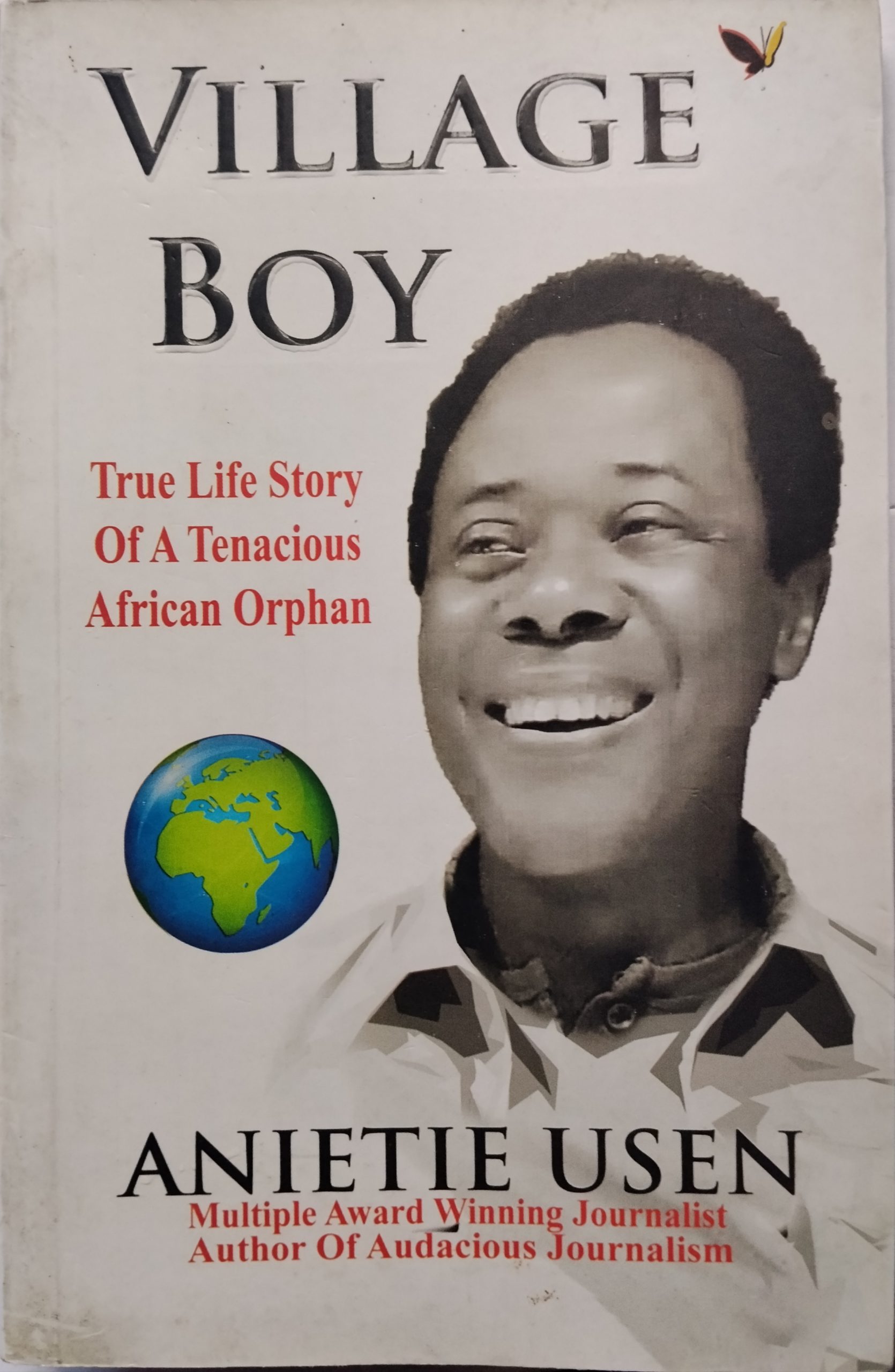
Title of book: Village Boy
Author: Anietie Usen
Publisher: Paresa Publishers Ltd. Lagos
No. of Pages: 204
Reviewer: Israel Umoh
Village Boy, an exceptional and captivating book, is unique in the class of prose, probably in the mould of one of James Hardly Chase’s thriller books.
The novel illustrates the struggles of a persevering orphan, who lived with his paternal grandmother in a village, attempted every menial job for living, struggled financially from primary to secondary school, and then surmounted the hurdles after graduation from university and National Youth Service Corps (NYSC), through juicy appointments.
The literary work, which is a fictional autobiography, is a faction- an amalgam of facts and fiction, revolving around Akan as the hero, having returned to his village after the tragic death of his father in Lagos to the warm embrace of Nne Nwa, his paternal grandmother, as a deuteragonist.
Also read: From Village Roots to Educational Greatness: The Inspiring Story of Dr. Emmanuel Abraham
The 204-page novel has 25 Chapters, while the main title is a symbolism of emptiness, hardship, hopelessness and struggles for better life capped with sub-titles sounding poetic and rhythmic to arouse the curiosity of readers.
It explores the resilience of a courageous teenager from Afaha Akpan Iman Ibom, the heartland of Ibibioland, who braves life’s upheavals in a typical African society through hard work, tenacity, faith in God, and an unrelenting passion for education, rising from the ashes of poverty to the acme of fame and fortune.
Apart from the author splashing different pages with illustrative pictures, he deftly employs fables, imageries, hyperboles, folklores, repetitions, proverbs, Biblical allusions, personifications and oxymoron to attract attention and vividly engage the readers.
In addition, he sprinkles humorous and vernacular expressions, and evocative words in the work to provide comic relief. It is further spiced by what is known as “vernacular obstruction” to accentuate the fact that every tribal or ethnic colouration in Nigeria has its flaw.
Chapter 1 opens with an intriguing title Footsteps of the Ghost, evoking fear and reinforcing the widespread African belief in supernatural beings.
Chapter 2 evokes fear nursed by Akan about the near-death experience from snake bite of his Grandma, who instantly recovered after drinking juice of snake leaf, an elixir of what could be seen as African wonder.
Chapter 3-4, introduce readers to the inner circle of hunting expedition by some village boys as a means of survival and paint grim pictures of his grandma’s ailing thatched house smacked by scenes of ruralness and poverty.
Chapter 5–7 herald the boys’ hunting expedition skills, rabbit eating, winged termite roasting, and the tragedy of the fabled lizard, in combining youthful adventure with survival skills, and marking a striking volte-face in the novel’s portrayal of village life.
Akan is fed up by bullying and misery he passed through in the hands of a tempestuous uncle as contained in Chapter 8, while Chapter 9 captures the reluctant boy, who despite his tender age, rejected entreaties to stay at home but volunteered to start primary school. Chapter 10, therefore, teaches hard lessons and warns people against deceit, lying and pretence.
For example, Zacchaeus, Akan’s friend who fell from guava tree suffered bone fracture. To escape excruciating pains, he lied to the bonesetter and in return earned limping.
While Chapter 11 narrates Akan’s dexterity in domestic work, and enduring hunger, in addition to the corporal punishment to one of his friends due to lateness, in which an action triggered the hunter father to go for revenge, resulting in many escaping the premises for safety.
Cheat Udo No More, the title of Chapter 12 is a pun, depicting the proliferation of churches in the village that culminated in outpouring of false prophecies.
Challenged by the Okpara’s convoy snaking through his village, Akan dreams of becoming an influential figure in the society, as revealed in Chapter 13. This amplifies the biblical allusion to Peter’s trance in Joppa, while praying on the rooftop of Simon the tanner’s house (Acts 10:9-11).
The journey to Aba with his grandmother aboard The Lord Is My Shepherd lorry vividly captures the culture shock and rural-urban alienation in their futile struggle to embrace modernity. “It was expected that Grandma would soon adjust to life in the city. That expectation never materialise.” (Chapter 14-15).
Chapter 17-18 narrate his grandmother’s success in a securing loan for, and repayment through farmland labour, his primary education, and how he rejected the idea of becoming a bicycle repairer after his primary.
Also read: Udoh: From Ashes of War to Pinnacle of Civil Service
While marking time for a secondary education, the orphan-turned houseboy due to maltreatment, flees from his boss in Uyo to the village. However, luck smiled on him as Uncle Onofiok awarded him scholarship to study in secondary school, courtesy of his mother’s letter (Chapter 20).
Chapters 23–24 chronicle his entry into secondary school, the challenges he faces, and his eventual appointment as Senior Prefect, dovetailing into his admission to University of Calabar, serving as NYSC member and upon completion, working as freelance writer for some newspapers and appointment as a Special Assistant to a Governor.
However, Chapter 25 entitled: Advantage and Disadvantage, seen as a flaw of the novel, throws readers into an unending suspense.
One of the novel’s central themes is the hero’s journey through the forest of poverty and hopelessness to the wetland of prosperity and success. The work resonates with Civil War Child by Nestor Udoh and The Previous Hours of the Present Day by Emmanuel T. Abraham, who as creative and daring protagonists, like the author himself, rise from financial hardship, to pursue education against the odds, and ultimately soar to the heights of success.
Another theme of the novel is its celebration of the hero’s audacity to defy conventions, overcome daunting circumstances, dare the impossible, and rise to discover his God-given talent and fulfil his destiny.
On account of its relevance, I recommend the novel to English Literature teachers and students, the underprivileged, teachers of Gospel, counsellors, widows and widowers, school proprietors and proprietress, among others.
