

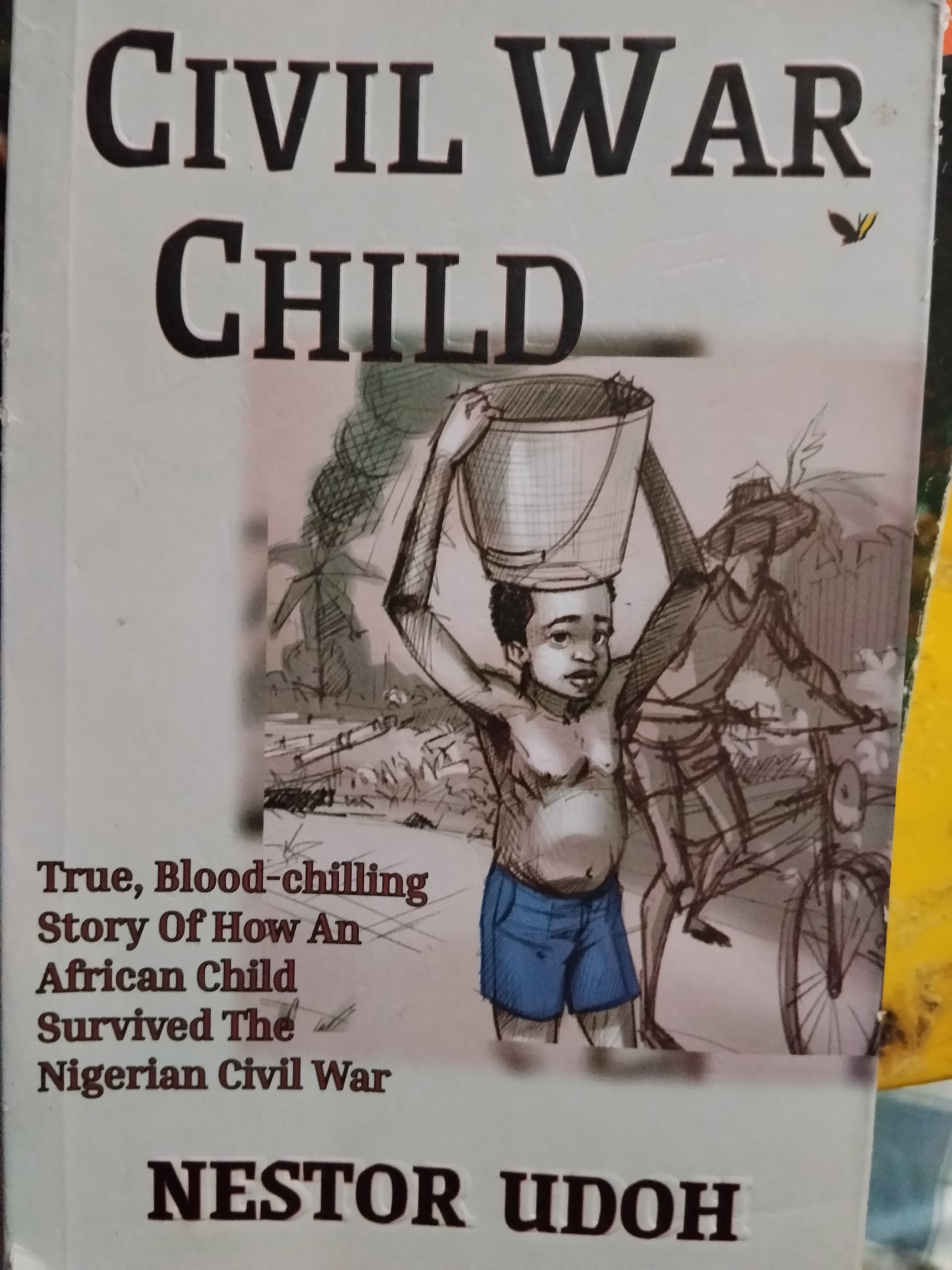
Title: Civil War Child
Author: Nestor Udoh
Publisher: Origami/Parrésia Publishers in 2023
No of pages: 453
Reviewer: Israel Umoh
The exciting but fascinating semi-autobiograhical novel or autofiction is remarkably spun from a village setting bastardised by the outbreak of a three-year Nigerian Civil War coupled with return of the villagers to build a stronger community.
It tells a story of a young boy born after the colonial rule, baptised in Catholic Faith before the Nigerian Civil War outbreak and groomed to adulthood after the period the author daubed “confusion” and “madness.”
From the semi-autobiography, the author draws on the historical accounts and narratives of his grandmothers, parents, and siblings, alongside his personal experiences, to weave a remarkable story.
Properly steeped in historical facts and rich cultural values, the writer, born in Ikpe Annang, Essien Udim Local Government Area of Akwa Ibom State, then serene and unspoiled, draws richly from the convergence of experiences and perspectives across two generations.
The title of the memoir: Civil War Child is an irony with metaphorical sub-titles, contrasting the innocence of a child with the brutality and horrors of the anomie.
Also read: From Village Roots to Educational Greatness: The Inspiring Story of Dr. Emmanuel Abraham
He casts his parents, Okon and Dima, of blessed memory, as deuteragonist and secondary character, weaving their lives into an inspiring, poignant narrative steeped in nostalgia and rendered compelling.
The 453-page book is segmented into Three parts with 43 pages with epilogue as an addendum.
The novel begins with a blood-chilling but stomach-churning story of orgies of execution by soldiers of unsuspecting civilians.
The prologue captures what Thomas Hobbes in his book: Leviathan describes as “The life of man [in the state of nature] is solitary, poor, nasty, brutish, and short,” to portray the author’s ancestral and cultural heritage.
Chapter One of the novel shows the grooming of a maiden in then ‘village school’- fattening room, a typical Annang culture adapted from the Efiks.
Chapter Two and Three reminisce the ancient conduct of female circumcision and decorations of the maiden (mbopo) for market outing whom prospective suitors then scrambled for.
In Chapters Four and Five, the author narrates the Annang processes in traditional marriage rites between beautiful Dima and her heartthrob- Okon and how Ekpo masquerade festival initially delayed the ceremony, though the process ended with the consent of marriage between both families.
In fact, Chapters Eight and Nine capture the formal introduction of the couple to new religious worship- Christendom and their acceptance in which on the road to acquire better understanding of the newfound religion, a fresh tendril- first child- was born.
Chapter Eleven opens with a traditional sacrifice for a baby boy, while Chapter Twelve turns to mounting pressure on the indifferent trader-groom to enter politics as a councillor.
However, Chapter Thirteen exposes the wife’s resistance to the introduction of a prospective bride, driven by the preference for a male child, while Chapter Fourteen reveals the couple’s turn to traditional sacrifices in search of a son.
From Chapters Nineteen to Twenty Three, the author paints the grim pictures at the war theatre and its tolls on the primary targets- the people.
In fact, Chapters Twenty Six to Forty of the novel unearth the atrocities, betrayals, brutality, refugees’ crisis, rising deaths, starvation, diseases outbreak, poverty, morbid fascination, and other accompanying effects of the war.
The aftermath was the eventual surrendering by Biafran leadership to Nigerian Government. Life returned to normalcy, people returned homes and businesses. In Part Three, the hero of the novel resumed schools- primary, secondary and university. The tragicomedy ends with the hero gaining employment, marrying his heartthrob, and then growing in the career to have landed as Permanent Secretary in Àkwa Ibom State Civil Service.
One of the strengths of the memoir is the author’s use of metaphors, imageries, repetitions, symbolisms, similes, historical allusions, juxtapositions, Annang proverbs, and first-person narrative to vividly paint graphic pictures and experiences, which the war had embalmed his tender life.
To him, the war was a potent instrument of despoliation of cultural heritage, especially desecration of totemic items and traditional worship and sacrilege against deities by women, non-initiates and soldiers, thus turning the hitherto “virgin” and vulnerable community to a militarised enclave of robbery, violence, extra-judicial killings by soldiers, incessant rapes, betrayals by civilians and soldiers alike, and revenge.
Another major strength is Nestor Udoh’s enthusiasm and passion to acquire formal education that eventually transformed him from a village dude to an urbane man, through his stellar academic performance, graduation from one of the prestigious universities, employment as a medical doctor to reaching the peak of his career as a Permanent Secretary in Àkwa Ibom State Civil Service.
One of themes too is that the memoir exposes the psychological trauma and devastating effects of the three-year war on the people both in the rural and urban settings of the defunct East Central State.
In short, the novel x-rays how the war displaced families, and bred refugees crisis, grief, fear, starvation, diseases, colossal losses, including weaponisation of poverty.
Without any hesitation, I strongly recommend the novel to English Literature teachers/students, crisis managers, marriage counsellors, religious leaders, military/security experts, school administrators and employers/employees of labour.
