

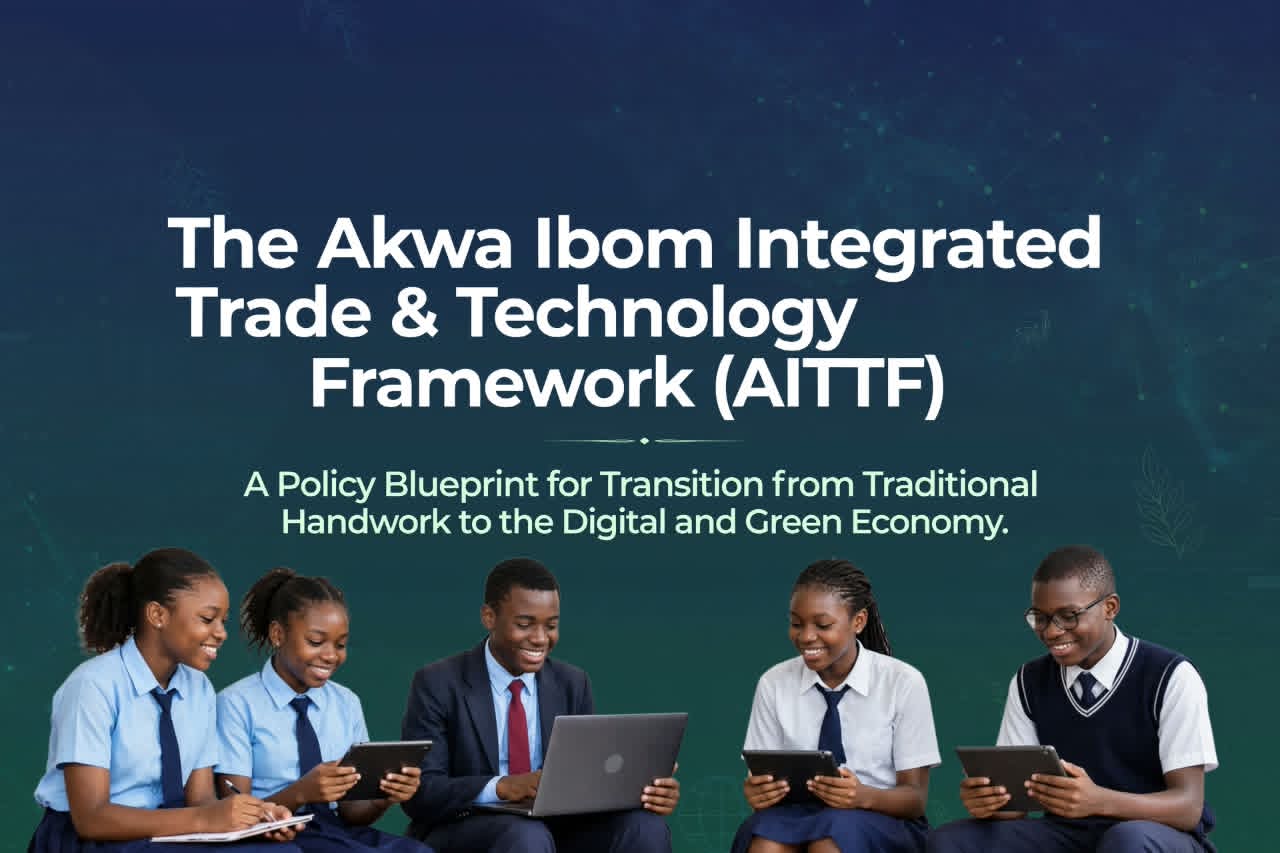
… Akwa Ibom Integrated Trade and Technology (AITTTF) is bold shift to innovation
… a policy Blueprint for Transitioning from Traditional Handiwork to the Digital & Green Economy
Prince Ukpong Idiong Jr and Ekerete Umoren
Preamble: The gradual disappearance of practical education from our basic school system presents an urgent economic vulnerability.
However, merely restoring the traditional crafts we once knew as handwork is insufficient. The nature of work has evolved, and our policy must reflect this reality.
Crucially, we must acknowledge a stark economic baseline: Akwa Ibom currently possesses a minimal manufacturing base. Therefore, an updated educational framework cannot merely aim to supply workers for industries that do not yet exist.
Also read: From Handwork to High-Tech: Need for New Face of Trade Education in Akwa Ibom
Instead, this policy must be designed to cultivate the pioneer cohort that will physically build, operate, and sustain the state’s future manufacturing and industrial economy from the ground up.
To achieve this within our current infrastructure constraints, we propose a transition to an integrated “Three-Circle Model” tailored for Akwa Ibom’s secondary schools, where students possess the cognitive maturity for advanced technical and business training.
The Three-Circle Policy Framework
To ensure technical skills translate directly into industrial capacity and economic empowerment, the curriculum must stand on three equally weighted pillars:
- Contextual Classroom & Laboratory Instruction
Trade education must be intra-curricular, carrying the same academic weight as mathematics and the sciences. Given our goal of industrialising the state despite current infrastructure limitations, the curriculum must focus on foundational, high-leverage disciplines:
Industrial Fabrication & Manufacturing Foundations: Teaching the bedrock skills of component fabrication, machine tool operation, and industrial safety necessary to attract and build a future manufacturing sector.
Also read: Revitalising Trade Education in Akwa Ibom Primary Schools
Modern Agriculture and Food Processing: Moving beyond basic farming to encompass mechanised harvesting, food production technologies, and commercial packaging standards, laying the groundwork for local agro-allied manufacturing.
Facility Operations and Maintenance: Training students in the mechanical, HVAC, and electrical systems required to maintain large commercial properties, ensuring that when industrial facilities are built, the local talent exists to keep them operational.
Digital Systems Engineering: Progressing from basic computer literacy to software development, database deployment, and network architecture.
Renewable Energy Mechanics: Practical instruction in residential solar installation and battery storage to address the local power grid challenges that currently hinder industrial growth.
- Supervised Trade & Enterprise Experience (STEE)
The classroom teaches the mechanism; the STEE teaches the market. Every student enrolled in a technical track must maintain a graded, school-supervised micro-enterprise or apprenticeship.
Because large-scale manufacturing facilities are currently scarce, STEE projects must serve as incubators for future industries through Public-Private Partnerships (PPP):
Incubating Light Industry: Students partner with existing light agricultural enterprises to learn food packaging and quality control, bridging the gap between farming and agro-manufacturing.
Supervised Micro-Enterprises: Students utilise school-based fabrication labs to prototype components or build simplified digital management systems for local retail businesses, effectively operating as small-scale vendors.
Community Service Contracts: Under expert supervision, technical students provide routine solar maintenance or IT troubleshooting for local government offices, gaining real-world operational experience.
- Structural Governance & Leadership
Technical brilliance alone does not build sustainable industries. We must deliberately train the industrial employers and factory owners of tomorrow. The final component embeds a student-led leadership organisation within the curriculum to teach public speaking, parliamentary procedure, welfare policy drafting, and business administration.
Administrative Design Imperative: To maximise resources, ensure uniform certification standards, and maintain strong negotiating power with future private-sector investors, this leadership body must operate as a single, centralised state-wide entity.
Implementing fragmented local chapters across different Local Government Areas would dilute the organisation’s impact. A unified central structure is essential to create a cohesive network of future industrialists across the state.
Phased Implementation Strategy Policy becomes stronger when evidence is placed behind it. A mass, immediate overhaul of the state education system is neither financially responsible nor logistically feasible. Implementation must be phased and data-driven:
Phase 1: Labour-Market Assessment Before curriculum deployment, the Ministry of Education must execute a state-wide assessment identifying the specific skills necessary to stimulate industrial investment, alongside a survey of the local businesses currently capable of participating in PPP mentorships.
Phase 2: Secondary School Pilot Matrix Launch the framework in a selection of secondary schools across diverse Local Government Areas. Align pilot programmes with local economic potential (e.g., placing the agricultural processing pilot in a predominantly farming district to stimulate agro-manufacturing). Focus heavily on talent identification, connecting students with exceptional technical or entrepreneurial aptitude directly to the Dakkada Skills Acquisition Centres.
Phase 3: Evaluation and Expansion Measure the pilot’s success by the revenue generated through student STEE projects, the retention rate of private-sector mentors, and the creation of student-led micro-businesses that have the potential to scale into manufacturing enterprises.
Also read: Heavens Overflow: The Rising Cost of Heavy Rainfall in Akwa Ibom
Conclusion: Society has too often treated vocational occupations as what a child should pursue when they cannot succeed academically. That mindset must change. Our children must be taught that there is immense dignity and wealth in wearing safety boots inside a facility plant, operating modern food packaging equipment, writing software, or building a solar grid.
The students entering this proposed system will not merely be looking for jobs. They are the essential cohort upon which Akwa Ibom’s entire future manufacturing base will rely. By teaching them how to turn knowledge into skills, skills into businesses, and businesses into industries, we are laying the concrete foundation for a self-sustaining, industrialised state.
Prince Idiong Jr and Umoren write from Abuja and USA respectively.
