
Press Release
Delta Government and students in the state secondary schools have praised the Sterling Oil Exploration and Energy Production Company Limited (SEEPCO), over the company’s investment in their academic progress.
Moreover, officials of the state government are equally excited that SEEPCO chose to initiate the Igniting Minds through Science (IMS) programme, an initiative that aims to transform classroom curiosity into practical solutions in science related subjects, with a view to solving society’s most pressing challenges.
These were part of the outcomes of the 2026 grand finale of the IMS Science programme, driven by Vcare for Development Foundation in partnership with the Delta State government in selected schools in the state, being part of the company’s Corporate Social Responsibility (CSR).
Also read:
- NAOWA Hails SEEPCO for Economic Empowerment of Members
- SEEPCO, VCDF Equip Eastern Obolo women with Vocational Skills and Financial Literacy
- Coy Delivers Educational Materials to Eastern Obolo School
Students, who took part in the contest, addressed waste management challenges, explored alternative means of generating energy, developed alternative electricity sources and blended creativity and accessible materials for creative product design.
The students also demonstrated how critical thinking and teamwork can drive innovations and were guided to think beyond classroom theory and apply STEM knowledge to solve real-life challenges.
In the qualifying stages, about 37 schools in the state exhibited their science projects and models, out of which eight emerged for the grand finale.
At the grand finale, each of the eight schools presented a prototype developed through research, experimentation and teamwork.
The projects showed how simple materials and scientific knowledge can produce useful solutions with potential benefits for homes, schools and communities.
Students of Obiaruku Grammar School, Obiaruku, Ukwuani LGA, who were engaged in the Anaerobic Biogas Digester which converts organic waste into biogas, grabbed the first position, while students of Government College, Ughelli, took second place over fabrication of the Solar Powered Desktop Electric Fan which offered an energy-efficient response to heat and unreliable power supply.
Onuaboh Secondary School, Onuaboh, in the Ndokwa East LGA, emerged third, with the handmade woven backpack and crochet bag which showcases the use of creativity to produce marketable items.
One of the participating students at the grand finale, Chukwunonso Greatness said “being here and emerging first place with our project- Anaerobic Biogas Digester- is an incredible feeling. There was a point when we almost lost hope, but we are grateful that our efforts paid off. We are excited and proud of what we have achieved.”
“A big thank you to VCDF and Sterling Oil Group for believing in young innovators and giving us the opportunity to learn, showcase our ideas and excel. We truly appreciate you.”
Another student from the Onuaboh Secondary School said ‘‘IMS experience has strengthened my interest in science and inspired me to put in even more effort. I am incredibly excited and grateful for the opportunity to showcase the project alongside other talented students. I thank my school teachers, Sterling Oil and VCDF for the experience.”
The Chief Inspector of Education, Ministry of Basic and Secondary Education, Ndokwa West, Mrs Mercy Udi-Anighoro, expressed thanks to SEEPCO “for making this programme possible. This programme has made students courageous enough to solve challenges in their communities with science and technology.”
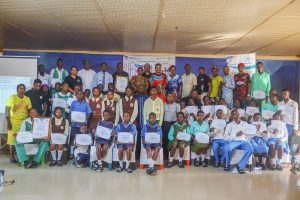
All the participating schools, teachers, and students received certificates and science educational materials, while the Inning Schools received additional prizes, including human anatomy models, adult-sized human skeletons and electric compound microscopes to enhance practical science teaching and learning in the respective schools.
Since 2023 the floating of IMF scheme by SEEPCO, more than 612 schools across Lagos, Akwa Ibom and Delta states have taken part, with about 26,000 students and teachers impacted by the initiative.
