

Israel Umoh
The Akwa Ibom Internal Revenue Service has unveiled the key outcomes of Nigeria Tax Reforms recently introduced by the Federal Government.
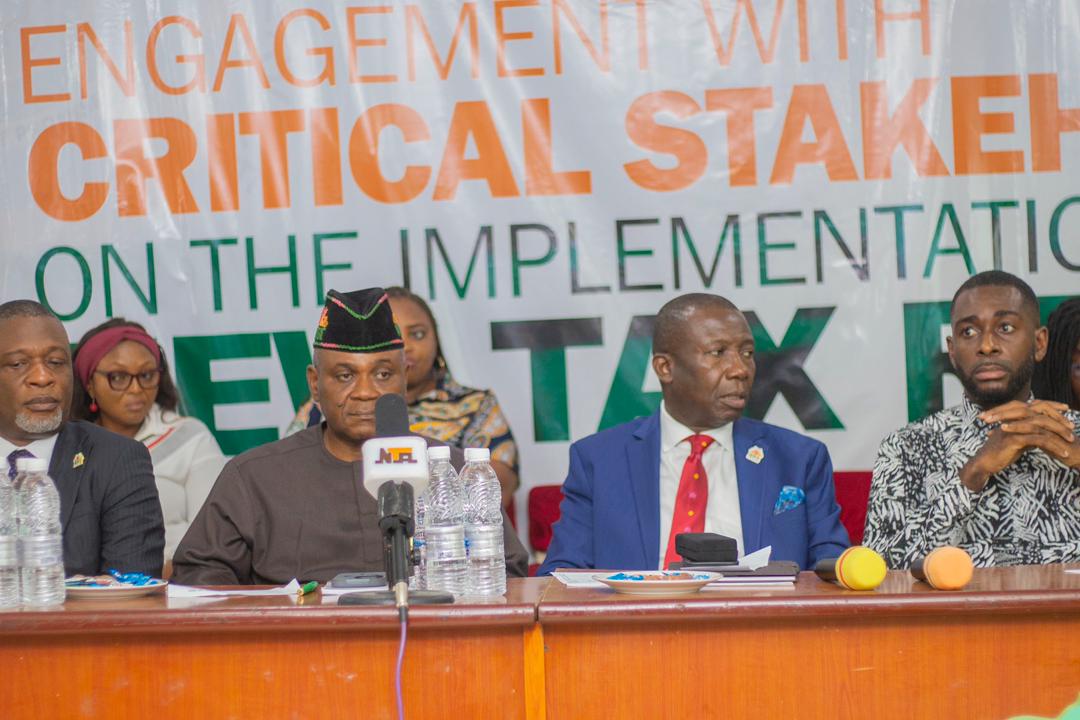
Addressing journalists in Uyo last Friday, the Executive Chairman of Akwa Ibom Internal Revenue Service (AKIRS), Sir Okon Okon who spoke on the title: On the Nigeria Tax Reforms: Synopsis of the Implications said the reforms were necessitated by the desire to achieve meaningful results for the new tax regime.
He explained that government needed to amend archaic and stale laws to give way for simplicity of revenue administration and compliance, multiplicity of taxes and levies for low-income–friendly thresholds, nuisance taxes for fiscalization, huge tax burden on low-income earners and small businesses for harmonization of taxes and tax administration, lack of uniformity across jurisdictions for best practices and professionalism.
Related News:
- Akwa Ibom Rakes N43.13 billion IGR in 2023
- Akwa Ibom Budget to Get N60 billion boost in 2024- AKIRS
- AKIRS collects more Revenue in Q3 of 2023 than last year- Okon
Nigerian President Bola Ahmed Tinubu signed four key tax reform bills into law on June 26, 2025. These bills are collectively known as the Nigerian Tax Reform Acts. The reforms are aimed at overhauling the country’s fiscal governance, tax administration, and revenue generation.
Announcing that the reforms would take effect from January 1, 2026, Okon further said there was need to change the fiscal imbalance to eliminate multiple and nuisance taxes, improve inefficient administration for efficient, unified, technology-driven tax, prevent insufficient transparency for optimized revenue generation for all tiers of government, audit multiple taxpayer identifiers for single National Tax Identification Number (Tax ID) and remove uneven professional standards for global competitiveness.
Highlighting Tax Acts, he announced that Joint Revenue Board (JRB) Establishment Act 2025 replaces the Joint Tax Board (JTB), coordinates tax administration nationwide across Federal, State & Local Governments, as well as oversees national tax programmes, policies, Data4Tax, and technology systems.
‘‘Nigeria Revenue Service (NRS) Establishment Act 2025 replaces the Federal Inland Revenue Service (FIRS), serves the Federation – not just the Federal Government, improved organisational structure, can collect revenue for states when mandated.’’
On the Nigeria Tax Administration Act (NTAA) 2025, he explained that New legal framework for State Revenue Authorities (Section 87) establishes the Office of the Tax Ombud (national & regional), re-establishes Tax Appeal Tribunals nationwide, Nigeria Tax Act (NTA) 2025 consolidates 25+ tax laws into a single Act, Repeals/amends Acts including PITA, VAT, Stamp Duty, Lottery, CGT, TETFund, Customs & Excise, FERMA etc. (Sections 196–198) as well as streamlines revenue rights across all tiers of government.
The AKIRS boss announced 50 tax Exemptions and reliefs benefiting to the masses to include Personal Income Tax/PAYE, National minimum wage earners exempt, Annual income ₦1.2 million exempt, lower PAYE rates up to ₦20 million yearly income, gifts exempt, allowable Deductions, Pension contributions and NHIS contributions.
Others are Loan interest for owner-occupied homes, Life insurance/annuity premiums, Rent Relief Allowance up to ₦500,000 or 20% of rent, Pensions & Gratuities, Pension funds under PRA exempt, Retirement benefits under PRA exempt and Loss-of-employment compensation up to ₦50 million exempt, among others.
The state Commissioner for Finance, Mr. Emem Bob joined his voice in calling on Nigerians and Akwa Ibom people to support the new tax regime, which, according to him, would benefit the poor masses.
Earlier, the State Chairman of Nigerian Union of Journalists, Comrade Nsibiet John Udoh, had commended the Executive Chairman of AKIRS for coming to the journalists on the sensitization programme to reach to the larger masses on the Nigeria Tax Reforms.
Udoh urged him to orgnaise more trainings for journalists for them to be in a better position to educate the masses on the impact and benefits of the new tax regime.
