

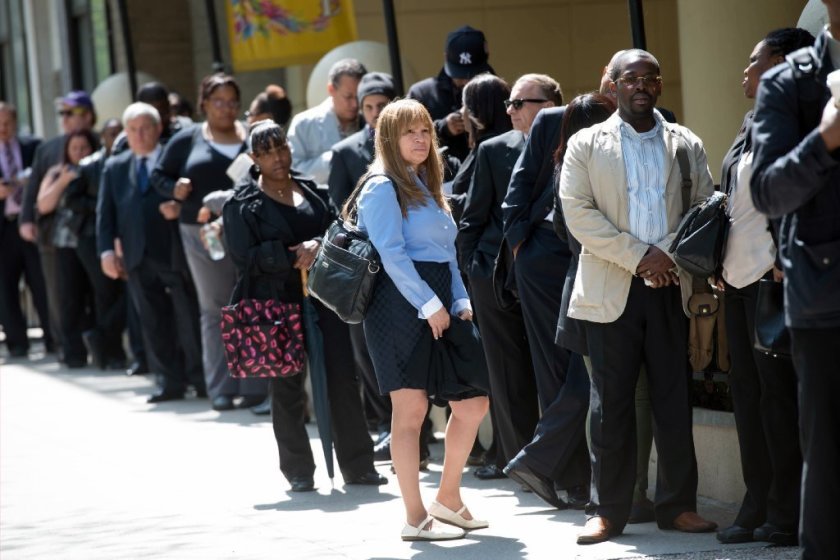
The novel coronavirus pandemic has exacerbated income inequality, experts say, stretching the racial wealth gap in the United States and making the richest wealthier while leaving many of the poorest without jobs.
As the COVID-19 pandemic overtook the US, it brought with it an unprecedented financial crisis and unemployment rates at their highest levels since the Great Depression, especially among Black, Hispanic and Asian workers (16.8%, 17.6% and 15% in May compared to 12.4% for whites). At least 45 million people have filed for unemployment since the pandemic began.
Between March 18 and June 17, as the pandemic raged, the combined wealth of the 614 U.S. billionaires increased by $584 billion, according to an analysis released late last week by the Institute for Policy Studies, a progressive think tank based in Washington, D.C. The researchers calculated the billionaires’ wealth gains based on real-time data from Forbes.
Experts said the wealth of the richest Americans is tied more closely than the rest of America to the stock market, which crashed at the onset of the crisis but has rallied since — largely detached from the broader economic picture.
“The pandemic crisis will widen the already worrisome levels of income, racial, and gender inequality in the U.S,” Dimitri Papadimitriou, President of the Levy Economics Institute at Bard College, and former Greek Minister of Economy and Development, told ABC News. “This engenders an element of a vicious circle at work: not only will the pandemic and its fallout worsen inequality; inequality will exacerbate the spread of the virus, not to mention undermine any ensuing economic recovery efforts.”
Data has shown that the virus has disproportionately affected Blacks and Latinos, who each have hospitalization rates 4.5 times that of non-Hispanic whites, according to the latest data from the Centers for Disease Control and Prevention. Communities of color are also overrepresented among essential workers who are generally unable to work from home and more likely to come into contact with the virus.
“Even though most people would assert that a disease or other disaster is blind to differences of race, creed or wealth, we are not ‘all in this pandemic together,'” Papadimitrou added. “This assumption that ‘we are together’ distracts us from the socio-economic dimensions of the COVID-19 crisis.”
Chuck Collins, the co-author of the analysis and the director of the program on inequality at the Institute for Policy Studies told ABC News that their findings are “a reflection of this extremely unequal time that we are living in and it’s not that simple, it’s really 40 years of accumulating, accelerating inequality.”
As the U.S. entered the pandemic, “in some ways the extreme inequality was the preexisting condition,” Collins said.
Deadly consequences
The impact of income inequality during a pandemic isn’t just linked to economic hardship — it can also be deadly.
A team of researchers from the London School of Economics U.S. Centre argued in a May analysis that “states with greater income inequality are more likely to report more COVID-19 cases and fatalities.”
“The effect of inequality is large — it is tied with the Human Development Index as the second strongest predictor of COVID deaths in various states,” Harold Clarke, a professor of economics at the University of Texas at Dallas and Paul Whitely, a professor at the University of Essex, wrote in their findings.
The researchers measured inequality using the Gini Index, an economic barometer that ranks income inequality from 0 (total inequality) to 1 (total equality) and found that it was a strong predictor of COVID-19 deaths. New York, which had one of the highest Gini Index numbers at .52 also had the highest number of fatalities in the nation by a margin. But excluding New York and New Jersey, the researchers found that inequality was still a strong predictor.
“The U.S. so far has had the most deaths of any country,” Dr. Mary Bassett, the director of the FXB Center for Health and Human Rights at the Harvard T.H. Chan School, told ABC News. “In the U.S., these track along racial lines, and you’ll hear the phrase racial capitalism now being raised by protesters that the kind of economy that the United States developed was not only a capitalist economy but one that was kick-started by its reliance on slave labor.”
“We see that reflected in the present day,” Bassett said. “To be black or Latino or Native American in the United States is to have a much higher risk of being poor.” A Brookings Institute analysis found that in 2016, the typical white family had a net worth 10 times that of a Black family ($171,000 compared to $17,150).
“People’s income determines their everyday lives, which includes their ability to access health services — that’s always true, but COVID-19 broke down into stark relief,” Bassett said. “I would argue that a series of choices that have been made in the United States at the societal level meant that the U.S. was much more vulnerable to this pandemic.”
Papadimitriou added that “a reduction in income inequality is one of the most important — if not the single-most-important — structural changes that need to be implemented so that the U.S. economy can return to a sustainable growth path in the medium run.”
A public policy brief written by several of Papadimitriou’s colleagues at the Levy Economics Institute, concludes that “had these issues been addressed already, the pandemic’s impacts on the United States would have been less severe.”
Why the ultra-rich are getting richer and the poor getting hurt
Michael Graetz, a professor at Columbia University and the author of the book “The Wolf at the Door: The Menace of Economic Insecurity and How to Fight It,” said some of the richest have seen their wealth grow during the pandemic in part because of how divorced the stock market can be from the real economy.
“Some stocks, the tech stocks, in particular, have done extremely well during the pandemic and of course lots of shares of Facebook and Amazon and others are owned by billionaires so of course, their wealth has gone up because their stock has gone up in value,” he said. “The bottom half of the American public doesn’t own stocks so they haven’t shared in those gains.”
The bottom 40% of earners, he added, have been hurt most by unemployment during the pandemic.
“So you have a situation where they’ve lost their wages and Congress has temporarily provided some extra unemployment benefits to some of those folks and then sent $1,200 dollar checks but for those people, the people at the bottom half of the income distribution, have been living a precarious life before the pandemic, Graetz said.
Congress boosted unemployment benefits during the pandemic and opened relief up to freelancers and others generally not covered by unemployment insurance. But people had to wait for weeks in some cases for benefits. Stimulus checks were also not issued on a sliding scale based on need (although married couples making over $198,000 were ineligible).
Even before the pandemic, Graetz cited a 2018 Federal Reserve survey that found nearly 40% of American families said they couldn’t cover an unexpected $400 expense.
“The pandemic has created emergencies that are much larger than $400,” he said.
Wealth inequality in the U.S. is intrinsically linked to the racial wealth gap, Valerie Wilson, the director of the program on race, ethnicity, and the economy at the Economic Policy Institute told ABC News.
“If we’re seeing growth wealth inequality in general then it almost goes without question to say that the racial wealth gap is widening as well because a lot of the underlying racial disparities throughout the economy in wages, employment, income,” Wilson said. “Part of getting to recovery has to do with addressing these holes that have been opened even more by the pandemic.”
Recovery efforts
Understanding the rampant inequalities that are being exacerbated during the crisis are crucial when policymakers look towards economic recovery efforts.
“The first thing is just how to make sure the current recovery programs and stimulus programs reduce the racial wealth divide, not make it worse,” Collins told ABC News. One solution is the Democrat-backed HEROES Act, Collins said, which provides hazard pay to front-line workers among other relief as well as oversight of current funding.
“We’re spending trillions of dollars, let’s not make the same mistakes that we did after the great recession of 2009 where we put in place policies that worsened the racial wealth gap,” he added. “It requires a certain intentional commitment to racial equity as part of the recovery.”
Bassett noted that “$2 trillion [in the CARES Act] was mobilized to save Wall Street and large corporations” which proves “the U.S. can mobilize that kind of level of resource to protect people.”
“But that would take a great deal of political courage and votes that currently don’t exist,” she added.
Collins said data collection amid the pandemic is crucial, as are audits of how stimulus and government relief funds are being used.
Finally, Collins noted the ultra-rich need to be paying their fair share of taxes.
“One of the reasons why our economy is so ill-prepared, our public health system and our ability to respond to the pandemic, is because the very rich have seen their share of taxes continue to go down over the last three-four decades, so we have to restore some progressivity to the tax code,” he said.
Papadimitriou said that policies combatting the epidemic and financial crisis must “be sensitive to inequalities and to avoid exacerbating biases that increase social, gender, and racial gaps.”
“If we ignore the regressive impact or refrain from taking action to mitigate these unequal harms will not only be an affront to principles of fairness, it will prolong the pandemic and worsen its severity,” he added.
(ABC NEWS)
