

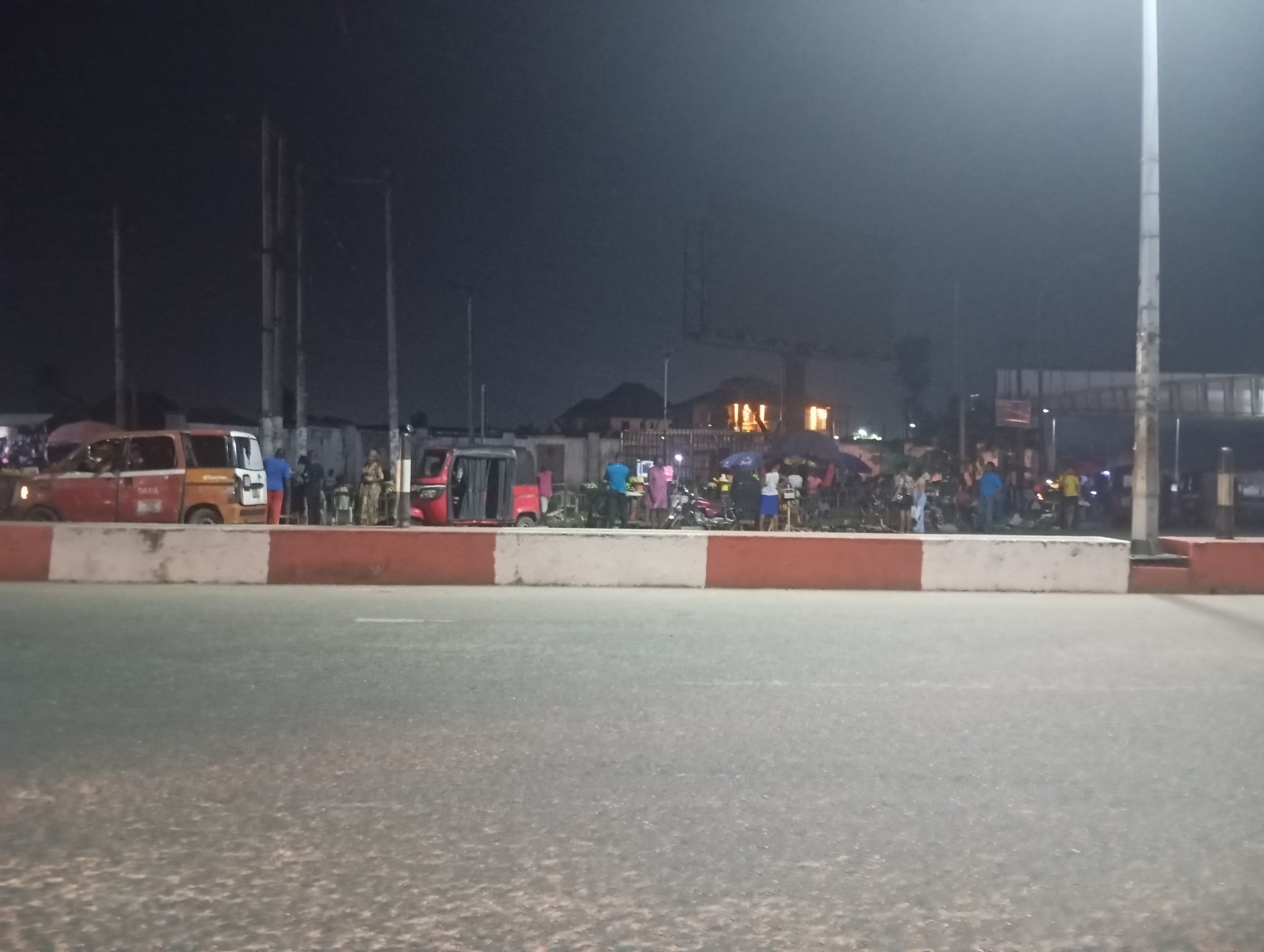
The Water Fountain, a major urban landmark and social corridor along Nwaniba Road in Uyo, Àkwa Ibom capital, is typically bustling during the day and lively at night.
At night, the architectural masterpiece, no less, turns to a beehive of mercantile and social hubs showcasing vehicular and human activities. At times, a splinter of outdoor religious and secular events feature to enliven the nightlife. Beside the major arteries abutting the fountain at night are breeding businesses – fruits, food joints, Suya, POS, wears, and wares, among others.
Nwaniba Road is a dual carriageway artery snaking through Idu, an urban and Uruan Local Government headquarters of Àkwa Ibom, straying into villages and terminating at Ibom Icon Hotel & Golf Resort (formerly Le Meridien) in Uruan. The road is a permanent reminder of a key trading station established by European businessmen following the British subjugation of the region after 1887, evolving into a local administrative hub that contributed to early urbanization in the area. In fact, during the transatlantic slave trade era, Nwaniba and surrounding communities served a major slave trade routes.
Also read
- Thieves Of Metal Drain Covers On The Prowl In Uyo
- The Booming Inagha Business In Akwa Ibom
- December: Change My Name
On the contrast, the Water Fountain provides a navigational contour of historical picturesque to emerging artists, content creators and tourists for fascinating shots. Indeed, the fountain is a beacon of urban landscape and a convergence of two major roads: Edet Akpan Avenue and Nwaniba Road emptying into Etim Okon Usanga and Udo idiong Akpanya Streets.
Edet Akpan Avenue popularly known as Four Lanes and Nwaniba Road upshooting the Water fountain haul assorted vehicles blaring hones and flashing lights, as well as “tuck-tuck-tuck” noise by Keke tricycles help to drown the hitherto serenity of the area at night. From the mouths of Udo Idiong Akpanya and Etim Okon Usanga Streets are traders of different makes surging to shut out other road users.
Different water pumps harboured by the iconic Roundabout splash to the adjoining roads with glittering lights, at times, adorned in colours to beautify the arena and the artificial ”waterfall.”
At the access of Edet Akpan Avenue opposite the fountain overhung Pedestrian Overpass Bridge, an elevated but corrugated crossover where large billboards are usually placed. Beneath are Zebra stripes with conical road divider for vehicles to “behave” as pedestrians stroll past.
Along the small open field with GSM antenna are planted rails to guard against trespassers. On the right hand from the access route lies a sprawling field. During Yuletide period, the field always decorated with Christmas lights is casually turned to what is called ‘Lagos Arena’, while on Saturdays, gymnasium instructors with their clients flood the arena displaying various physical skills. On some weekdays and weekends, the field frequently hosts funeral services, concerts, exhibitions and other entertainment activities.
Contiguous to the roundabout are kiosks and bars usually busy, while the premises of Chicken Republic and African Pot are crowded with vehicles and people angling for leisure and entertainment.
A cursory look shows that some suspected thieves had removed drain covers, thus posing danger to first-time visitors.
Straightnews publisher who visited the fountain on Tuesday night, February 24, discovered that despite the increasing number of business people, sunbathers, loafers, and strollers, there are no toilet facilities in the environment.
In an interview, Alice Udoh, a food vendor, told Straightnews “I sell food every night to cater for my family. At times, you make good money, at times, you make a loss. But, then it is better than not having anything daily. A plate of Garri or fufu costs N1,200. A plate of rice or beans with meat goes for N1,000.”
Another food vendor, Grace Udoh confirmed that “I have sold food here for more than five years. It is better than staying idle. Unfortunately, we do not have toilet facilities. Some people defecate, wrap it and dispose it into gutters late at night. However, there is a urinary. I want to appeal to state government to build even if it is mobile toilet for us.”
Musa Tahir, Suya seller said “I sell meat here every night. We make small, small money. Business no too dey.”
Ekaete Akpan, a POS operator, said “I operate here. Business no too flow. I just dey manage small, small.”
Expressing her happiness, she said she was happy that illegal revenue collectors do not come to ‘extort’ from them- the traders.”
Ms Ngozi, a shoe/bag dealer, told Straightnews “I sell here every night. Sales are poor. But, I dey manage to use the proceeds to pay house rent, feed myself and my family as a single mother.”
Macdonald Okon, one of the customers to the food vendor told Straightnews, “I come here to eat some nights I don’t cook. I like their food.”
The Fountain creatively designed and ingeniously executed during the administration of Ex-Governor Godswill Akpabio stands tall as a masterclass of tourist delight and of historical significance.
The Nwaniba Road Water fountain remains one of the few operational public fountains in the mega city, serving as a rare splash of vibrancy amidst widespread neglect of civic infrastructure.
The fountain’s presence on a major arterial route gives it a dual character: aesthetic feature and social and cultural touchpoint where modernity and beautification meet humanity.
Residents, commuters, and visitors often reference the fountain as a feature along the stretch of Nwaniba, particularly near Edet Akpan Avenue, where daily traffic, street life, and community interactions converge.
Its artificial visibility from the road makes it a natural rendezvous point and backdrop for photographs, small events, or casual meetups, even as the condition of the surrounding infrastructure shifts with seasonal weather.
The fountain’s working status contrasts with other city fountains that are clogged or dormant, reinforcing its significance as one of the last remaining public water features meant for enjoyment, visual relief, and urban beautification.
