

Agency Report
Oil prices climbed above $100 per barrel Thursday after attacks on commercial shipping in the Persian Gulf raised fears of further disruptions to global energy supplies, despite a record release of emergency reserves by major consuming nations.
Brent crude, the international benchmark, surged more than 9% to about $100 a barrel as escalating Middle East tensions rattled energy markets, while U.S. benchmark West Texas Intermediate crude rose into the mid-$90s range.
The spike followed reports of additional attacks on vessels in the Gulf region, part of a widening Iran-linked campaign targeting shipping and energy infrastructure after the United States and Israel launched their airborne strikes against Iranian targets February 28.
Three ships were hit by unknown projectiles in the Persian Gulf early Thursday, according to a British maritime agency.
The United Kingdom Maritime Trade Operations said one container ship was struck off the coast of Jebel Ali, United Arab Emirates, causing a small fire onboard. Two tankers were also hit near Al Basrah, Iraq, and were set ablaze. UKMTO said all crew members were reported safe in the incidents.
The attacks brought the total number of vessels targeted to six over the past two days, intensifying concerns over the security of the Strait of Hormuz, a critical maritime chokepoint through which about one-fifth of the world’s crude oil and liquefied natural gas supply passes.
Iran has sought to pressure global energy markets following U.S. and Israeli strikes on Iranian targets nearly two weeks ago. Iranian officials and military commanders have warned that shipping through the strait could be disrupted, and maritime traffic through the waterway has already fallen sharply amid the escalating conflict.
In an attempt to calm markets, the International Energy Agency announced that its member countries will release a combined 400 million barrels of oil from emergency reserves — the largest coordinated stock drawdown in the organization’s history.
“The oil market challenges we are facing are unprecedented in scale, therefore I am very glad that IEA Member countries have responded with an emergency collective action of unprecedented size,” IEA Executive Director Fatih Birol said in a statement.
The current crisis has already caused sharp volatility in global energy markets, with Brent crude prices spiking to nearly $120 a barrel on Sunday before retreating in subsequent days.
Ship ablaze in Strait of Hormuz, 2 other cargo vessels attacked
A cargo vessel was set ablaze in the Strait of Hormuz in the early hours of Wednesday after being hit by an unknown projectile, British maritime authorities said.
The Royal Navy’s Maritime Trade Operations center said in an alert that the vessel had issued an SOS and the crew were evacuating after it was struck about 11 nautical miles north of Oman’s Musandam Peninsula.
UKMTO said the incident had been reported to it by a “company security officer.”
“Vessels are advised to transit with caution and report any suspicious activity to UKMTO while authorities continue to investigate,” the center added.
Recall that the U.S. Department of Defense estimates that about 140 U.S. troops have been wounded since the United States began its military operation against Iran last month.
The injuries are in addition to seven U.S. service members who have been killed in retaliatory strikes by Iran. Pentagon spokesperson Sean Parnell said in a statement that a “vast majority” of those wounded have suffered “minor” injuries.
Of about 140 injured, 108 returned to duty.
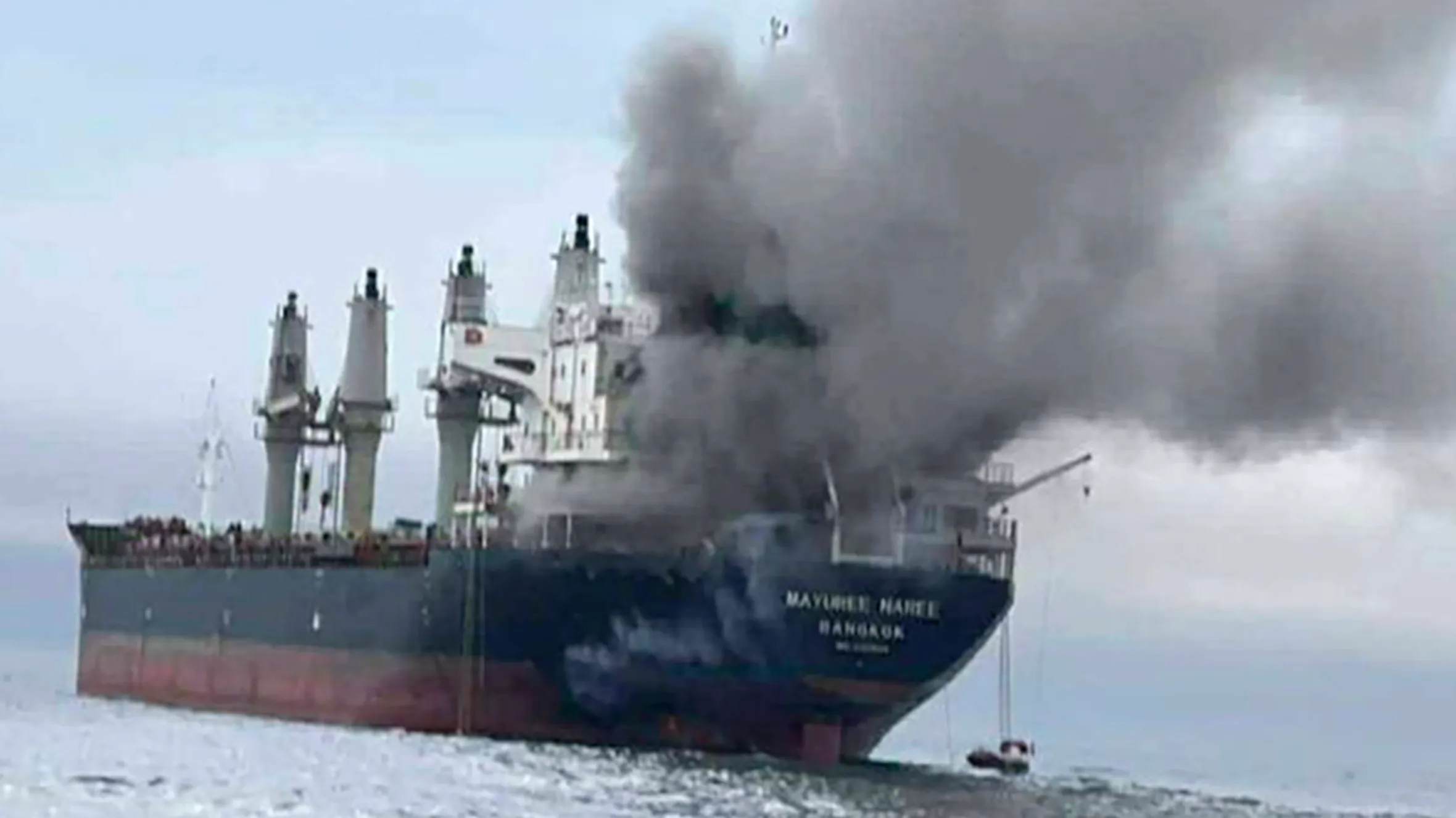
The report did not state the type of cargo vessel but the BBC named it as the Thai-flagged container ship, Mayuree Naree, along with pictures of thick black smoke billowing from the deck.
Thai authorities said a rescue effort by the Oman Navy was underway and had rescued 20 of 23 crew so far.
The Mayuree Naree was en route from Khalifa Port in the UAE when it was attacked, the Thai Navy said.
UKMTO issued warnings regarding attacks on two other commercial vessels off the coast of the United Arab Emirates on Wednesday.
The master of a bulk carrier called in being hit by an unknown projectile in the Persian Gulf, 50 nautical miles northwest of Dubai, just after 6 a.m. local time. No one was hurt and there was no report of any environmental impact.
In the second incident, the master of a container vessel, also northwest of the UAE, reported “sustaining damage from a suspected but unknown projectile,” but confirmed that all crew members were safe and accounted for. The extent of the damage had yet to be determined and was being investigated by the crew.
The first of these was the Marshall Islands-flagged Star Gwyneth, while the second was the Japan-flagged One Majesty, both of which sustained damage to their hulls, with One Majesty reported to be limping its way to a safe harbor, according to the BBC.
Wednesday’s incidents bring to 13 the number of confirmed attacks on vessels in and around the Strait of Hormuz since the United States and Israel launched their airborne offensive against Iran on Feb. 28.
Iran has responded by bringing to a virtual standstill shipping using the narrow waterway through which around 20% of the world’s oil and gas is exported from Gulf producers to global markets.
U.S. Central Command said Tuesday that it had sunk a significant number of Iranian vessels near the strait, including 16 that were laying mines in the shipping lane.
“Iran’s rapid and extensive retaliation against shipping and regional energy, port and economic infrastructure has severed a vital artery in global supply chains, as the flow of oil, refined products, LNG and chemicals grinds to a near halt,” Verisk Maplecroft’s Middle East analyst Torbjorn Soltvedt wrote in a note.
“Additional attacks against ships in and around the Strait of Hormuz overnight underscore that Iran still presents a very real threat to shipping,” he said.
U.S. President Donald Trump has repeatedly raised the prospect of using the U.S. Navy to provide safe passage to shipping through the strait but the White House was forced Tuesday to deny claims by Energy Secretary Chris Wright that the first naval escort had taken place.
