

Eyoh Etim, PhD
Theme Quote
What makes you a poet is a gift for language, an ability to see into the heart of things, and an ability to deal with important unconscious material. When all these things come together, you’re a poet. . . Erica Jong
Introduction
In Musings of Yesteryears, Udeme Nana bequeaths to us a poetic offering that at once entertains and educates, intrigues and instructs. The collection commands reality into existence through the instrumentality of language and rememory. Thus, we find in Udeme Nana’s debut collection an artistic treasure that preserves the memory of the bygone years, preventing them from experiencing the ravages of time and the rust of human memory. The collection is an embodiment of the ethos of the Nigerian nation, the culture and the sensibility of the African peoples, the collective recalled history of a race, and the pangs and angsts of our common humanity. This collection stands as a testament to Nana’s lifetime commitment to art, literature and creativity. The poems in the collection are indicative of the fact that Udeme Nana has performed his duty of observing and recording events in society successfully over the years. The collection is also a reward for his hard work and steadfastness in fostering a culture of intellectualism in our society.
In Musings of Yesteryears, one would find poems on love and life, death, nature, politics and power play, culture and culture shock; all from the vantage point and agency of history and memory. Indeed, the collection is divided into five parts that align with its themes and subject matter: politics, nature, love, sorrow and death or tragedy. A study of the poems in the collection attests to Nana’s craftsmanship in poetry, as confirmed by the foreword by Professor Joseph Ushie and the review/introduction by Professor Friday Okon. What interests me in this review is to examine the imagery and tropes in the collection in order to highlight the aesthetics of Nana’s poetry. At this point, a definition of imagery and tropes is required. But before then, let us examine the preliminaries.
The Man: Dr Udeme Nana is a journalist, lecturer, writer, editor and an avid reader of books. He is the founder of Uyo Book Club and the father of book club initiative in Akwa Ibom State. He is the author of The Age of Videots, Success Secrets of Cristiano Ronaldo and Musings of Yesteryears, which is his debut poetry collection. He is also the author of the celebrated essay, The Age of Digidiots. The word ‘Digidiot’ is being considered for inclusion in the Collins English language Dictionary.
The Title: The collection’s title suggests a preoccupation with the past and its re/memory. History serves as a veritable material for literature and Nana has demonstrated this by deploying history in the crafting of the poems in this collection. Some of the historical events dramatised in the poems are colonialism, apartheid, the Nigerian Civil war, post-colonial realities in Africa, among others. The title is, therefore, a fitting illustration of history’s continued relevance in contemporary literature.
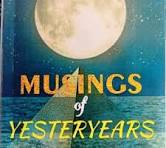
The Cover: The cover of Musings of Yesteryears is well illustrated with two symbolic/iconic concepts: the full moon and the pyramid. The full moon represents the ripeness of time for the exposition of human actions in the form of fiction. It also symbolises the passage of time and the events embodied in time which are depicted in the collection. The pyramid is a symbol of time, history and African civilisation, which the poet extols in the collection. These two symbols ask us to be conscious of history as we approach Nana’s collection. The lettering of the text’s title, the author’s name and the words announcing the introductory notes of the collection and its author is rendered in bright gold/white/yellow hues which make it attractive to the reader.
Imagery
Imagery refers to the use of vivid and descriptive language in works of arts in order to create mental pictures, sensations and emotions in the reader by appealing to their senses; the five senses. The basic tool for writing is language. Writers use language to achieve whatever effect they desire in the reader by consciously selecting words and expressions that bring about those effects. This is what Thomas Eliot refers to as the objective correlative: the precise arrangement of words and images to correspond to a particular emotion [joy, love, hate, fear, sadness] in the reader as intended by the writer.
Imagery exists in dimensions and types, all conjured up by the nature of the diction deployed. These are visual, auditory, tactile, gustatory, olfactory, organic imagery and kinetic imagery. Visual imagery appeals to the sense of sight and is denoted by the use of sight words like black, red, house, ocean and forest, among others. Auditory imagery appeals to the sense of hearing and is exemplified in onomatopoeic words like splash, crash, cry, hiss and wail, among others. Gustatory imagery appeals to the sense of taste and can be elicited by words like sweet, bitter and sour. Tactile imagery appeals to the sense of touch and is denoted by words like smooth, rough, velvet, wet, cold and hot, among others. Olfactory imagery appeals to the sense of smell and can be exemplified in words such as fragrance, perfume, aroma, putrid and scent. Organic imagery appeals to emotions like love, hate, fear, joy and gloom, while kinetic or kinaesthetic imagery appeals to the sense of movement in literature which could be denoted by words like fly, run, jump, skip, fall and drop, among others.
Tropes
Tropes are poetic figures that beautify our language and speech. Tropes can be defined as recurring devices, elements and motif in works of art, often captured in figurative expressions like metaphors, similes, personification, irony and sarcasm, among others. Taken together, these elements enrich poetry, creating a sense of fun or enjoyment in the reader. In the paragraphs that follow, selected poems are read based on their recurrent poetic elements, imagery and tropes.
A Review of Imagery and Tropes in Selected Poems in Udeme Nana’s Musings of Yesteryears
Udeme Nana writes contemporary poetry which is socially committed in orientation. Socially committed art engages with the real issues that affect the common people in society, aiming to bring about positive societal changes and developments. As a committed poet, Nana uses poetry to raise awareness about the past and the present social conditions, as they affect the well being of the people. In order to achieve this, Nana has to speak in the language the people would understand, despite writing through the medium of poetry, often considered difficult and obscure by its very nature. This is an aspect of Nana’s poetry that qualifies it as contemporary poetry, apart from the deployment of rich imagery and tropes.
Another aspect of contemporary poetry found in Nana’s Musings of Yesteryears is that it is written in free verse. Free verse began to be used in poetry in the modern period and is denoted by the absence of rhyme and meter in order to allow for freedom of expression beyond the bounds of stanzaic strictures found in metered verses. Nana’s poems are also mostly written in run-on-lines or enjambment; which implies the free flow of ideas from one line to another, in line with the liberation of the verses through the use of free verse.
In A Festival of Renewal, Udeme Nana deploys paralipsis and refrain as major poetic tropes in discoursing the essence of Uyo Book Club and similar intellectual gatherings. Paralipsis is a poetic figure in which a person mentions something by saying that they do not want to mention or talk about it. An example is seen in the first stanza of the poem: ‘We are not here to gossip/About such things as who fought/Abducted, inflicted injuries or/Took life in the search for ephemeral power and/position./No. Never’ (p.6).
The stanza is a free verse and constitutes an enjambment in keeping with the structure of contemporary poetry. A refrain refers to the repetition of words or expressions at regular intervals in literature. The expression that constitutes a refrain in the poem is ‘No. Never’ which occurs at the end of each stanza in the poem.
Another important trope deployed in the poem is innuendo, which is an indirect reference to a person or a thing, done in such a way that the person knows that they are being talked about, but without their names being mentioned. An instance of innuendo is seen in the second stanza of Udeme Nana’s ‘A Festival of Renewal’ which reads: ‘We are not here to talk/About who employed jobless youths/Ex-convicts, armed them to terrorize people/And seize ballot boxes./No. Never’ (p.6).
In the fourth stanza, the persona states the actual purpose of the gathering (Uyo Book Club) or any intellectual gathering: ‘We are here at the start of the wet season/At the start of the planting season/To plant seeds of reawakening of the/Spirit of men’ (p.6). The title of the poem itself is a metaphor for intellectual gathering like the Uyo Book Club because, through reading books and generating intellectual discussions around books, we ‘clear cobwebs from the mind’, leading to renewal and revival for the individual.
In terms of terms of imagery, we have the dominance of kinetic, visual, tactile and organic imagery in words like ‘fought’, ‘ballot boxes’, ‘wet’ and ‘sorrows’, respectively (p.6). Put together, these images generate the psychological sensation required by the reader to understand and enjoy the poem. Also, note the alliteration in the lines: ‘Among kith, kin, kindred spirits’, denoted by the repetition of the voiceless velar plosive /k/ in ‘kith’, ‘kin’ and ‘kindred’ (p.7).
In Taxi Misunderstanding, the poet narrates what appears to be a personal encounter with a taxi driver that went awry in Calabar. The problem is that of not negotiating a price before the journey starts: ‘No bargaining!’ On reaching the destination, the persona pays the driver the amount he has, but the driver refuses to take the money offered. Instead, the taxi driver takes off to an unknown destination as punishment to the persona for refusing to pay a higher amount. With threats and counter threats, the encounter terminates at Nsidung Beach, where the rogue driver tries to engage the services of thugs in a bid to intimidate the persona. The bravery of the persona is seen in how he remains unscathed by the thugs’ threats. In the end, he leaves without making any payment.
Taxi Misunderstanding is a narrative poem, rich in dialogue which heightens the dramatics of the poem. It is rich in kinetic, visual and auditory imagery. Kinetic imagery in the poem is exemplified in words like ‘approach’, ‘went in’, ‘sat’, ‘come in’, ‘commot here’ and ‘moved’. Visual imagery is seen in words like ‘taxi’, ‘money’, ‘Nsidung Beach’, ‘Mayne Avenue’ and ‘thugs’.
Auditory imagery is found in words like ‘yelled’, ‘laughed’, ‘screeched’, ‘mute’ and ‘shouted’. It is interesting that this poem is written in the same conversational style as Wole Soyinka’s ‘Telephone Conversation’, in one long stanza, replete with dialogue that commands the attention of the readers. In the poem, Nana satirises the ill attitude of most taxi drivers in Nigeria, which is characterised by impoliteness and inconsiderate actions towards clients. The rude behaviour of the taxi driver is demonstrated through imperatives like ‘Bring out the note’, ‘give me that money and commot’, and ‘Drakkam out’ (pp.12, 13), as well as sarcastic expressions like ‘Are you enjoying the ride?’, while actually driving the client to a different destination.
The poem, A Walk in the Countryside, can be read as a pastoral poem which dramatises the healing effect of nature on the poet’s persona. The persona meets nature at the point when he is sick, but gets healed at the end of the encounter. There is the use of alliteration in the first line seen in the words ‘weak and weary’ and in the penultimate line in the expression ‘. . .cascading sound of the cataract’ (p.16). We have personification in the expression ‘insect talking’, as well as in ‘the wind weaving music and caressing various/leaves. . .’ (p.16), found in the second stanza of the poem.
The dominant imagery in the poem is visual imagery. Words that conjure up visual imagery in the poem are ‘Mbiabong Atim’, ‘village stream’, ‘greenery’, ‘narrow footpath’, ‘Ine’, ‘Atan’ and ‘farmsteads’, among others. We also have the dominance of auditory imagery in the poem, seen in words like ‘call’, ‘sound’, ‘tunes’, ‘singing’, and ‘music’. The kinetic imagery in the poem is exemplified in words such as ‘cascading’, ‘leads to’, ‘stopped’, ‘walked’ and ‘returned’ (p.16).
Miscellaneous Cases of Imagery and Tropes in Udeme Nana’s Musings of Yesteryears
In this section, I would analyse the tropes, poetic elements and imagery in other poems in the collection without dwelling extensively on the entire poem. We will proceed by mentioning a trope, explaining their meaning and citing instances of their occurrences in some of the poems in the collection.
Rhetorical Question: Rhetorical question is a type of question asked for its effect and not to elicit a response. An instance is found in the poem ‘Dele Giwa’ in the second stanza: ‘. . . Were your assignments/Completed? Could finesse not be/ accommodated /In this place?’ (p.2). Another instance of rhetorical question is found in the poem ‘Nigeria Politicians Pharisaic’ in the expressions: ‘Do you like your sight?/Are you comfortable in your /skin?’ (p.4).
Personification: This is the ascription of human qualities to inanimate things. An example is found in the poem ‘Celebration’ in the lines: ‘The sky, sea and land/bathe in the soothing embrace/of the full-grown moon’ (p.26).
Simile: This is a figure of speech in which comparison is made using ‘as’ or ‘like’. An instance of simile is seen in the poem ‘Bravo, Leopold Sedar Senghor’ in the lines: ‘Rather than end in disgrace/Like Bokassa. . .’ (p.5). Another instance of simile is seen the poem ‘Qua Falls’ in the expression ‘She roars like thunderstorm’ (p.35).
Metaphor: A metaphor is a type of comparison that does not make use of ‘as’ or ‘like’. An example of metaphor in Udeme Nana’s collection can be found in the poem ‘Nsukka’ in the line: ‘UNN is a lion/trapped in a valley’ (p.32).
Alliteration: This is the repetition of initial consonant sounds in a line of a poem. An example is seen in the poem ‘Celebration’ in the line: ‘The sky is black, bleak’ (p.25), seen in the repetition of the voiced bilabial plosive /b/.
Pathetic Fallacy: This device attributes human emotions to inanimate things. An example of pathetic fallacy is seen in line ‘The moon looks sad’ in the poem ‘To Pik Botha’ (p.8).
Hypophora: This is a poetic device whereby the poet asks a question and then proceeds to answer it, compared to a rhetorical question which does not require a response. An instance of hypophora is seen in the poem ‘Intellectual Famine’ in the lines: ‘What have we got here? Traders/What have we got here? Nurses. . ./What have we got here? Copiers, Copy cats, dubbers’ (p.9).
Caesura: This refers to a pause in the middle or near the middle of the line in a poem, often denoted by punctuation marks like comma, full stop, colon, semi-colon or question mark. The pause causes a break in thought either for reflection or to prepare the mind of the reader for additional and interesting information. Nana’s poems are rich in caesuras. An example would suffice in the poem ‘Another Season’ in the lines: ‘. . . hoes, tillers; farming implements/are carried along with crops/cassava tubers, yam heads/cocoyam, maize, melon, cucumber. . .’ (p.28).
Anaphora: This infers the repetition of words and expressions in the initial part of a stanza or a poem. An instance of anaphora is seen in the repetition of the phrase ‘when the’ in the first stanza of the poem ‘Nature’s Rival Disappointment’: ‘When the invisible God directs/When the immortal God speaks/When the everlasting God inspires. . .’ (p.38).
Parody: This is a device in postmodern literature which describes a work of art that humorously imitates another work of art. About two poems constitute a parody in Udeme Nana’s Musings of Yesteryears. One of them is ‘A Reader’s Creed’ which parodies Psalm 23, the other is ‘Casualties’ which parodies J. P. Clark’s poem that goes by the same title. Remember that the Bible is considered one of the greatest texts in English literature. A few lines from the poem ‘A Reader’s Creed’ read: ‘The book is my refuge/I shall not want/Books make me to lie down in well-mannered green fields/They lead me beside springs and waterfalls/They restore my soul’ (p.40).
Historical Allusion: A key device deployed in the poem which aligns with its subject matter and title is historical allusion, which is a brief reference made to history and historical events in a work of art. Some of the poems which embody historical allusion are ‘Dele Giwa’, ‘Diana and Dodi’, ’To Pik Botha’ and ‘Bravo, Leopold Sedar Senghor’. Other types of allusion in literature are biblical allusion and literary allusion. Poems that exemplify literary allusion are ‘Casualties’ and ‘Songs of Sorrow’, which allude to J. P. Clark and Awoonor’s poems, respectively, that go by the same titles.
Conclusion
This review aimed to analyse the poetic figures, imagery and tropes in Udeme Nana’s Musings of Yesteryears. The review has demonstrated that Dr Nana is a gifted poet from birth, as can be seen in the richness of his poems in content and form. The review has paid more attention to the formal attributes of Nana’s poetry, especially in accounting for how the use of language contributes to the effectiveness of the poems’ politics. It is hoped that readers would find in the poems the inspiration they need to work for the betterment of our literature, art and society.
Work Cited
Nana, Udeme. Musings of Yesteryears. Uyo: Planeyo Publishers, 2025.
Dr Etim is a Lecturer in the Department of English, Akwa Ibom State University.
