

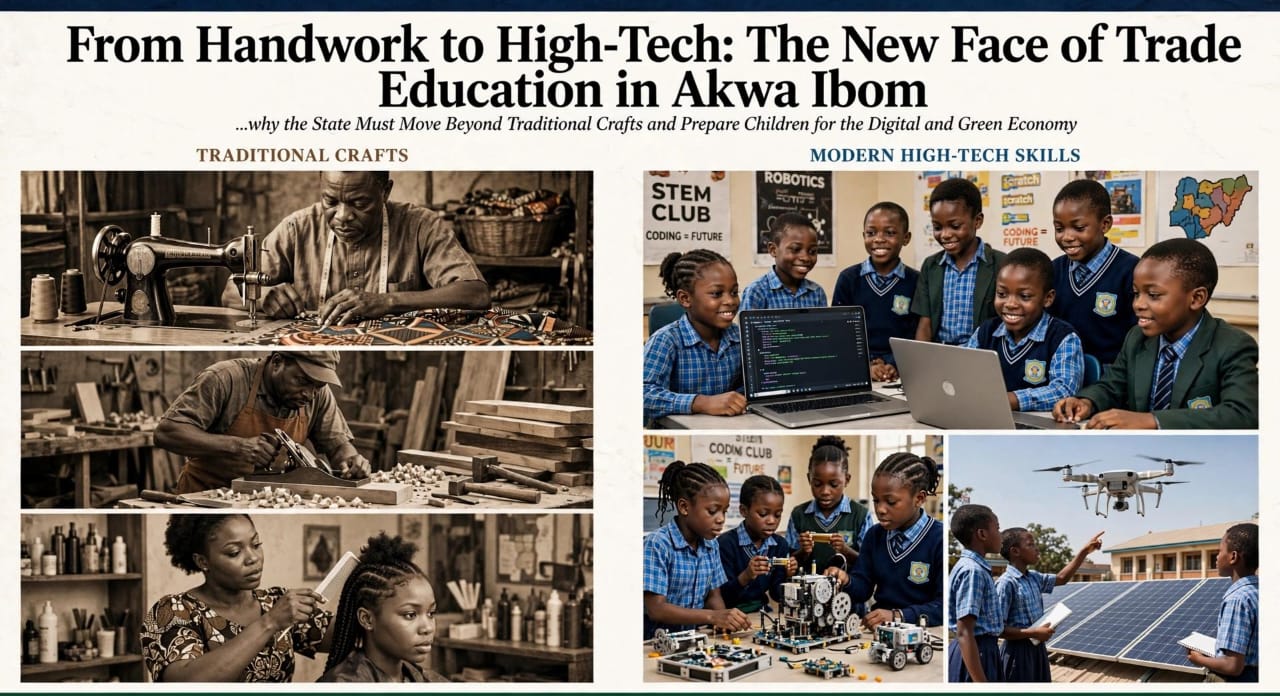
…why the State Must Move Beyond Traditional Crafts and Prepare Children for the Digital and Green Economy
Prince Ukpong Idiong Jr & Ekerete Umoren
In the first part of this series, Revitalising Handwork, Rebuilding the Future: Why Akwa Ibom Must Restore Trade Education to Primary Schools Before It Is Too Late, we argued that the gradual disappearance of practical education from our basic school system deserves urgent attention. The response to that conversation has reinforced one important reality: Akwa Ibom must begin to rethink what we traditionally call “handwork.”
Handwork must no longer be understood merely as the traditional crafts we once knew in our primary schools. The world has changed, technology has advanced, and the nature of work has evolved. What we need today is a modern trade education system that combines craftsmanship with technology, innovation, environmental sustainability, and entrepreneurship.
Read: Revitalising Trade Education in Akwa Ibom Primary Schools
The child who learns to work with wood today should also be exposed tomorrow to modern construction technology. The pupil fascinated by electricity should eventually be able to learn residential solar installation and maintenance. The child interested in computers should not only learn how to operate a computer but gradually understand software development, database management, and other digital systems. This is the new meaning of handwork. It is skill education for the twenty-first century.
The Green Economy & Mechanised Agriculture
Consider the opportunities emerging from the green economy. As Nigeria increasingly searches for alternative and sustainable energy solutions, skills in solar energy installation, electrical systems, battery technology, and facility maintenance will become even more important. These are not “lesser” professions. They are specialised technical careers with the potential to create businesses and employ other people.
The same applies to Agriculture. Akwa Ibom has enormous agricultural potentials, yet the modern agricultural economy requires more than farming with traditional tools. Young people can be trained to operate modern agricultural equipment, manage commercial farms, maintain machinery, process agricultural products, and apply technology to improve productivity.
The Pioneer Cohort: Building an Industrial Base from Scratch
As we advocate for these advanced skills, we must confront a stark economic reality: Akwa Ibom currently possesses a minimal manufacturing base. We cannot simply train students to fill jobs in factories that do not yet exist. Instead, our schools must cultivate the pioneer cohort — the future industrialists, fabricators, and engineers who will physically build, operate, and sustain our manufacturing economy from the ground up.
The modern economy requires people who can maintain buildings, manage large facilities, operate industrial equipment, fabricate components, and maintain technical systems. These skills must become part of the conversation whenever we discuss the future of education, as they are the prerequisites for attracting industrial investment.
A Proven Blueprint: The Three Pillars of Modern Trade Education
To achieve this industrial leap, we must adopt an integrated educational architecture. While primary schools should introduce basic tool literacy and technological awareness, the core of this advanced training must shift to our secondary schools, where students possess the cognitive and physical maturity to operate complex systems.
Read also: Popular Clergyman ‘rescues’ Technical College in Àkwa Ibom
Drawing from successful global models, this new framework must stand on three essential pillars:
Contextual Classroom Instruction: Trade education must be intra-curricular, holding the same academic weight as mathematics. It must blend theoretical knowledge with immediate laboratory application.
Supervised Enterprise Experience: The classroom teaches the skill; the real world teaches the business. Every technical student must maintain a supervised micro-enterprise or apprenticeship—for instance, providing routine IT support or learning quality control on a food processing floor.
Structural Governance and Leadership: We must deliberately train the employers of tomorrow. This requires a formal, student-led leadership organisation embedded in the curriculum to teach business administration, parliamentary procedure, and welfare policy drafting. Because our Diaspora and student populations are geographically scattered, this leadership body must operate as a single, centralised state-wide entity rather than fragmented local chapters. This unified structure ensures cohesive networking, uniform certification standards, and strong negotiating power.
The Classroom Must Connect to Industry
However, government cannot and should not be expected to carry the entire burden alone. This is where Public-Private Partnership (PPP) becomes critical.
“Handwork must no longer be treated as a fallback for children who cannot pursue white-collar careers. In the new economy, practical skills can become technology, businesses, industries and wealth.” ~ anonymous.
Akwa Ibom is home to businesses, contractors, technology entrepreneurs, manufacturers, agricultural enterprises, engineering firms, and other private-sector players whose expertise can complement government investment in education.
Also read: Gov Advocates Entrepreneurial Development For Nigeria’s Ailing Educational System
Imagine a situation where selected companies sponsor practical workshops in public schools. Imagine technology companies creating supervised digital-learning laboratories. Imagine engineering firms establishing apprenticeship pathways for promising students.
Imagine agricultural companies working with schools to expose pupils to modern farming equipment and processing techniques. That is how education becomes connected to the real economy. Government provides the policy direction and institutional framework; the private sector contributes expertise, equipment, mentorship, and industry exposure.
Evidence-Based Policy and Changing the Mindset
The argument for trade education must also increasingly move from observation to evidence. Akwa Ibom needs a serious labour-market assessment that identifies the skills currently in demand, the occupations facing shortages, and the businesses capable of hosting apprenticeships. We need to know how many electricians, fabricators, software developers, solar installers, equipment operators, and facility-maintenance professionals are required across the state.
For too long, society has sometimes treated vocational occupations as what a child should pursue when he or she cannot succeed academically. That mindset must change.
A young person who becomes a highly skilled electrician can establish an electrical services company. A fabricator can build a manufacturing enterprise. A software developer can establish a technology company. A solar technician can build a renewable-energy business. A mechanic can grow from a roadside workshop into an automotive service centre.
A Phased Implementation
One of the most practical ways to begin this reform is through a phased implementation programme. Akwa Ibom does not necessarily need to overhaul the entire education system overnight. The Ministry of Education can begin with a pilot programme involving selected public secondary schools across different Local Government Areas, aligning each school’s focus with local economic potential.
The most important component, however, remains talent identification. Local Government education authorities can work with schools to identify children displaying exceptional practical, technological, creative, or entrepreneurial abilities. Those children can then be connected to mentors, technical institutions, Dakkada Skills Acquisition Centres, and suitable private-sector partners.
Conclusion
The question before us is no longer whether trade education is necessary. The question is whether we are prepared to redefine it for the generation coming behind us. Akwa Ibom cannot afford an education system that produces young people who know what they want to become but have never been given the opportunity to learn how to build, repair, design, operate, manufacture, or create.
To build a trade education of tomorrow, the real objective is not simply to teach children how to use their hands. It is to teach them how to turn knowledge into skills, skills into businesses, businesses into industries, and jobs into sustainable wealth.
Prince Idiong Jr & Umoren from Abuja – Nigeria & USA respectively.
